


How Composition AI Prompts Elevate Your Generations
The difference between an AI image that looks like a snapshot and one that looks like professional photography almost always comes down to composition. Understanding composition AI prompts — the specific keywords and phrases that control how elements are arranged within your frame — is one of the highest-leverage prompt engineering skills you can develop.
Professional photographers and cinematographers spend years studying composition rules. The good news is that AI models have absorbed these principles from millions of well-composed images in their training data. You just need the right vocabulary to activate that knowledge. This guide provides every essential composition keyword, organized by category, with practical examples.
The Rule of Thirds and Subject Placement
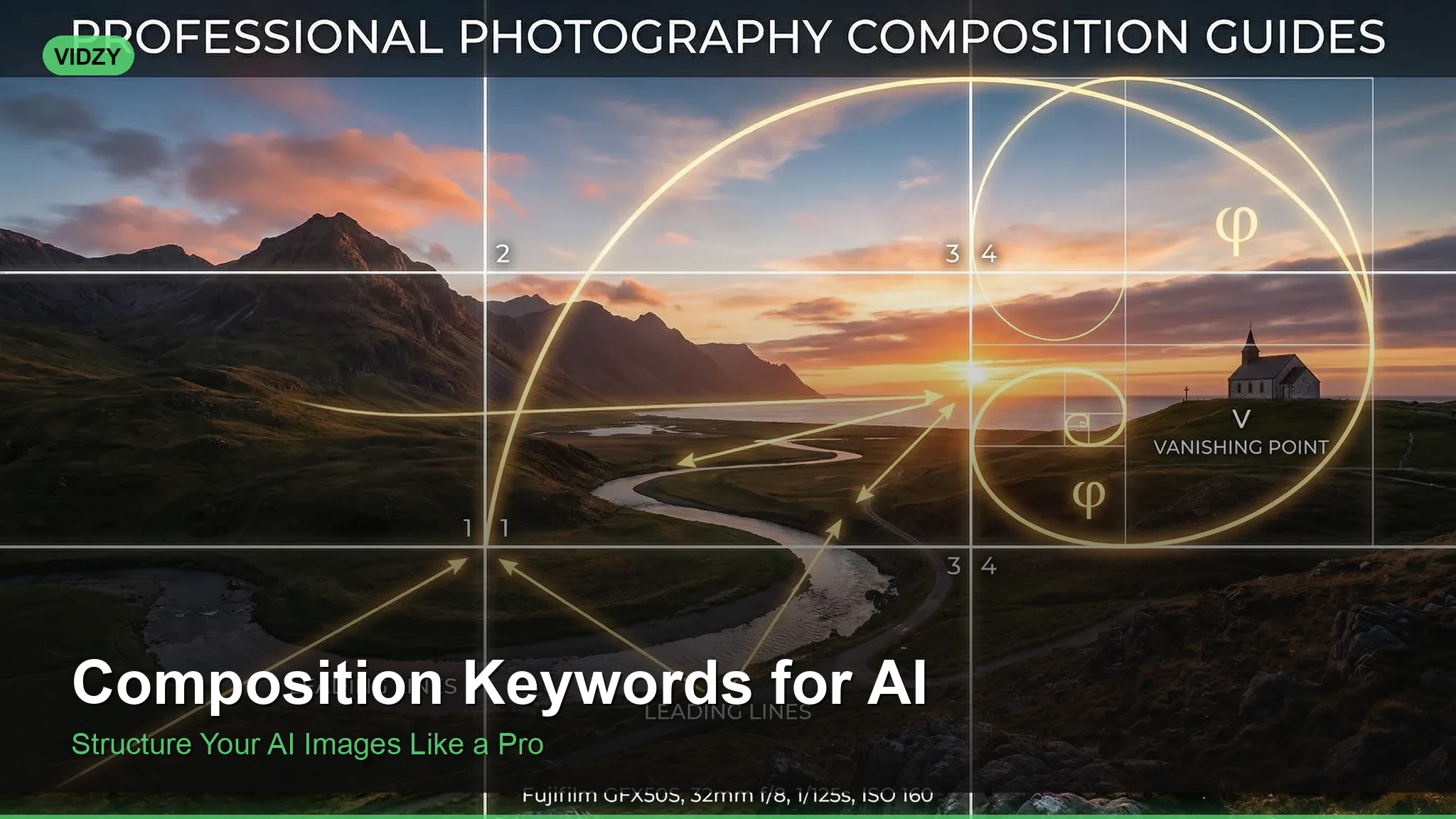
The rule of thirds is the most fundamental composition principle: divide your image into a 3×3 grid, and place key elements along the lines or at their intersections.
Without composition direction: “A lighthouse on a cliff at sunset”
With composition direction: “A lighthouse positioned on the right third of the frame, perched on dramatic sea cliffs, golden sunset filling the left two-thirds of the sky, rule of thirds composition”
AI models understand several placement keywords:
“Rule of thirds” — The model places the subject off-center at natural focal points.
“Centered composition” — Subject placed dead center. Creates symmetry and power. Works for portraits, product shots, and architectural symmetry.
“Off-center subject” — Creates visual tension and dynamic energy. Great for editorial and artistic work.
“Negative space” — Large areas of emptiness around the subject. Creates a minimalist, high-end feel. Essential for design and typography overlays.
“Minimalist product shot, single perfume bottle centered in frame, vast negative space, clean white background, editorial style”
Camera Angles and Perspective
Camera angle determines the viewer’s relationship to the subject. Each angle triggers different emotional responses.
Vertical Angles
“Eye level” — Neutral, natural perspective. The viewer feels like an equal to the subject.
“Low angle” / “worm’s eye view” — Camera looks up at the subject. Makes subjects appear powerful, imposing, or heroic.
“Low angle shot of a skyscraper piercing through clouds, converging vertical lines, dramatic upward perspective, architectural photography”
“High angle” / “bird’s eye view” — Camera looks down. Makes subjects appear smaller, vulnerable, or provides context.
“Dutch angle” / “tilted horizon” — Camera is rotated. Creates unease, dynamism, or artistic tension. Common in thriller and action compositions.
“Overhead” / “flat lay” — Directly above looking straight down. Perfect for product arrangements, food photography, and workspace setups.
“Overhead flat lay of a writer’s desk, open leather journal, fountain pen, cup of black coffee, vintage typewriter, warm wood surface, organized chaos, Instagram aesthetic”
Horizontal Angles
“Front view” / “head-on” — Facing the subject directly. Confrontational, honest, powerful.
“Three-quarter view” — The classic portrait angle. Shows dimension and depth. Most flattering for faces and products.
“Profile” / “side view” — Shows the subject’s silhouette. Dramatic and graphic.
“Over the shoulder” / “OTS” — Creates intimacy and places the viewer into a scene. Common in conversational compositions.
Depth and Layering Keywords
Professional images have a sense of depth — foreground, midground, and background layers that create a three-dimensional feeling.
“Foreground interest” — Places elements in the near foreground, creating depth. Flowers, leaves, or objects partially visible at the frame’s edge.
“Mountain landscape with wildflowers in the foreground creating natural bokeh, winding river in the midground, snow-capped peaks in the background, layered depth composition”
“Leading lines” — Lines that draw the viewer’s eye through the image toward the subject. Roads, fences, rivers, architectural lines.
“Depth of field” / “shallow DOF” / “deep focus” — Controls what’s sharp and what’s blurred. Shallow DOF isolates subjects; deep focus keeps everything sharp.
“Atmospheric perspective” — Distant objects appear hazier and bluer. Creates a natural sense of vast depth in landscapes.
“Layered composition” — Explicitly tells the AI to create distinct foreground/midground/background layers.
Framing and Cropping Keywords
How tightly you crop your subject changes the entire feel of an image.
Shot Types (Film Language)
“Extreme close-up” / “macro” — Fills the frame with a detail. An eye, a texture, a droplet. Intimate and dramatic.
“Close-up” — Face fills most of the frame. Emotional, personal.
“Medium close-up” — Head and shoulders. The standard portrait framing.
“Medium shot” — Waist up. Shows body language while maintaining facial detail.
“Full shot” / “full body” — Complete figure visible. Shows pose, outfit, and environment context.
“Wide shot” / “establishing shot” — Subject is small within the environment. Establishes location and scale.
“Extreme wide shot” — Vast environment with a tiny subject. Creates a sense of scale and solitude.
“Extreme wide shot of a lone hiker on a vast glacier, tiny human figure against enormous blue ice formations, establishing the immense scale of nature”
Natural Framing
“Framed through” — Subject is viewed through a natural frame: a doorway, window, arch, or gap in foliage.
“Frame within a frame” — An architectural or natural element creates a secondary frame inside the image border.
“Portrait framed through an ornate stone archway, subject standing in warm sunlight beyond the arch, the arch itself in cool shadow, creating natural vignetting”
Symmetry and Pattern Keywords
“Perfect symmetry” — Mirror-image balance. Powerful for architecture, reflections, and formal compositions.
“Asymmetric balance” — Unequal elements that still feel balanced. More dynamic than symmetry.
“Radial composition” — Elements radiate from a central point. Spirals, mandalas, circular arrangements.
“Pattern repetition” — Repeating visual elements creating rhythm. Windows on a building, rows of trees, market stalls.
“Breaking the pattern” — One element disrupts an otherwise uniform pattern. Creates instant focal points.
“Aerial view of identical red umbrellas on a beach, one single yellow umbrella breaking the pattern, minimalist composition”
Movement and Dynamic Composition
Even still images can convey motion and energy through compositional technique.
“Dynamic diagonal” — Key elements arranged along diagonal lines create energy and movement.
“Motion blur” — Implies movement through selective blur on moving elements while keeping the subject sharp.
“Frozen motion” — High-speed capture that freezes a dynamic moment. Splashing water, flying debris, mid-jump.
“Visual flow” — Elements guide the eye on a deliberate path through the image.
Combining Composition Keywords: Advanced Examples
The real power comes from combining multiple composition concepts. Here are professional-grade prompt structures:
“Three-quarter portrait of a jazz musician, shallow depth of field, subject on the left third of the frame, saxophone in sharp focus, smoky club atmosphere blurred in background, leading lines from stage lights converging on the musician, warm tungsten color palette, medium close-up”
“Dramatic low angle architectural shot, modern glass skyscraper, perfect symmetry reflected in rain puddle on the ground, converging leading lines, deep focus from foreground puddle to building top, overcast sky creating even diffused lighting”
These prompts use 4-6 composition keywords each, creating specific and intentional visual arrangements.
Composition for Different Use Cases
Social media content: Use centered compositions with negative space for text overlays. Bright, simple arrangements. Vidzy makes it easy to generate social-ready compositions in the right aspect ratios.
Product photography: Three-quarter angles, clean backgrounds, shallow DOF to isolate the product. Use overhead flat lays for lifestyle arrangements.
Landscape/Travel: Leading lines, foreground interest, layered depth, rule of thirds for horizon placement. For more on environmental prompting, see our guide on mood and atmosphere in AI prompts.
Editorial/Fashion: Dynamic angles, Dutch tilts, dramatic framing, strong negative space. Combine with texture keywords for maximum impact.
Frequently Asked Questions
What is the best composition for AI-generated portraits?
For most portraits, use “three-quarter view, medium close-up, shallow depth of field, rule of thirds placement” as your base composition. This combination consistently produces professional-looking results across all AI platforms.
How many composition keywords should I use per prompt?
Three to five composition keywords per prompt is the sweet spot. One for camera angle, one for framing/crop, one for depth, and optionally one for subject placement and one for dynamic element. More than six can cause the AI to struggle with conflicting instructions.
Do composition keywords work for AI video generation?
Yes, and they’re especially important for video because they define the starting frame and camera behavior. “Low angle tracking shot” or “slow dolly in from wide to close-up” give video models strong compositional direction.
Can I combine composition with aspect ratio for better results?
Absolutely. Certain compositions work better at certain ratios. Wide shots pair naturally with 16:9, portraits with 2:3, and flat lays with 1:1. See our complete guide to aspect ratios for detailed pairing advice.
What composition style gets the most engagement on social media?
Centered subjects with strong negative space, bright lighting, and clean backgrounds consistently perform best on Instagram and TikTok. For Pinterest, vertical compositions with text overlay space at the top or bottom perform well.