


Why Color Theory Matters in AI Image Generation
Color is not decoration — it is communication. Every color in an image carries emotional weight, cultural meaning, and compositional impact. When you understand color theory in AI prompts, you stop hoping for the right palette and start designing it. You gain control over mood, focal points, visual harmony, and emotional resonance — all through the words you choose.
Most AI prompt writers leave color entirely to chance. They describe a subject, a style, maybe some lighting, and accept whatever palette the model produces. But AI models respond powerfully to color direction. A few well-chosen color keywords can transform a generic image into something that feels intentionally designed, cohesive, and emotionally specific.
This guide covers the fundamentals of color theory as they apply to AI prompt engineering, with practical keywords and example prompts you can use immediately.
The Color Wheel Basics for Prompt Engineers
You do not need an art degree to use color theory effectively. Here are the essential relationships:
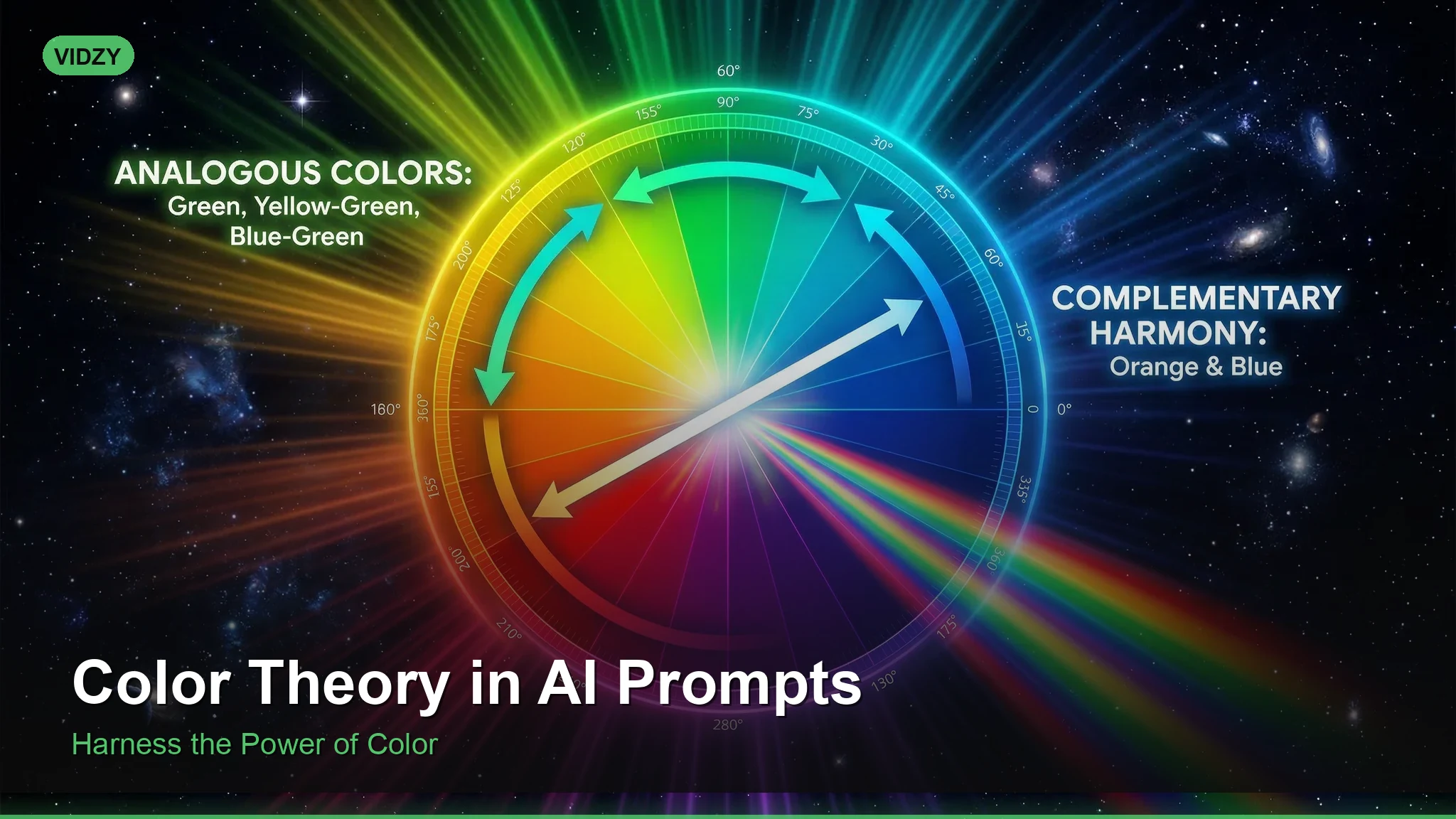
Complementary Colors
Colors opposite each other on the color wheel create maximum contrast and visual energy. They make each other pop. Classic complementary pairs:
- Blue and orange: The most common cinematic color grading combination. Used in virtually every Hollywood blockbuster poster.
- Red and green: High energy, natural (think red flowers against green foliage).
- Purple and yellow: Royal, vibrant, attention-grabbing.
- Teal and amber: A cooler variation of blue/orange, very popular in modern cinematography.
Prompt: “Cinematic portrait of a woman in a dark blue evening gown, warm amber streetlights in the background, complementary teal and orange color grading, shallow depth of field, moody urban night scene”
Analogous Colors
Colors next to each other on the wheel create harmony and a sense of cohesion. They feel natural and pleasing because they share undertones.
- Blue, blue-green, green: Oceanic, natural, calming
- Red, orange, yellow: Warm, energetic, fiery
- Purple, blue, indigo: Cool, mysterious, nocturnal
Prompt: “Serene underwater photograph of a coral reef, analogous color palette of teals, turquoises, and seafoam greens, soft filtered sunlight from above, peaceful and immersive, National Geographic style” These color theory AI prompts are designed for professional results.
Monochromatic
Using variations of a single hue — different saturations and brightnesses — creates a unified, sophisticated look. Monochromatic palettes feel deliberate and artistic.
Prompt: “Monochromatic blue portrait of a woman in a misty forest, varying shades of cobalt, navy, and pale blue, ethereal and dreamlike, fine art photography, desaturated environment” Using the right color theory AI prompts makes all the difference in your output quality.
Triadic Colors
Three colors equally spaced on the color wheel (e.g., red, yellow, blue). Creates a vibrant, balanced look. Used frequently in graphic design and illustration.
Prompt: “Pop art illustration of a city street scene, triadic color scheme of primary red, blue, and yellow, bold graphic shapes, Andy Warhol influence, high contrast, flat design” With these color theory AI prompts, you can achieve stunning results every time.
Color Keywords That AI Models Understand
AI models respond to several types of color direction. Here is the vocabulary that works:
Named Color Palettes
earth tones— browns, greens, muted oranges, warm neutralsjewel tones— deep emerald, sapphire, ruby, amethystpastel color palette— soft pink, lavender, mint, baby bluemuted tones— desaturated, grey-toned versions of any colorneon colors— bright, saturated, electricneutral palette— whites, greys, beiges, taupeswarm color palette— reds, oranges, yellows, warm brownscool color palette— blues, greens, purples, steel greys
Color Grading Terms
These terms come from film and photography post-production and are well-understood by AI models:
teal and orange color grading— the Hollywood blockbuster lookcross-processed— unusual color shifts, vintage feel, green-yellow shadowsdesaturated— colors muted, almost approaching monochromehigh saturation— vivid, punchy colorsbleach bypass— reduced saturation with increased contrast, gritty metallic feelsplit toning— different colors in highlights vs. shadows (e.g., warm highlights, cool shadows)Kodachrome colors— rich, warm, slightly faded vintage color
Prompt: “Vintage 1970s street photography of a gas station at dusk, Kodachrome color palette, warm faded tones, slight grain, nostalgic and melancholic atmosphere, 35mm film, wide shot” Master color theory AI prompts to take your AI generation to the next level.
Specific Color Descriptions
When you want precise color control, describe colors in detail rather than using generic names:
- Instead of “red” → “deep crimson,” “burnt sienna,” “coral pink,” “rust orange-red”
- Instead of “blue” → “navy,” “cerulean,” “steel blue,” “powder blue,” “midnight indigo”
- Instead of “green” → “sage,” “emerald,” “olive,” “forest green,” “seafoam,” “chartreuse”
The more specific your color name, the more consistent the result.
Using Color for Emotional Impact
Color psychology is not an exact science, but AI models have learned strong associations between colors and emotions from their training data. Use these associations intentionally.
Warm Colors: Energy, Passion, Urgency
Red, orange, and yellow create feelings of warmth, energy, and immediacy. Red is particularly powerful for drawing the eye — it is the color of urgency, passion, and danger. Orange feels friendly and energetic. Yellow communicates optimism and warmth.
Prompt: “Editorial photograph of a street food market in Bangkok at night, warm color palette dominated by amber lanterns and red signage, steam rising from cooking stalls, energetic and vibrant atmosphere, shallow depth of field” The best color theory AI prompts combine technical precision with creative vision.
Cool Colors: Calm, Trust, Mystery
Blue, green, and purple create feelings of calm, depth, and introspection. Blue conveys trust and stability (which is why technology companies love it). Green feels natural and balanced. Purple suggests luxury, mystery, and creativity.
Prompt: “Minimalist architectural photograph of a modern museum interior, cool color palette of steel blue and soft grey, clean geometric lines, vast empty space, contemplative and serene, natural light from skylights” These color theory AI prompts are designed for professional results.
Neutrals: Sophistication, Timelessness
Black, white, grey, beige, and taupe create a sense of elegance, timelessness, and sophistication. They also allow accent colors to shine without competition.
Prompt: “Fashion editorial of a model in a cream linen suit, neutral palette of beige, ivory, and soft grey, minimalist studio setting, single warm accent light, sophisticated and timeless, Vogue aesthetic” Using the right color theory AI prompts makes all the difference in your output quality.
Color Contrast and Focal Points
One of the most powerful applications of color theory in AI prompts is directing the viewer’s eye. A single contrasting color against a muted background becomes an instant focal point.
Prompt: “A woman in a vivid red coat walking through a desaturated grey city street in the rain, the red coat is the only saturated color in the image, cinematic, shallow depth of field, melancholic atmosphere” With these color theory AI prompts, you can achieve stunning results every time.
This technique — isolating one color — is used in films like “Schindler’s List” and “Sin City.” AI models handle it well because the instruction is clear: everything desaturated except one element.
Prompt: “Black and white photograph of a farmer’s market, only the fresh fruits and vegetables are in full color, selective color technique, documentary photography style, 35mm film” Master color theory AI prompts to take your AI generation to the next level.
Color Palettes for Common Use Cases
Product Photography
Keep colors clean and intentional. Neutral backgrounds (white, soft grey, light marble) let the product color speak. Avoid competing palette elements.
Prompt: “Product photograph of a forest green ceramic vase with dried pampas grass, white marble surface, soft neutral background, complementary warm peach accent towel, clean minimalist styling, soft studio light” The best color theory AI prompts combine technical precision with creative vision.
Social Media and Marketing
Use your brand colors explicitly. Bold, high-contrast palettes grab attention in crowded feeds. Our Thumbnail Preview Tool lets you check how your color choices will look at small sizes.
Landscapes and Nature
Reference time-of-day for natural color cues. “Golden hour” implies warm golds and soft pinks. “Blue hour” implies cool blues and purples. Specifying season also affects color: “autumn forest” gives you reds, oranges, and golds automatically.
Portraits
Skin tones interact with surrounding colors. Warm lighting (golden hour, tungsten) flatters most skin tones. Cool backgrounds make warm skin tones pop through complementary contrast. Reference specific film stocks known for skin rendering: “Kodak Portra” is famous for its flattering skin tone reproduction.
Advanced Color Techniques
Color Harmony with Lighting
Color and lighting are deeply intertwined. The color of your light source changes the color of everything it touches. Combining specific lighting with specific color direction creates sophisticated, intentional looks.
Prompt: “Dramatic portrait lit by a single warm amber spotlight from the left, cool blue fill from the right, split color lighting creating warm and cool halves of the face, cinematic color contrast, dark background” These color theory AI prompts are designed for professional results.
For a full exploration of lighting terminology, see our lighting keywords guide.
Period-Accurate Color
Different eras have distinctive color signatures. Reference these for historically-grounded images:
- 1950s: Pastel pink, turquoise, cream, chrome silver
- 1970s: Avocado green, harvest gold, burnt orange, brown
- 1980s: Neon pink, electric blue, hot purple, black
- 1990s: Muted grunge tones, flannel reds, faded denim blue
- 2010s-2020s: Millennial pink, sage green, terracotta, minimalist neutrals
Prompt: “1970s kitchen interior photograph, avocado green appliances, harvest gold countertops, brown wood paneling, warm tungsten lighting, slightly faded Kodachrome color, vintage and nostalgic” Using the right color theory AI prompts makes all the difference in your output quality.
Color Restriction
Sometimes limiting color is more powerful than adding it. Restricting your palette forces visual coherence.
Prompt: “Duotone illustration of a jazz musician playing saxophone, only deep navy blue and warm gold, high contrast, silhouette and highlight, minimalist and elegant, poster design” With these color theory AI prompts, you can achieve stunning results every time.
Common Color Mistakes in AI Prompts
Not Specifying Any Color Direction
When you leave color to the model, you get the model’s default — which is often a fairly neutral, unremarkable palette. Even a simple addition like “warm color palette” or “cool desaturated tones” significantly improves intentionality.
Color-Mood Mismatches
Asking for “bright neon colors” with a “peaceful and serene mood” creates tension the model resolves poorly. Neon screams energy; serenity wants muted tones. Make sure your color and mood directions align.
Over-Specifying Colors
Listing seven specific hex-code-level colors in a prompt overwhelms the model. Stick to a palette concept (e.g., “earth tones,” “teal and amber”) or at most name two or three specific colors. Let the model handle the supporting tones.
Frequently Asked Questions
Can I specify exact hex colors in AI prompts?
Most AI models do not understand hex codes (#FF5733). Instead, use descriptive color names that are specific enough to narrow the output: “coral pink,” “deep teal,” “burnt sienna,” “powder blue.” These descriptive names are in the model’s training vocabulary and produce much more reliable results than hex codes.
How do I maintain a consistent color palette across multiple AI-generated images?
Include the same color direction keywords in every prompt of the series. A reusable suffix like “muted earth tone color palette, warm Kodak Portra color grading, soft desaturated tones” appended to each prompt will create visual consistency. For even stronger consistency, use reference image features on platforms that support them. See our full guide on prompt engineering fundamentals for more on consistency techniques.
What color terms work best for photorealistic vs. illustrated outputs?
For photorealistic images, use film stock and color grading terminology: “Kodak Portra tones,” “teal and orange grading,” “bleach bypass.” These terms are associated with real photography in the training data. For illustrations, use art-world color vocabulary: “complementary palette,” “limited palette of three colors,” “watercolor washes of indigo and gold.” Match your color vocabulary to the medium you are targeting.
Put Color Theory to Work in Your Prompts
Understanding color theory in AI prompts gives you a level of creative control that most users never access. Color is the fastest way to establish mood, direct attention, and create visual cohesion across a series of images. Start with one technique — try complementary colors or selective color isolation — and observe how dramatically it changes your output.
Use Vidzy’s Prompt Generator to build color-aware prompts with structured guidance, then see your creations come to life. Download Vidzy and start generating visually stunning AI images and videos today.