One of the most debated topics in the AI generation community is AI prompt length — how many words should your prompt be? Too short and you get generic, unpredictable results. Too long and the model may ignore parts of your instructions or produce muddled output. The optimal length exists in a sweet spot that varies by model, content type, and complexity.
This guide presents data-driven findings from extensive testing across multiple AI models, giving you clear guidelines for prompt length in every context.
How AI Models Process Prompt Length
Understanding why length matters requires a basic grasp of how AI models read prompts. Image and video generators use attention mechanisms that assign weight to each word or token in your prompt. Here is what happens at different lengths:
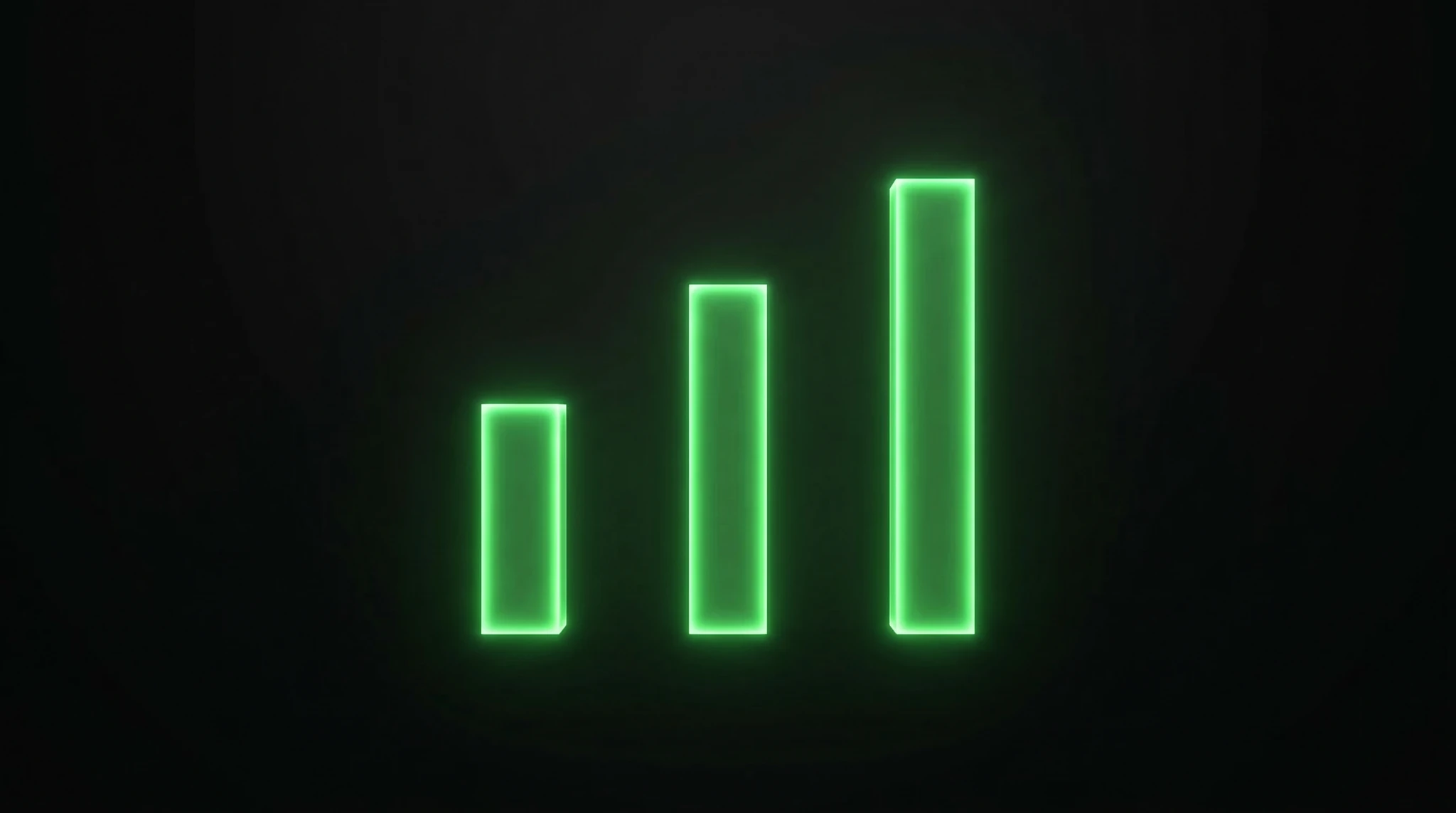
Very short prompts (1-10 words): Every word receives high attention weight. The model interprets each word broadly, pulling from the most common associations in its training data. Results tend toward generic, default compositions. There is little to differentiate your output from anyone else using the same words.
Medium prompts (20-60 words): The model has enough detail to make specific choices while still processing every word effectively. Each word still carries significant weight, but the combined instruction set narrows the output space meaningfully. This is the productive zone for most generations.
Long prompts (80-150 words): The model begins to prioritize certain sections over others. Generally, words at the beginning and end of the prompt receive more attention than words in the middle. If critical instructions are buried in the middle of a long prompt, they may be de-emphasized.
Very long prompts (150+ words): Diminishing returns set in. The model may average out or partially ignore instructions, especially in the middle section. Contradictions become more likely. The output may feel like a compromise between too many competing directives.
Optimal Length by Model
Each AI model has different effective prompt length ranges:
DALL-E 3:
Effective range: 30-100 words
Sweet spot: 40-70 words
Handles natural language well, so conversational descriptions work
Very long prompts are automatically summarized internally, which may alter your intent
Video prompts naturally need more words to describe temporal elements (motion, camera movement, timing)
Longer prompts are justified when describing complex scenes with multiple motion layers
Length by Content Type
Different types of content require different amounts of description:
Simple portraits (30-50 words):
“A medium close-up portrait of a young man with short dark hair and light stubble, wearing a gray crewneck sweater, soft window light from camera left, gentle smile, neutral blurred background, 85mm lens at f/2.0, warm color temperature”
This works at 38 words because portraits have a limited number of key variables: subject, framing, lighting, background, and lens.
Complex environments (60-90 words):
“A wide-angle interior of a Japanese tea house during autumn, low wooden table set with ceramic matcha bowls and a cast iron kettle, shoji screens on the left side partially open revealing a garden with red maple trees, warm afternoon sunlight filtering through the paper screens creating soft geometric light patterns on the tatami floor, steam rising from the kettle, zen minimalist composition with deliberate negative space, muted earth tones and deep red accents, 24mm lens perspective”
This 82-word prompt is justified because the scene contains multiple elements that each need description: architecture, objects, outside view, light behavior, atmosphere, and composition.
Product photography (40-60 words):
“An overhead flat-lay product photograph of a matte white skincare bottle with minimal sans-serif label, surrounded by scattered fresh rosemary sprigs and river stones on a light linen surface, soft studio lighting from upper left with gentle shadows, clean and organic styling, commercial beauty photography, shot on 50mm lens at f/8”
At 50 words, this covers all essential product photography elements: product description, styling, surface, lighting, and style reference.
AI video (60-100 words):
“Camera slowly dollying forward through a narrow medieval stone corridor lit by flickering wall-mounted torches, warm orange firelight dancing on rough stone walls, dust particles visible in the shafts of torchlight, the corridor opens into a vast cathedral interior with soaring Gothic arches and stained glass windows casting colored light patterns on the stone floor, camera continues moving forward into the space, transitioning from claustrophobic corridor to awe-inspiring open architecture, dramatic atmosphere, cinematic 2.39:1, 6 seconds”
This 80-word video prompt earns its length by describing camera motion, environmental motion, lighting, architecture, spatial transition, and temporal progression — all essential for video generation.
The Density Principle: Quality Over Quantity
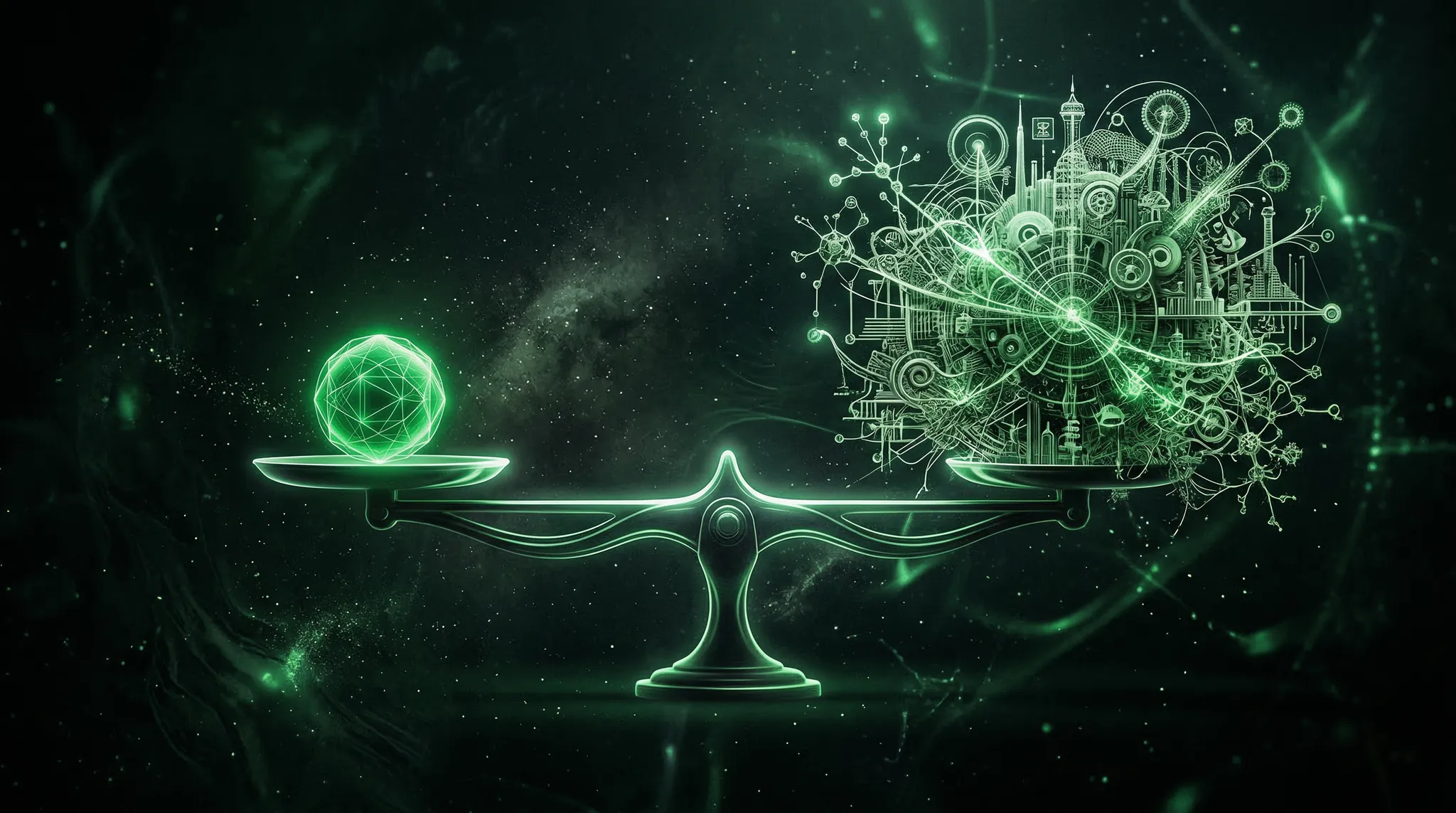
The most important principle of AI prompt length is not the word count — it is the information density. A 50-word prompt where every word adds visual information outperforms a 100-word prompt full of filler.
Low density (bad — 42 words):
“A really amazing and beautiful stunning high-quality professional photograph of a really pretty incredible landscape with gorgeous incredible lighting and absolutely breathtaking colors, ultra-realistic, best quality, masterpiece, incredibly detailed, award-winning photography, 8K UHD”
High density (good — 42 words):
“A Norwegian fjord at blue hour, still water reflecting snow-covered mountains and a violet sky, a single red fishing cabin with warm window light on the rocky shore, low mist at the waterline, 24mm wide-angle, deep depth of field, long exposure”
Both prompts are 42 words, but the second one contains about ten times more visual information. Every word in the high-density version changes the image. In the low-density version, most words are interchangeable synonyms for “good” that add no visual direction.
The Information Test
Here is a simple test to determine if your prompt is the right length: try removing one word or phrase. Does the removal change what the image would look like? If not, that word is filler — remove it. If yes, keep it. Apply this test to every element of your prompt.
Your prompt should be exactly as long as it needs to be to describe your vision — no shorter (or you lose control), no longer (or you add noise).
Structuring Long Prompts
When your vision genuinely requires a longer prompt (70+ words), structure it to work with how attention mechanisms process text:
Front-load the most important elements. Put your subject and its most critical attributes first — these receive the highest attention weight.
Put secondary details in the middle. Environmental details, props, and atmospheric effects go in the middle section where attention weight is lower but still present.
End with technical specs and style references. Camera settings, style tags, and quality indicators at the end receive a second attention peak and serve as a final calibrating influence.
“[SUBJECT: most important] + [SUBJECT DETAILS] + [ENVIRONMENT] + [LIGHTING] + [ATMOSPHERE AND PROPS] + [CAMERA SPECS AND STYLE]”
This front-loaded structure ensures that even if the model de-emphasizes the middle, the critical subject and the calibrating style reference are both fully processed.
When to Go Short
Shorter prompts (under 30 words) work well in specific situations:
Exploring ideas — when you want creative surprise, a short prompt gives the model freedom to interpret
Midjourney’s artistic strengths — the model’s strong default aesthetic means short prompts still produce polished results
Iterative refinement — start short to see the model’s default interpretation, then add specifics to steer it
Abstract art — abstract concepts sometimes benefit from poetic, open-ended language
Speed — when you need many variations quickly, short prompts produce faster iteration
When to Go Long
Longer prompts (80+ words) are justified when:
Complex scenes — multiple subjects, detailed environments, many interactive elements
Video generation — describing motion, camera movement, and temporal changes requires more words
Technical photography — lens, camera, lighting, and post-processing details add length but also add precision
Converting art direction — translating a creative brief into a prompt naturally produces longer text
Prompt Length by Platform
Different platforms impose different constraints:
DALL-E API — 4000 character limit (roughly 600-800 words, far more than you need)
Midjourney — no hard limit but effectiveness drops beyond 75 words
Flux — tokenizer-dependent, generally effective up to 120 words
Vidzy app — optimized for focused prompts; use the Prompt Generator to build well-structured prompts of ideal length
For model-specific prompt strategies, the AI prompt keywords cheat sheet provides vocabulary that lets you communicate more information in fewer words.
The Editing Process: Getting to the Right Length
The most effective workflow is:
Write everything — dump all your visual ideas into a long first draft
Remove filler — cut every quality word that does not add visual information (“amazing,” “stunning,” “incredible”)
Remove redundancy — if you said “soft diffused light” you do not also need “gentle and even illumination”
Check for contradictions — remove any conflicting descriptors
Test the information density — can you remove any remaining word without changing the image? If not, your prompt is at optimal length
This process typically condenses a 120-word first draft into a 50-70 word final prompt that carries all the same visual information in a tighter package.
FAQ
What is the ideal AI prompt length?
For most image generators, 40 to 80 words of high-density, non-redundant visual description produces the best results. Video prompts can run 60 to 100 words due to the additional motion and temporal information required. The key metric is information density, not raw word count.
Are longer prompts always better?
No. Longer prompts with filler words or redundant descriptions perform worse than shorter, denser prompts. A 40-word prompt packed with specific visual details outperforms a 100-word prompt full of generic quality keywords. Length should reflect complexity, not aspiration.
Do different AI models prefer different prompt lengths?
Yes. Midjourney works well with shorter prompts (20-50 words) due to its strong default aesthetic. Flux benefits from medium-length technical descriptions (50-80 words). Video models like Sora need longer prompts (60-100 words) to describe motion and temporal elements. Match your length to your model.
What happens if my prompt is too long?
Very long prompts (150+ words) cause the model to de-emphasize the middle section, potentially averaging out or ignoring some instructions. The output may feel like a compromise between too many directives rather than a coherent realization of one vision. If your prompt needs 150+ words, consider splitting into sequential generations.
How do I make a short prompt more effective?
Increase information density by using specific, visually loaded terms. “Golden hour Rembrandt lighting, 85mm f/1.4, shot on Kodak Portra 400” is only 12 words but carries enormous visual weight. Every word should change the image — if it does not, cut it.
Find Your Prompt’s Sweet Spot
AI prompt length is not about hitting a word count target — it is about matching the length to your vision’s complexity and the model’s processing capabilities. Write dense, not long. Specify what matters, not everything. Test your prompts against the information test, and iterate toward the perfect length for each generation.
Use Vidzy’s AI Prompt Generator to build optimally structured prompts, or download Vidzy to start generating professional AI images and videos with perfectly calibrated prompts.
Sarah Chen is a prompt engineer and AI content strategist with 5+ years in generative AI. Former ML researcher at Stanford, she now helps creators unlock the full potential of tools like Sora, Flux, and Nano Banana. She writes about prompt engineering, image generation techniques, and the future of AI creativity.
Why Motion Keywords Video Prompts Define Your AI Video Quality The single biggest difference between amateur and professional AI-generated video comes down to motion. Static, lifeless scenes scream “AI-generated,” while videos with intentional, well-described movement feel cinematic and purposeful. Understanding motion keywords video prompts is the skill that separates generic clips from content that looks […]
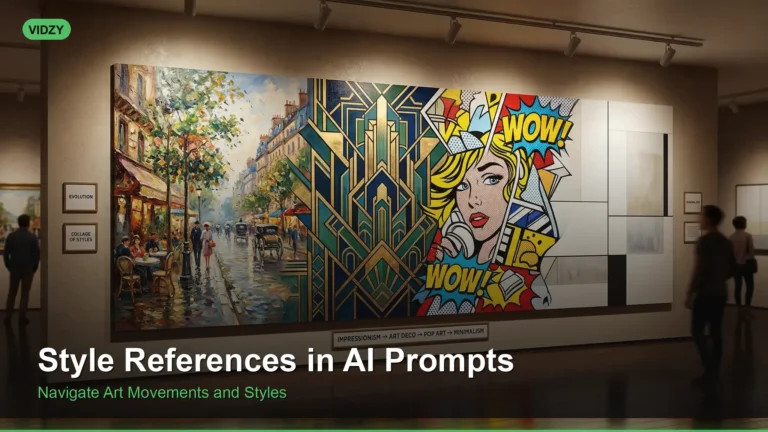
What Are Style References in AI Prompts? One of the most frustrating experiences in AI image generation is knowing exactly what aesthetic you want but not being able to articulate it in words. You might have a mood board, a favorite photographer’s portfolio, or a film still that captures the exact look you are after […]
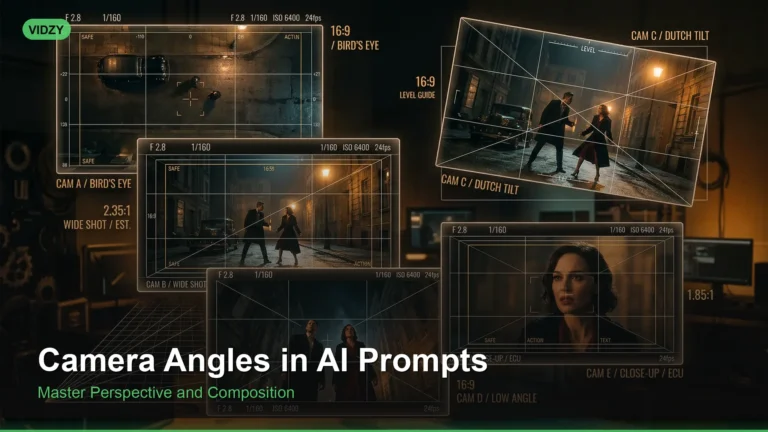
Why Camera Angles Matter in AI Prompts When you describe an image to an AI generator, you are effectively playing the role of photographer and cinematographer at the same time. One of the most powerful tools in that role is the camera angle. Camera angles in AI prompts do not just change where the viewer […]
Sarah Chen
10 min read
Your Next Video Is 30 Seconds Away
Download Vidzy free, pick a template, and create your first video right now.