Why Art Movement AI Prompts Transform Your Generated Images
Every art movement in history carried a distinct visual language — a set of rules about color, composition, texture, and emotion that defined its era. When you embed art movement AI prompts into your generation workflow, you tap into centuries of creative vocabulary that AI models have deeply learned from millions of training images.
The difference between a generic prompt and one informed by art history is staggering. Instead of writing “a painting of a city at night,” you can write “a city at night in the style of German Expressionism, with distorted angular buildings, heavy impasto brushstrokes, and a palette of deep cobalt blue and cadmium yellow.” The result shifts from forgettable to gallery-worthy.
Whether you use DALL-E, Flux, Midjourney, or Vidzy’s built-in prompt tools, understanding how to reference specific art movements gives you a creative edge that most AI users never develop.
How AI Models Understand Art Movements
AI image generators are trained on vast datasets that include millions of artworks spanning every major movement. When you mention “Impressionism” in a prompt, the model draws from its understanding of loose brushwork, natural light, and pastel palettes. It does not simply apply a filter — it reconstructs the compositional philosophy of the movement.
This is why specificity matters. “Impressionism” alone activates a broad set of associations. But “Impressionism in the style of Monet’s water lilies series, with dappled light reflecting on still water and soft horizontal brushstrokes” narrows the model’s output to a precise visual target.
The key insight is that AI models respond to layered art references. You can combine a movement with a specific artist, a particular period, a technique, and a subject — each layer adds precision to your output.
Classical and Renaissance Prompts
The Renaissance is one of the most recognizable art movements, and AI models reproduce its characteristics with remarkable accuracy. Here are prompt structures that work:
“A portrait of a scholar in the style of High Renaissance painting, sfumato technique, warm chiaroscuro lighting, oil on wood panel texture, muted earth tones with gold leaf accents, inspired by the composition principles of Leonardo da Vinci”
Key Renaissance keywords to include in your prompts:
Sfumato — soft, smoky transitions between colors
Chiaroscuro — dramatic contrast between light and dark
Trompe l’oeil — hyper-realistic illusion of three dimensions
Contrapposto — natural weight-shifting pose for figures
Tempera / oil on panel — specifies the medium texture
For Baroque drama, push the contrast further:
“A still life of fruit and flowers in the style of Dutch Golden Age painting, Baroque composition with dramatic Caravaggesque lighting, deep shadows, rich jewel tones, visible brushwork on canvas texture, vanitas symbolism”
Impressionism and Post-Impressionism
Impressionist prompts benefit from references to light, time of day, and outdoor settings. The movement was fundamentally about capturing fleeting moments of natural light.
“A sun-drenched garden scene in the style of French Impressionism, broken color technique with visible dabs of pure pigment, warm afternoon light filtering through trees, soft focus on distant figures, palette of lavender, pale yellow, and soft green”
Post-Impressionism diverges into several branches, each requiring different prompt strategies:
Pointillism (Seurat): Add “composed entirely of small dots of pure color, pointillist technique, scientific color theory” to your prompts.
Expressive (Van Gogh): Use “thick impasto swirling brushstrokes, vibrant complementary colors, emotional intensity, heavy texture visible in every stroke.”
Structural (Cézanne): Include “geometric simplification of natural forms, flattened perspective, visible construction of space through color planes.”
Modern Art Movements for AI Prompts
Modern art movements offer some of the most visually distinctive prompt ingredients:
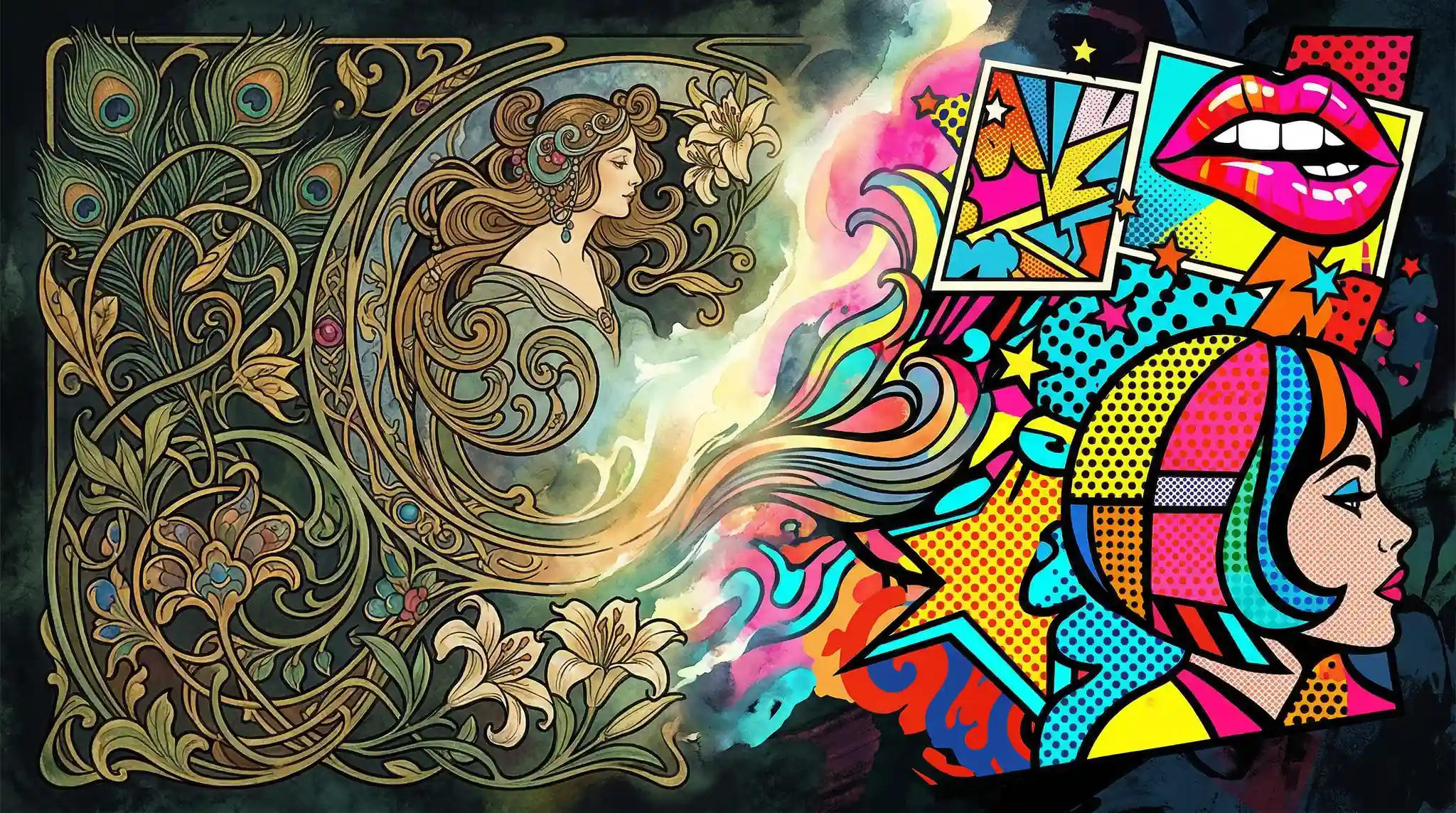
Art Nouveau:
“An illustration of a woman surrounded by flowing organic forms in the style of Art Nouveau, sinuous whiplash curves, decorative floral borders, gold and deep emerald color scheme, inspired by Alphonse Mucha’s poster designs”
Cubism:
“A portrait viewed from multiple simultaneous angles in the style of Analytical Cubism, fragmented geometric planes, monochromatic palette of grays and browns, flattened perspective, newspaper collage elements”
Surrealism:
“A melting landscape where clocks drip from dead trees, in the style of Surrealism, hyperrealistic rendering of impossible scenes, dreamlike atmosphere, desert setting with impossible perspective, inspired by Dalí’s paranoiac-critical method”
Abstract Expressionism:
“An abstract composition of violent gestural marks and dripped paint in the style of Abstract Expressionism, action painting technique, large-scale canvas energy, raw emotional intensity, palette of black, deep red, and white”
Minimalism and Contemporary Styles
Vidzy’s AI Prompt Generator can help you structure minimalist prompts, but understanding the underlying aesthetic principles makes your prompts far more effective.
Minimalism:
“A single geometric form floating in vast negative space, minimalist composition, clean edges, monochromatic white and pale gray palette, perfectly balanced asymmetry, inspired by Agnes Martin’s subtle grid paintings”
Pop Art:
“A consumer product rendered in the style of Pop Art, Ben-Day dots, bold primary colors with black outlines, commercial printing aesthetic, flat graphic quality, inspired by Lichtenstein’s comic strip technique”
Vaporwave / Digital Art:
“A glitched classical bust surrounded by tropical plants and geometric shapes, vaporwave aesthetic, neon pink and cyan gradient, retro digital artifacts, 80s grid perspective, marble texture on ancient sculpture”
Combining Multiple Art Movements
One of the most powerful techniques is blending elements from different movements. This creates unique outputs that stand apart from standard single-movement references.
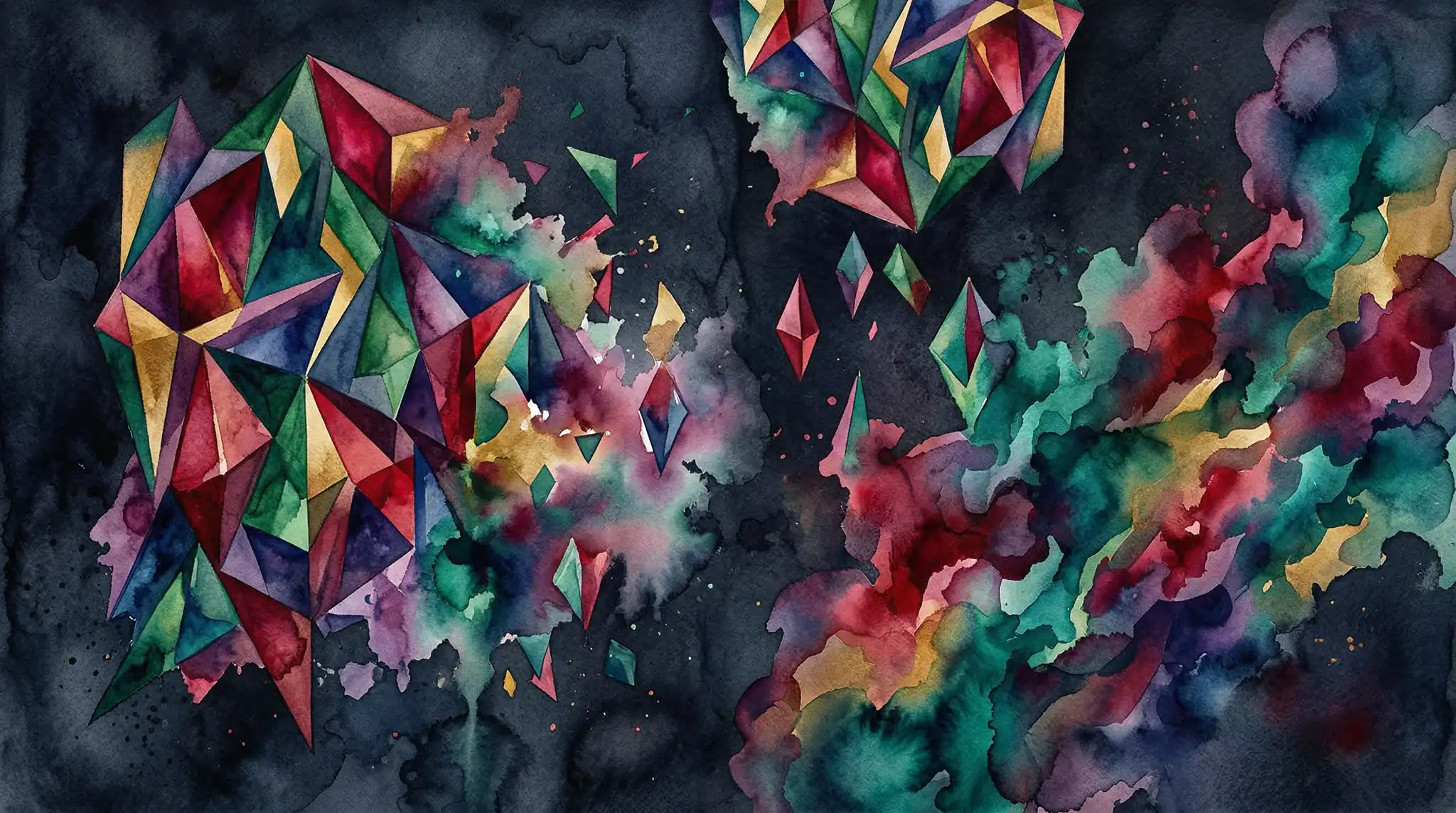
“A landscape combining Art Deco geometric patterns with Impressionist broken color technique, angular golden sunbeams cutting through soft pastel clouds, architectural precision meeting organic natural forms, jewel-toned palette”
When combining movements, follow this structure:
Primary movement — sets the overall composition and feel
Secondary movement — adds a contrasting technique or palette
Subject matter — grounds the image in something recognizable
Technical details — specifies medium, texture, and finish
Regional and Non-Western Art Styles
AI models also respond well to non-Western art traditions, which can produce stunning and unique results:
Ukiyo-e (Japanese woodblock):
“A great wave crashing against rocky shores in the style of Ukiyo-e woodblock printing, flat areas of color with bold outlines, limited palette of indigo, white, and pale pink, dramatic diagonal composition, inspired by Hokusai”
Chinese ink wash painting: Use “traditional Chinese shan shui landscape, ink wash on rice paper, negative space as mist, calligraphic brushwork, monochromatic with subtle ink gradations.”
Islamic geometric art: Include “intricate Islamic geometric patterns, perfect mathematical tessellations, arabesque floral motifs, gold and lapis lazuli color scheme, zellige tile texture.”
Practical Tips for Art Movement Prompts
After testing hundreds of art movement AI prompts across different generators, here are the patterns that consistently produce the best results:
Name the movement explicitly, then describe its visual characteristics — do not assume the model knows what you mean
Reference specific artists for precision, but combine with technique descriptions for originality
Include the medium (oil, watercolor, charcoal, fresco) to control texture
Specify the color palette using actual pigment names when possible
Add a time period reference to narrow the model’s interpretation
For video generation, art movement references work similarly but require temporal language. Learn how to describe motion in video prompts to combine movement styles with dynamic visual content.
FAQ
Which art movements work best with AI image generators?
Impressionism, Surrealism, Art Nouveau, and Pop Art consistently produce the strongest results because they have highly distinctive visual characteristics that AI models can clearly differentiate. Abstract movements like Minimalism also work well when you provide specific compositional instructions.
Can I combine multiple art movements in one prompt?
Yes, and it often produces the most original results. The key is to assign different roles to each movement — use one for composition, another for color palette, and a third for texture or technique.
How do I avoid generic results when referencing art movements?
Go beyond the movement name. Include specific techniques, named color pigments, compositional rules, and artist references. The more visual detail you provide, the less the model relies on generic associations.
Do art movement prompts work for AI video generation?
Absolutely. Video generators like Sora and Vidzy respond to art movement keywords. Combine them with motion descriptions for cinematic results — for example, “camera slowly panning across a Cubist cityscape with shifting geometric planes.”
Should I reference specific artists by name?
Referencing artists helps with precision, but combine the artist name with technique descriptions. This ensures the output captures the style without directly copying a specific work, and it gives you more control over the final composition.
Start Creating Art-Inspired AI Images
Art movement references are the fastest way to elevate your AI-generated images from generic to gallery-worthy. Start with movements you know well, experiment with combinations, and build a personal library of prompts that consistently deliver the aesthetic you want.
Try Vidzy’s AI Prompt Generator to build structured prompts with art movement keywords, or download Vidzy to generate stunning AI videos and images with art-inspired prompts directly from your iPhone.
Sarah Chen is a prompt engineer and AI content strategist with 5+ years in generative AI. Former ML researcher at Stanford, she now helps creators unlock the full potential of tools like Sora, Flux, and Nano Banana. She writes about prompt engineering, image generation techniques, and the future of AI creativity.
Why Aspect Ratios AI Generation Matter More Than You Think Understanding aspect ratios AI generation is one of the most impactful yet overlooked skills in prompt engineering. The aspect ratio you choose doesn’t just crop your image — it fundamentally changes how AI models compose the scene, distribute visual weight, and allocate detail across the […]
The Truth About AI Prompt Length and Quality One of the most debated topics in the AI generation community is AI prompt length — how many words should your prompt be? Too short and you get generic, unpredictable results. Too long and the model may ignore parts of your instructions or produce muddled output. The […]
Why Getting Text in AI Images Right Is So Difficult Generating readable, accurate text in AI images remains one of the hardest challenges in AI art. Most image generators struggle with spelling, letter spacing, and font consistency — producing garbled characters that undermine otherwise beautiful compositions. Yet the demand is enormous: social media graphics, product […]
Sarah Chen
8 min read
Your Next Video Is 30 Seconds Away
Download Vidzy free, pick a template, and create your first video right now.