Create High-Converting AI Social Media Ads: A Step-by-Step Tutorial
Social media advertising is a visual arms race. You are competing against thousands of other ads in your audience’s feed, and you have less than two seconds to stop their scroll. The brands winning this battle are the ones producing the most compelling creative at the highest volume — and increasingly, they are using AI to do it. Learning to make AI social media ads that convert is no longer a competitive advantage; it is a competitive necessity.
This tutorial teaches you how to create scroll-stopping ad creative using AI image and video generation, from strategy and prompt writing to platform-specific optimization and performance iteration.
Why AI-Generated Ad Creative Outperforms
The economics of AI-generated ad creative are compelling for businesses of every size:
Volume: You can generate 50 ad variations in the time it takes to create one manually. More variations mean more testing, and more testing means faster optimization.
Speed: Go from concept to finished ad creative in minutes, not days. This lets you react to trends, competitor moves, and seasonal opportunities in real time.
Cost: A single professional ad photoshoot or video production can cost thousands. AI generation costs pennies per asset.
Personalization: Create different visual treatments for different audience segments without multiplicative production costs.
Iteration: When an ad stops performing, generate fresh creative immediately instead of scheduling a new production.
Step 1: Define Your Ad Strategy Before Generating
Before touching any AI tool, you need clarity on four strategic elements. Skipping this step is the number one reason AI ads fail to convert.
1. Who is your audience? Describe your ideal customer in one sentence. Their age, interests, pain points, and aspirations should directly inform the visual style of your ad.
2. What is the offer? Free trial, discount, new product launch, content download? The offer determines the ad’s visual hierarchy and call to action.
3. What is the hook? The single most compelling reason someone should stop scrolling. This drives your headline and the dominant visual element.
4. What is the desired action? Click, sign up, purchase, download? Every element of your ad should funnel toward this single action.
Write these four answers down before you write a single prompt. They become the strategic foundation for every creative decision.
Step 2: Choose Your Ad Format
Each social media platform favors specific ad formats. Choosing the right format before generation ensures your creative fits the platform perfectly.
Instagram Feed Ads:
Style: Native, authentic, fast-paced. Should feel like organic content, not a polished ad.
Facebook Feed Ads:
Aspect ratio: 1:1 or 4:5
Format: Single image, video, or carousel
Style: Clear product visibility, benefit-focused, direct messaging
YouTube Pre-Roll:
Aspect ratio: 16:9 (landscape)
Format: Video (5-15 seconds for bumper ads, 15-30 seconds for skippable)
Style: Hook in first 2 seconds, cinematic quality, brand-forward
Step 3: Generate Scroll-Stopping Ad Images
Image ads are the foundation of social media advertising. Here are prompt formulas for the most effective ad image types, all optimized for generation through Vidzy.
Product hero ad:
A premium skincare serum bottle with a gold dropper cap, floating at a dynamic 15-degree angle against a clean gradient background from soft peach to warm cream, golden light rays streaming from behind creating a halo glow effect, tiny droplets of serum floating in mid-air around the bottle, luxury beauty advertising photography, shot on medium format camera, ultra-sharp product detail, aspirational and premium feel, space at bottom for text overlay, 4:5 aspect ratio
Lifestyle ad:
A young professional woman working on a laptop at a sunlit cafe table, wearing wireless earbuds, looking focused and productive, warm morning light streaming through large windows, a latte and notebook beside the laptop, aspirational lifestyle advertising photography, warm inviting tones, natural and authentic feel, person in left two-thirds with space on right for text, 1:1 aspect ratio
Before-and-after transformation:
Side-by-side split composition: left side shows a cluttered disorganized desk with scattered papers and tangled cables, right side shows the same desk perfectly organized with minimalist accessories and clean cable management, dramatic difference clearly visible, bright even lighting, clean and satisfying, transformation advertising style, 1:1 aspect ratio
Social proof ad:
Flat lay composition of a product surrounded by 5-star review cards, testimonial quotes on elegant paper, a smartphone showing positive comments, warm overhead lighting, clean white marble surface, trust-building social proof advertising layout, organized and premium, 4:5 aspect ratio
Step 4: Generate Video Ads That Stop the Scroll
Video ads consistently outperform static images on every major platform. AI social media ads in video format are particularly effective because you can generate multiple versions quickly and test different hooks.
Product reveal video (5 seconds):
A mysterious dark scene slowly illuminated by a rising light revealing a premium product in the center, light gradually expanding to show the product from multiple angles, dramatic cinematic lighting with lens flares, luxurious and anticipatory mood, slow reveal building excitement, commercial brand film style, 9:16 vertical format
Lifestyle in motion (8 seconds):
A person joyfully unboxing a product at their kitchen table, genuine expression of delight, carefully pulling the product from elegant packaging, examining it with appreciation, warm natural home lighting, authentic and relatable unboxing moment, shot in cinematic style but feeling natural and unscripted, 9:16 vertical format
Dynamic product showcase (6 seconds):
A sneaker rotating slowly on a turntable against a bold gradient background, camera slowly orbiting to show all angles, dramatic colored lighting shifting from blue to orange as it rotates, commercial shoe advertisement style, clean and premium, slow smooth motion, 1:1 square format
Step 5: Write Ad Copy That Complements Your Visuals
AI-generated visuals are the attention-grabber. Your ad copy seals the deal. Here is how to write copy that works with your AI creative:
The hook formula: Lead with the biggest benefit or the most relatable pain point. “Still spending 3 hours editing product photos?” or “Professional headshots in 60 seconds.”
The body: One or two sentences expanding on the hook. Focus on outcomes, not features. “Create studio-quality product images for your entire catalog without a photographer” is stronger than “AI-powered image generation with advanced neural networks.”
The CTA: Clear, specific, action-oriented. “Try it free today,” “Get 50% off this week,” “Start your trial.” Never end with a vague “Learn more” when you can be specific.
Step 6: Create Platform-Specific Variations
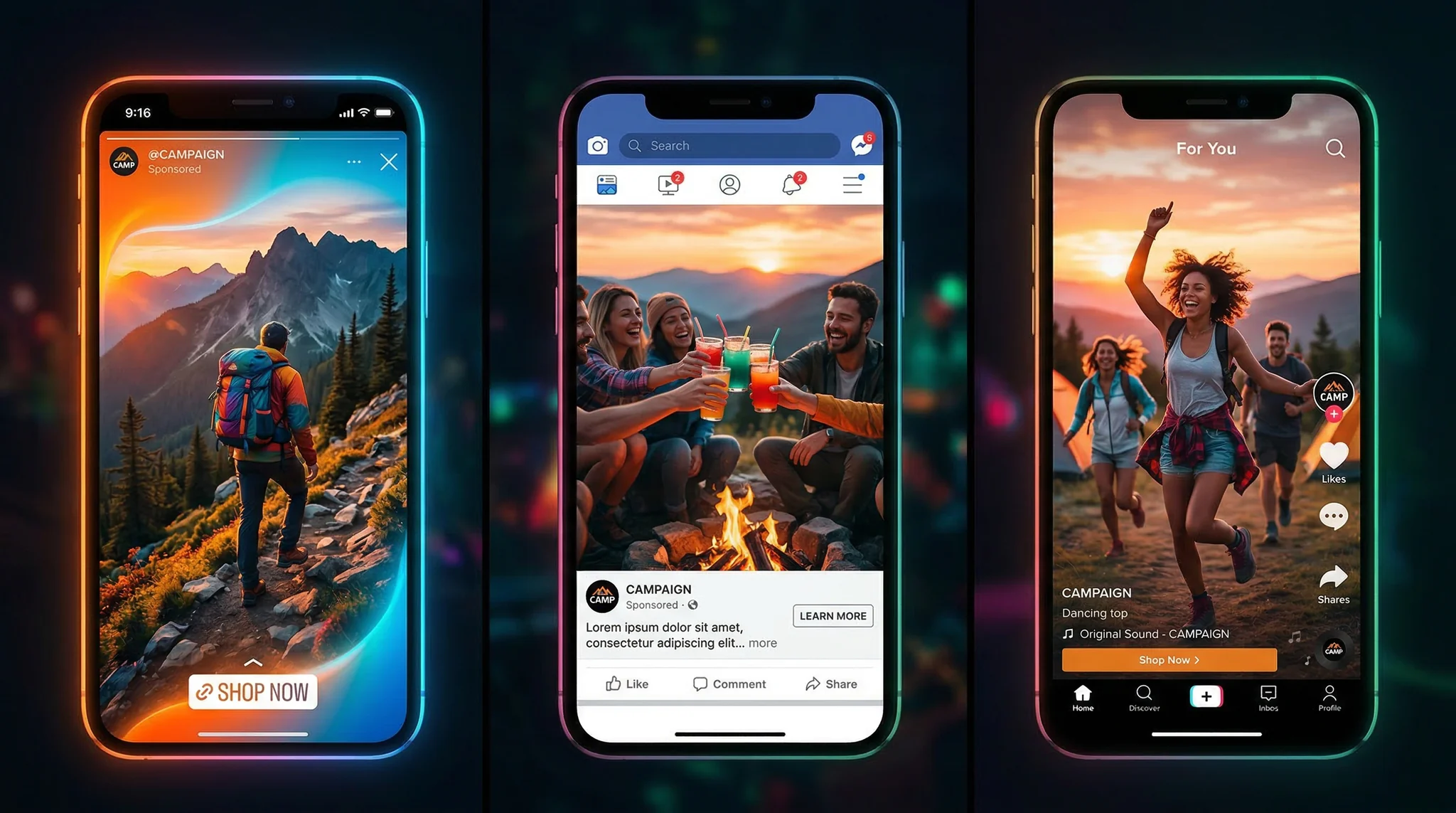
The same ad concept should look different on each platform. Generate variations that match each platform’s native aesthetic:
Instagram version: Polish and aspiration. Warm tones, lifestyle context, editorial photography quality. The ad should look like it belongs in a curated feed.
TikTok version: Raw and authentic. Slightly less polished, more dynamic motion, feels like user-generated content rather than a slick ad. Include “handheld camera feel, authentic and raw, UGC style” in your video prompts.
Facebook version: Clear and direct. Product prominently visible, benefit clearly communicated, straightforward composition. Older demographics respond better to clarity over style.
YouTube version: Cinematic and attention-grabbing. The first 2 seconds must hook — use the most dramatic visual right at the start. “Opening frame shows the most visually striking element” in your prompt.
Generating these variations takes minutes with AI, whereas producing platform-specific creative manually would multiply your production timeline and budget.
Step 7: Build a High-Volume Testing System
The real power of AI social media ads is the ability to test at scale. Here is a systematic approach:
Generate 10-15 image variations for your ad concept — different backgrounds, different angles, different color palettes, different compositions.
Write 3-5 headline variations for each visual concept.
Create audience segments in your ad platform — different demographics, interests, or lookalike audiences.
Launch combinations: Mix and match visuals and headlines across audience segments. Modern ad platforms like Meta Ads Manager will automatically optimize toward the best-performing combinations.
Monitor for 48-72 hours and identify winning combinations by CTR, CPC, or ROAS.
Generate more variations of winners: Take your best-performing visual direction and generate 10 more variations of it. Double down on what works.
Kill losers fast: Pause underperforming ads within 48 hours and replace them with new AI-generated creative.
This rapid iteration cycle — generate, test, learn, generate again — is the fundamental advantage AI gives you over manual creative production.
Step 8: Avoid Common Pitfalls
Do not make your ads look too perfect. On platforms like Instagram and TikTok, overly polished ads can trigger “ad blindness” where users instinctively scroll past anything that looks like a traditional advertisement. Mix in authentic, slightly raw-looking creative that blends with organic content.
Do not ignore platform policies. Each platform has specific rules about ad content. Facebook limits text overlay to a recommended maximum percentage of the image. All platforms prohibit misleading imagery. Ensure your AI-generated creative complies with these guidelines before launching.
Do not use the same creative across all platforms. A vertical 9:16 video ad that performs on TikTok will look terrible in a Facebook feed. Invest the extra few minutes to generate platform-specific formats.
Do not forget the landing page. The best ad in the world will fail if it sends users to a confusing, slow, or irrelevant landing page. Your AI ad creative and your landing page should tell a consistent visual and messaging story.
Frequently Asked Questions
Are AI-generated ads against platform advertising policies?
No. Meta, Google, TikTok, and other major platforms allow AI-generated ad creative. The policies focus on what the ad communicates, not how the creative was produced. Misleading claims, prohibited content, and deceptive practices are prohibited regardless of whether the ad was photographed, designed, or AI-generated.
How much does it cost to create AI social media ads?
Through Vidzy, each image or video generation costs a small number of credits. Generating 20-30 ad variations will cost significantly less than a single professional photoshoot or video production session.
What performs better — image ads or video ads?
Video ads generally achieve higher engagement rates and lower cost-per-click on most platforms. However, static image ads can outperform video for certain products and audiences. The best approach is to test both formats — which is easy and affordable with AI generation.
How often should I refresh my ad creative?
Most social media ad creative experiences fatigue after 2-4 weeks. Plan to generate fresh creative on a bi-weekly basis. AI makes this practical where traditional production timelines would make it impossible.
Can I use AI to create ads for regulated industries?
Yes, but regulated industries (finance, healthcare, alcohol, etc.) have additional advertising requirements that apply regardless of how creative is produced. Ensure your ad content, claims, and disclaimers comply with industry-specific regulations.
Launch Your First AI Ad Campaign
AI social media ads are not replacing human creativity — they are amplifying it. Your strategic thinking, audience understanding, and brand voice remain essential. AI simply removes the production bottleneck that previously limited how many ideas you could test and how quickly you could iterate.
Start today: Define your offer and audience, generate 10 ad variations using the prompts and techniques in this guide through Vidzy, launch a test campaign, and let the data tell you what works. Then generate more of what works and less of what does not. That cycle of creation, testing, and iteration is the engine of modern performance marketing — and AI just made it run ten times faster.
Elena Vasquez is a digital marketing consultant specializing in AI-powered content for small businesses. She helps brands leverage AI video and image tools to create professional marketing assets on any budget. She writes about use cases, social media strategies, and practical AI tutorials.
Build a Complete AI Content Creation Workflow from Ideation to Publishing Creating content with AI is easy. Creating content with AI systematically — in a way that is repeatable, scalable, and consistently high-quality — is where most creators and teams fall short. An AI content workflow transforms scattered experimentation into a structured production pipeline that […]
Why AI Infographics Are a Content Marketing Essential Infographics remain one of the most shared content formats on the internet. They compress complex information into visual, scannable formats that readers love and social algorithms boost. But traditional infographic design requires graphic design skills, hours of layout work, and expensive tools. AI infographics change the equation […]
Why AI Slideshow Presentations Are Changing the Game Creating polished AI slideshow presentations used to require hours of design work, stock footage licensing, and video editing expertise. With modern AI video generators, you can now turn bullet points into cinematic slide-based videos in minutes. Whether you are pitching a startup, building a course, or creating […]
Elena Vasquez
6 min read
Your Next Video Is 30 Seconds Away
Download Vidzy free, pick a template, and create your first video right now.