


What Are Style References in AI Prompts?
One of the most frustrating experiences in AI image generation is knowing exactly what aesthetic you want but not being able to articulate it in words. You might have a mood board, a favorite photographer’s portfolio, or a film still that captures the exact look you are after — but translating that visual feeling into a text prompt feels impossible. This is where style references in AI prompts come in.
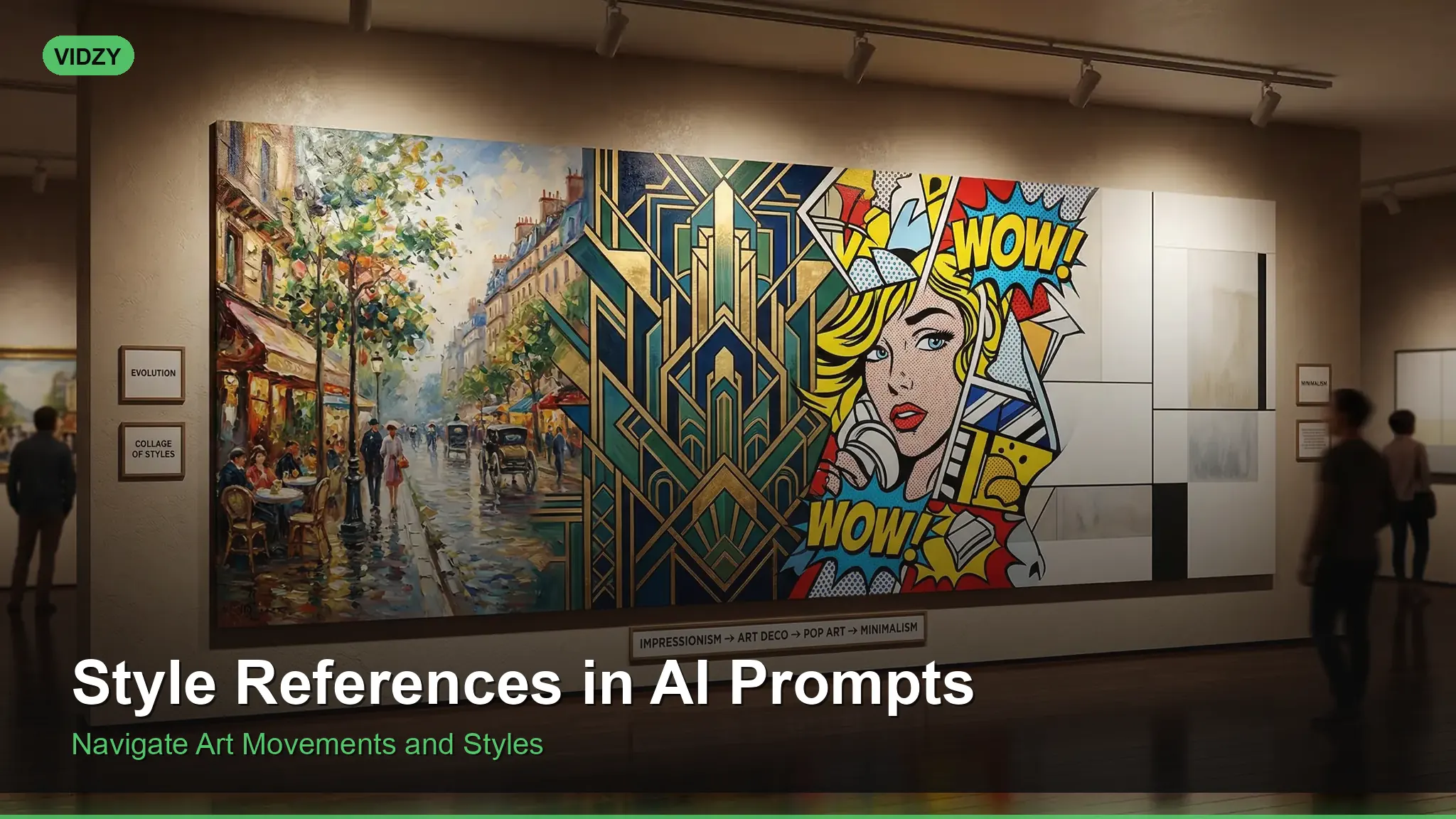
Style referencing is the practice of directing an AI model toward a specific visual aesthetic by naming artistic movements, photographers, film stocks, design eras, or cultural visual traditions. Instead of describing every aspect of a style from scratch, you invoke a shorthand that the model already understands from its training data.
Think of it as the difference between explaining what jazz sounds like to someone who has never heard music versus saying “play something like Miles Davis in the 1960s.” The reference instantly narrows the creative space to a specific neighborhood of possibilities.
Types of Style References You Can Use
There are several categories of style references, each working slightly differently in AI prompts.
Art Movements and Periods
AI models have been trained on images spanning the entire history of art. Referencing a specific art movement is one of the most reliable ways to set an aesthetic direction.
Effective art movement references:
- Art Nouveau: Organic curves, floral motifs, decorative borders, Alphonse Mucha influence
- Art Deco: Geometric patterns, gold and black, bold symmetry, 1920s glamour
- Impressionism: Visible brushstrokes, light-focused, soft edges, atmospheric color
- Surrealism: Dream-like, impossible combinations, subconscious imagery
- Bauhaus: Minimalist, functional, primary colors, geometric shapes
- Pop Art: Bold colors, halftone dots, commercial imagery, graphic flatness
- Ukiyo-e: Japanese woodblock print style, flat perspective, bold outlines
- Baroque: Dramatic, ornate, rich detail, chiaroscuro lighting
Prompt: “Art Nouveau poster illustration of a woman surrounded by blooming flowers, decorative border with organic flowing lines, muted gold and sage color palette, vintage print texture, Alphonse Mucha style”
Prompt: “Art Deco geometric portrait of a jazz singer, bold symmetrical composition, gold and black color scheme, 1920s glamour, Great Gatsby aesthetic, poster design” These style reference AI prompts are designed for professional results.
Photography Styles and Genres
For photorealistic outputs, referencing specific photography genres is more effective than art movements.
- Street photography: Candid, urban, documentary, decisive moment
- Editorial/fashion photography: Styled, intentional, magazine-quality
- Documentary photography: Raw, authentic, storytelling, photojournalistic
- Fine art photography: Conceptual, gallery-worthy, deliberately composed
- Film photography: Grain, softer color, analog feel, light leaks
- Polaroid: Square format, slightly faded, white border, vintage warmth
Prompt: “Street photography style, candid shot of an old man playing chess in a park, black and white, decisive moment captured, grain, documentary feel, Leica M6, Tri-X 400 film” Using the right style reference AI prompts makes all the difference in your output quality.
Film and Cinema References
Referencing specific films, directors, or cinematographic styles is extremely effective because AI models have been exposed to vast numbers of captioned film stills.
Effective cinematic references:
- Film noir: High contrast, shadows, venetian blinds, femme fatale, 1940s
- Wes Anderson: Symmetrical compositions, pastel color palettes, whimsical
- Blade Runner: Dystopian neon, rain, dense urban environment, retrofuturism
- Studio Ghibli: Lush hand-drawn animation, pastoral landscapes, warm colors
- Christopher Nolan: IMAX-scale, practical effects feel, epic composition
- Wong Kar-wai: Saturated colors, motion blur, neon, urban melancholy
Prompt: “Wes Anderson style photograph of a grand hotel lobby, perfectly symmetrical composition, pastel pink and mint green color palette, whimsical and meticulously arranged details, wide-angle lens, centered framing” With these style reference AI prompts, you can achieve stunning results every time.
Film Stock and Camera References
Naming specific cameras and film stocks is a subtle but powerful form of style referencing. Each camera and film combination has a distinctive look that the AI can replicate.
- Kodak Portra 400: Warm skin tones, soft contrast, subtle pastel palette
- Fuji Velvia 50: Vivid saturated colors, especially greens and blues, high contrast
- Kodak Ektar 100: Ultra-fine grain, vivid colors, ideal for landscapes
- Ilford HP5: Classic black and white, versatile, rich tonal range
- CineStill 800T: Tungsten-balanced, halation around highlights, cinematic
- Hasselblad: Medium format sharpness, distinctive bokeh, fashion and portrait favorite
- Leica: Contrasty, sharp rendering, street photography association
Prompt: “Portrait shot on CineStill 800T, tungsten color shift, halation glow around city lights in background, cinematic and moody, nighttime street scene, 35mm film grain” Master style reference AI prompts to take your AI generation to the next level.
Design Eras and Cultural Aesthetics
Broader cultural and era references can set a comprehensive visual tone:
- Vaporwave: Pink and purple, Roman busts, early internet, glitch, retro-futurist
- Cottagecore: Pastoral, soft, wildflowers, handmade, warm and cozy
- Y2K: Glossy, metallic, butterfly motifs, low-rise, early 2000s pop culture
- Brutalist: Raw concrete, imposing geometry, stark, monumental
- Scandinavian minimalism: Clean lines, natural materials, neutral palette, hygge
- Maximalism: Ornate, layered, pattern-on-pattern, more-is-more
How to Layer Style References Effectively
The most sophisticated prompts often combine style references from different categories. The key is to combine references that complement rather than contradict each other.
Effective Combinations
Prompt: “Wes Anderson meets Art Deco: a perfectly symmetrical hotel dining room with geometric floor tiles, gold and teal color scheme, centered composition, whimsical but elegant, shot on Hasselblad medium format” The best style reference AI prompts combine technical precision with creative vision.
This works because Wes Anderson’s symmetry harmonizes with Art Deco’s geometric precision. The Hasselblad reference adds photographic clarity.
Prompt: “Ukiyo-e woodblock print of a cyberpunk Tokyo street scene, traditional Japanese print techniques applied to futuristic subject matter, flat perspective, bold outlines, limited color palette of indigo and neon pink” These style reference AI prompts are designed for professional results.
Mixing a historical art style with a futuristic subject creates a striking fusion that feels fresh and intentional.
Problematic Combinations
“Minimalist maximalist” — direct contradiction. “Photorealistic watercolor painting” — choose one medium. “Bright and airy film noir” — film noir is defined by darkness and shadow. When references contradict, the model averages them, and you get a muddled result.
Platform-Specific Style Reference Techniques
Midjourney
Midjourney has a dedicated --sref (style reference) parameter that lets you upload a reference image whose style the model will attempt to match. You can also use --style raw for less stylized, more literal interpretations. Midjourney responds very well to artist and movement references in the text prompt itself.
Stable Diffusion
Style references in Stable Diffusion work through text prompts, LoRA models (trained on specific styles), and style-specific checkpoints. You can fine-tune or download community models trained specifically on a style — “Studio Ghibli LoRA,” “film noir checkpoint,” etc. This gives you more control but requires more technical setup.
Flux
Flux excels at photorealistic style references. Camera names, film stocks, and photography genre references produce excellent results. Artistic style references (painting, illustration) work but tend to lean more photorealistic than purely artistic.
DALL·E
DALL·E handles natural language style descriptions well. Full sentences like “in the style of a 1970s National Geographic photograph” work better than comma-separated keywords. DALL·E may not reproduce specific artist styles as strongly as Midjourney due to content policy considerations.
Building a Style Reference Library
As you experiment with style references, keep a personal library of prompts that produced results you love. Organize them by category:
- Color palettes that work: “muted earth tones,” “teal and amber cinematic grading,” “high-saturation 1970s Kodachrome”
- Texture and finish: “film grain,” “matte finish,” “glossy magazine print,” “rough watercolor paper texture”
- Compositional styles: “symmetrical Wes Anderson framing,” “Dutch Masters diagonal composition,” “minimalist negative space”
- Era-specific looks: “1960s mod fashion photography,” “1980s neon noir,” “Victorian scientific illustration”
This library becomes your personal style vocabulary — reusable building blocks you can mix and match across projects.
Creating Consistent Style Across Multiple Images
If you are generating a series of images — for a website, a social media campaign, or an art collection — consistency is crucial. Style references are your primary tool for achieving it.
Method 1: Lock your style suffix. Write a reusable style block that you append to every prompt in the series:
Prompt: “[subject and scene description], editorial photography, shot on Fuji X-T5, Kodak Portra color grading, soft natural light, muted warm tones, 85mm lens, shallow depth of field” Using the right style reference AI prompts makes all the difference in your output quality.
Change the subject and scene for each image, but keep the style suffix identical.
Method 2: Use a reference image. On platforms that support it (Midjourney’s –sref, Stable Diffusion’s IP-Adapter), upload one reference image and use it across all generations.
Method 3: Create a custom model/LoRA. For maximum consistency, train a LoRA on 10-20 images in your target style. This is the most effort but the most reliable approach for professional projects.
Frequently Asked Questions
Can I reference specific living artists in my prompts?
Technically, most models respond to living artist names, but this raises ethical and legal questions. Some platforms (like DALL·E) actively filter certain artist names. As a best practice, reference art movements, techniques, or aesthetics rather than specific living artists. Instead of “in the style of [specific photographer],” try describing what makes their work distinctive: “high-contrast black and white street photography with decisive moment composition and strong geometric shadows.”
How many style references should I include in one prompt?
One to three is the sweet spot. One primary style reference sets the foundation, a second can add a complementary dimension (like a film stock on top of a genre reference), and a third can handle mood or color. Beyond three, the references start competing for influence and the output becomes inconsistent.
What if my style reference is not producing the expected result?
First, try rephrasing. “Art Nouveau” might work better as “Art Nouveau poster illustration, organic flowing lines, decorative botanical border.” Adding descriptive details that define the style helps the model understand your intent. Second, try combining the reference with a specific subject that fits naturally — “Art Nouveau portrait” will likely work better than “Art Nouveau basketball game.” Third, check if your platform handles that particular reference well; some styles work better on certain models.
Start Creating with Intentional Style
Mastering style references in AI prompts transforms you from someone who generates random images into someone who creates with intention and consistency. Combined with strong prompt engineering fundamentals, these techniques let you achieve specific visual goals reliably.
Build your next prompt with Vidzy’s Prompt Generator to get structured style guidance, or explore how your images will look at different dimensions with the Video Size Guide.
Ready to create images with distinctive, intentional style? Download Vidzy and start generating today.