AI Video Generation History: From Blurry Pixels to Cinematic Brilliance
The story of AI video generation history reads like science fiction compressed into just four years. What began as stuttering, seconds-long clips of barely recognizable shapes in 2022 has evolved into a technology capable of producing photorealistic, minute-long cinematic sequences by recently. This transformation didn’t happen overnight—it was the result of compounding breakthroughs in diffusion models, transformer architectures, and compute scaling that rewrote the rulebook on what machines could create.
Whether you’re a creator evaluating AI video tools, a filmmaker curious about the technology, or a marketer planning your content strategy, understanding this timeline helps you make smarter decisions about where the industry is headed—and how to position yourself ahead of the curve.
2022: The Proof-of-Concept Era
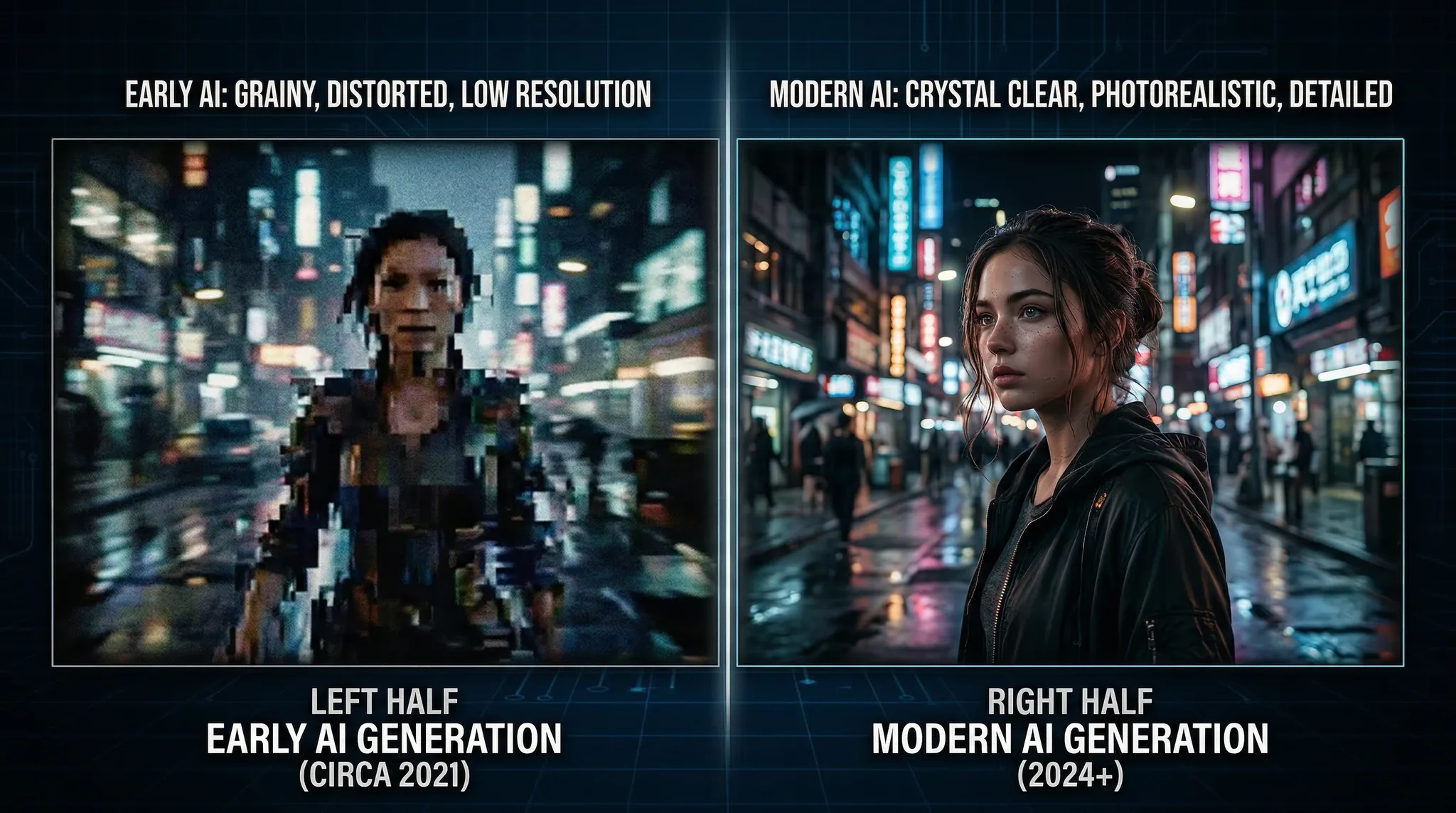
In 2022, AI video generation was largely an academic curiosity. Models like Make-A-Video from Meta and Imagen Video from Google demonstrated that text-to-video was theoretically possible, but the results were far from production-ready. Clips were typically 3 to 5 seconds long, ran at low frame rates, and featured visible artifacts—warped faces, flickering backgrounds, and objects that morphed unpredictably between frames.
The core architecture during this period relied on cascaded diffusion models. A base model would generate a low-resolution clip, and subsequent super-resolution models would attempt to upscale it. The process was computationally expensive and slow, often requiring minutes per second of generated video.
Despite the limitations, these early demonstrations proved a critical point: diffusion models, which had already revolutionized image generation through DALL-E 2 and Stable Diffusion, could be extended into the temporal domain. That signal was enough to trigger a gold rush of research investment across every major AI lab.
2023: The Architecture Race Begins
The year 2023 marked a significant shift as multiple approaches to video generation competed for dominance. Runway’s Gen-2 became one of the first commercially available text-to-video tools, allowing creators to generate 4-second clips from text prompts or transform existing videos using style transfer.
Stability AI entered the arena with Stable Video Diffusion, an open-source model that could generate short clips from a single reference image. Meanwhile, Pika Labs launched its consumer-friendly video generation platform, emphasizing accessibility over raw quality.
The key technical debate of 2023 centered on architecture choice. Some teams favored pure diffusion approaches with temporal attention layers, while others experimented with hybrid architectures that combined diffusion with autoregressive components. Google’s Lumiere, announced late in the year, introduced a space-time U-Net architecture that generated entire video clips in a single pass rather than stitching together keyframes—a meaningful step toward temporal coherence.
Video lengths during this period topped out at around 4 to 8 seconds, and resolution rarely exceeded 720p. But quality improvements were unmistakable: faces held together better, camera motions became smoother, and physics started to look more plausible.
2024: The Year Everything Changed
If 2023 was about experimentation, 2024 was about execution. OpenAI’s reveal of Sora in February sent shockwaves through the creative industry. The demo videos—a woman walking through a snowy Tokyo street, woolly mammoths trudging through a blizzard—showed a level of temporal consistency and visual fidelity that felt like a generational leap.
Sora introduced a diffusion transformer (DiT) architecture that treated video as patches of spacetime, similar to how vision transformers process images. This approach, combined with training on a massive dataset of video data, enabled Sora to generate 60-second clips at up to 1080p resolution with remarkable coherence.
Google responded with Veo, which matched Sora’s quality benchmarks and added stronger physics understanding. Runway released Gen-3 Alpha, significantly improving motion quality and prompt adherence. Kling from Kuaishou and Dream Machine from Luma AI brought competition from unexpected directions.
By the end of 2024, AI video generation had crossed the threshold from “interesting novelty” to “production tool.” Creators began incorporating AI-generated B-roll into YouTube videos, marketers used it for rapid ad concept prototyping, and independent filmmakers experimented with it for pre-visualization.
2025: Refinement, Control, and Commercialization
The AI video generation history took a practical turn in 2025. Rather than pure quality improvements, the focus shifted to controllability and workflow integration. Camera control became standard—creators could specify dolly movements, crane shots, and tracking motions through natural language or parameter sliders.
Image-to-video generation matured significantly. Feeding a single photograph or AI-generated image into models like Veo 2 or Sora produced animations that maintained the exact style, composition, and subject identity of the source material. This capability transformed AI video from a standalone curiosity into a component of multi-step creative workflows.
Wan 2.0 from Alibaba’s Tongyi Lab emerged as a strong open-source contender, enabling local deployment and fine-tuning. The open-source ecosystem, previously focused almost entirely on image generation, began building serious video generation infrastructure.
Duration continued to extend—reliable 30-second generation became common, and some models could produce clips exceeding a minute with acceptable quality degradation. Frame rates improved to a smooth 24 to 30 fps as standard.
The Present Frontier
Currently, AI video generation has reached a point that would have seemed impossible at the start of this timeline. Sora 2 and Veo 3.1 lead the quality race with photorealistic output, accurate physics simulation, and sophisticated understanding of lighting, materials, and cinematography.
The biggest breakthrough is character consistency. Models can now maintain a character’s appearance, clothing, and mannerisms across multiple generated clips—a capability that was essentially impossible just 18 months ago. This single advancement has opened the door to AI-generated short films, serialized content, and brand mascot videos.
Generation speed has also improved dramatically. What once took minutes per second of video now completes in under a minute for a full clip, thanks to optimized inference pipelines and specialized hardware.
Tools like Vidzy have made these capabilities accessible to anyone with a smartphone, abstracting away the complexity of prompt engineering, model selection, and parameter tuning. The democratization of video creation is no longer theoretical—it’s happening in real time.
Key Technical Milestones at a Glance
2022: First text-to-video diffusion models demonstrated. 3–5 second clips, low resolution, heavy artifacts.
2023: Commercial tools launch (Gen-2, Pika). Stable Video Diffusion goes open source. 4–8 second clips at 720p.
2024: Sora and Veo introduce diffusion transformers. 60-second clips at 1080p. Physics and temporal coherence dramatically improve.
2025: Camera control, image-to-video maturation, open-source ecosystem growth. 30+ second reliable generation.
Now: Character consistency, near-real-time generation, 4K output, multi-clip narrative coherence.
What These Four Years Tell Us About the Future
The pace of improvement in AI video generation has consistently outrun predictions. Each year has delivered capabilities that experts expected to take two or three years to materialize. If this trajectory continues—and there’s little reason to believe it won’t—we can expect to bring real-time video generation, full-length scene composition, and interactive video experiences where viewers influence the narrative through natural language.
The technology isn’t replacing human creativity. It’s amplifying it. Directors, marketers, educators, and independent creators now have access to production capabilities that previously required six-figure budgets and weeks of production time.
Frequently Asked Questions
When did AI video generation become commercially available?
The first widely accessible commercial AI video tools launched in mid-2023, with Runway’s Gen-2 and Pika Labs leading the way. However, quality suitable for professional use didn’t arrive until late 2024 with models like Sora and Veo.
What was the biggest breakthrough in AI video generation history?
The introduction of diffusion transformer architectures in early 2024, pioneered by OpenAI’s Sora, represented the single largest quality leap. This architecture enabled longer, more coherent, and higher-resolution video generation than anything that came before.
How long can AI generate videos today?
Currently, leading models can generate clips of 60 seconds or more at full HD or 4K resolution. Some workflows chain multiple generations together to create longer sequences.
Is AI video generation quality good enough for professional use?
Yes. By, AI-generated video is regularly used in advertising, social media marketing, pre-visualization for film and TV, educational content, and independent filmmaking. Quality has reached a point where many generated clips are indistinguishable from camera footage.
Start Creating AI Videos Today
You don’t need to wait for the next breakthrough. The AI video generation tools available right now are powerful enough to transform your content creation workflow. Download Vidzy and experience the cutting edge of AI video generation—no production crew, no expensive equipment, just your creative vision brought to life in seconds.
James Okafor is a tech journalist covering the AI generation space. With bylines in TechCrunch and The Verge, he brings an analytical lens to AI model reviews, industry trends, and the evolving landscape of creative AI tools.
AI Video Accessibility: How Generative AI Is Making Content Inclusive AI video accessibility is transforming how content creators think about inclusive design. For the first time, the same AI tools that generate stunning visual content can also make that content accessible to people with disabilities—automatically, affordably, and at scale. Captions, audio descriptions, sign language overlays, […]
AI Filmmaking Future: How Independent Cinema Is Being Reimagined The AI filmmaking future is unfolding right now in apartments, home offices, and coffee shops around the world. Independent filmmakers who once needed minimum budgets of $50,000 to $500,000 and months of production time are creating visually ambitious short films and web series for a fraction […]
Everything You Need to Know About Sora 2: The Complete Guide OpenAI’s Sora 2 has established itself as the benchmark for AI video generation. Since its full release, Sora 2 has been the model that other platforms are measured against — praised for its exceptional prompt understanding, consistent physics simulation, and cinematic output quality. Whether […]
James Okafor
9 min read
Your Next Video Is 30 Seconds Away
Download Vidzy free, pick a template, and create your first video right now.