AI Democratizing Content: Breaking Down the Barriers to Professional Creation
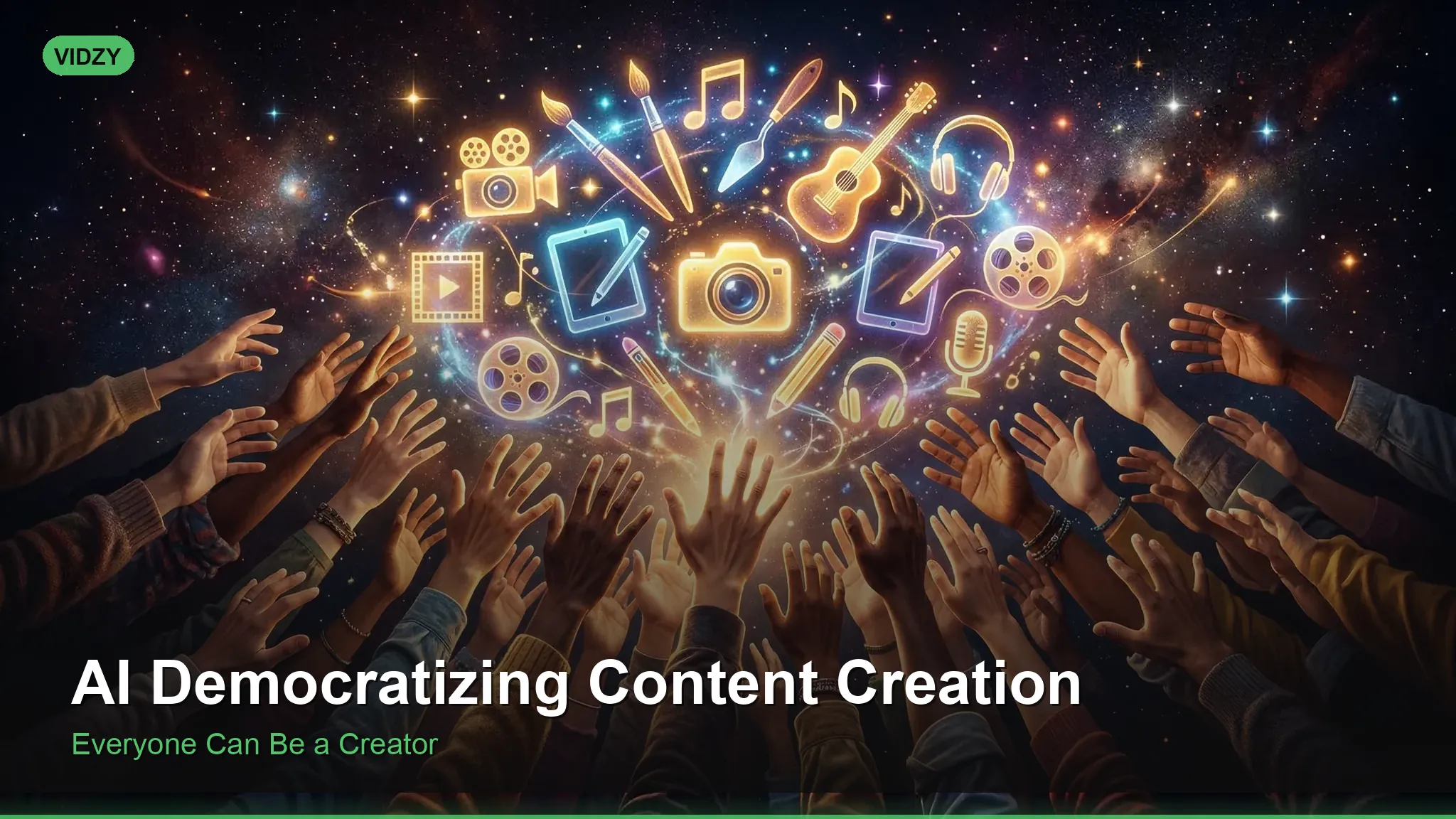
AI democratizing content creation is the defining story of the creative economy today. For the first time in history, professional-quality video, images, and multimedia content can be produced by anyone with a smartphone and a creative idea. The equipment, expertise, and capital that once gatekept professional content creation have been compressed into AI tools that cost less per month than a single stock photo used to cost.
This democratization isn’t theoretical—it’s measurable in the surge of new creators entering the market, the diversification of voices in media, the collapse of production cost barriers, and the emergence of content from communities and perspectives that were previously priced out of professional creation.
The Old Barriers: What Professional Content Creation Used to Require
Understanding the scale of democratization requires recognizing what professional content creation demanded before AI. The barriers were substantial and interconnected.
Financial barriers. A professional video setup—camera body, lenses, lighting, audio equipment, editing workstation, and software subscriptions—represented a minimum investment of $5,000 to $15,000 for entry-level professional quality. Studio rental, talent fees, and post-production services added thousands more per project. Professional photography required similar investment. Motion graphics and animation demanded even higher costs due to specialized software and the extensive training required to use it.
Skill barriers. Operating professional equipment required years of learning. Understanding cinematography—composition, lighting ratios, camera movement, color theory—typically came through formal education or extended apprenticeship. Post-production skills in software like Premiere Pro, After Effects, and DaVinci Resolve had steep learning curves that took months to years to climb.
Time barriers. Professional content took time to produce. A single polished marketing video required days of pre-production, a day or more of shooting, and 20 to 40 hours of post-production. This time investment made regular content production impractical for individuals and small businesses without dedicated production resources.
Geographic barriers. Professional equipment, studio access, and skilled collaborators were concentrated in major media markets. A creator in a rural area or developing region faced dramatically higher barriers than someone in Los Angeles, London, or Tokyo—not because of lesser talent, but because of lesser access.
How AI Dismantled Each Barrier
AI tools have systematically addressed each of these barriers, often simultaneously.
Financial Democratization
The cost of producing professional-quality visual content has dropped by 95 to 99 percent. A monthly subscription to an AI generation platform like Vidzy—typically under $30—provides access to capabilities that would have required tens of thousands in equipment and services.
This isn’t about lower quality at lower prices. The output quality of leading AI models matches or exceeds what mid-tier professional production delivers. The cost reduction comes from eliminating physical production requirements entirely—no equipment, no studio, no crew, no post-production pipeline.
Skill Democratization
Natural language prompting has replaced technical expertise as the primary creative input. Rather than needing to understand f-stops, shutter speeds, color spaces, and rendering engines, creators describe what they want in plain English. The AI handles the technical execution.
This doesn’t mean skill is irrelevant. Prompt engineering—the ability to articulate precise creative intent—is a real skill that improves with practice. And creative taste, visual literacy, and storytelling ability remain as important as ever. But the specific technical skills that created the steepest barrier to entry have been automated away.
Time Democratization
Content that took days or weeks to produce now takes minutes or hours. This compression enables consistent content production schedules that would have been impossible for individuals or small teams using traditional methods.
A solo creator using AI tools can now produce a volume and variety of content that would have required a small production team just two years ago. This changes the competitive dynamics of content creation—scale is no longer the exclusive advantage of well-resourced organizations.
Geographic Democratization
AI generation requires only an internet connection and a device. A creator in rural India has access to the same AI models, the same quality capabilities, and the same creative potential as a creator in a Manhattan studio. This is perhaps the most profound dimension of democratization—it eliminates geographic privilege from the content creation equation.
Who’s Benefiting: Real-World Impact
Small businesses. Local businesses that could never afford professional video marketing are now producing high-quality promotional content. A small restaurant can create cinematic food videos. A local gym can produce lifestyle marketing content. A boutique can generate product showcase videos that compete visually with major brand campaigns.
Educators. Teachers and educational content creators are producing illustrated explanations, visualized concepts, and engaging video lessons without production budgets. Complex scientific processes, historical events, and abstract concepts can be visualized in ways that dramatically improve learning outcomes.
Non-profit organizations. Cause-driven organizations that previously relied on volunteer filmmakers or bare-bones production are creating professional advocacy videos, fundraising content, and awareness campaigns that match the visual quality of well-funded campaigns.
Creators from underrepresented communities. Artists, filmmakers, and content creators from communities historically excluded from professional media production—due to financial barriers, geographic isolation, or lack of industry access—are finding their voices and audiences. The diversity of perspectives in online content has measurably increased as barriers have fallen.
Entrepreneurs and startups. Early-stage companies that previously bootstrapped their way through embarrassingly amateur marketing materials can now present themselves with visual polish that matches established competitors. The cost advantage extends across every content need—product launches, explainer videos, social media content, and investor presentations.
The Quality Equalizer
Perhaps the most significant aspect of AI democratizing content is the quality equalization it produces. In the pre-AI era, content quality was strongly correlated with budget. You could generally identify a $1,000 video versus a $50,000 video on sight. AI breaks this correlation.
A well-prompted AI generation from a budget creator can be visually indistinguishable from a well-prompted generation from a well-funded brand. When both are using the same Sora or Veo models, the quality ceiling is determined by creative vision and prompt skill rather than financial resources.
This quality equalization is revolutionary for competitive markets. Small brands competing against incumbents with massive marketing budgets can now produce visual content at parity quality. The competitive advantage shifts from “who can afford better production” to “who has better creative ideas and execution.”
The New Creative Skills That Matter
Democratization doesn’t eliminate the importance of skill—it changes which skills matter.
Creative vision. The ability to conceive compelling visual content is more valuable than ever because the gap between conception and execution has shrunk to nearly zero. If you can imagine it and describe it clearly, you can create it.
Audience understanding. Knowing what resonates with your specific audience—what visual styles they prefer, what content formats they engage with, what stories matter to them—becomes the primary differentiator when everyone has access to the same production capabilities.
Storytelling. Narrative skill—the ability to structure information, build emotional arcs, and create meaningful connections—remains fundamentally human and fundamentally valuable. AI generates visuals; humans create meaning.
Curation and taste. When AI can generate 50 variations of a concept in minutes, the ability to select the best one—to exercise informed creative judgment—becomes a critical skill. Taste, refined through exposure to great work and deliberate practice, is what separates memorable content from technically adequate but unremarkable output.
Strategic thinking. Understanding how content fits into broader goals—brand building, audience growth, conversion, education—determines whether beautiful content actually achieves anything. Strategic content thinking is amplified by AI tools but can’t be replaced by them.
Challenges of Democratization
Democratization brings challenges alongside its benefits.
Content oversaturation. When everyone can create professional content, the total volume of content competing for attention increases dramatically. Standing out requires either exceptional creative quality, strategic distribution, or strong audience relationships—preferably all three.
Quality floor vs. quality ceiling. AI has raised the quality floor (minimum acceptable quality) significantly, but it hasn’t raised the quality ceiling. Truly exceptional content still requires exceptional creative vision, and the best human-directed productions still surpass the best AI-only outputs.
Authenticity questions. As AI-generated content becomes ubiquitous, audiences may develop skepticism toward visual polish. The authenticity premium—where raw, human-created content commands attention precisely because of its imperfections—is a real counter-trend worth watching.
Frequently Asked Questions
Do I need technical skills to create professional content with AI?
No traditional production skills are required. AI content creation relies on creative vision, prompt writing ability, and editorial judgment rather than technical expertise with cameras, lighting, or editing software. These creative skills develop through practice, not formal training.
Can AI-generated content really compete with professionally produced content?
For most use cases, yes. AI-generated videos and images from leading models match mid-to-high-tier professional production quality. For content where specific human performances, physical locations, or unique practical effects are essential, traditional production still has advantages.
How has AI democratization affected professional content creators?
Professional creators who have adopted AI tools report increased productivity and the ability to take on more projects. Those whose primary value proposition was technical production quality face more competition, while those who differentiate on creative vision, storytelling, and client relationships find their skills more valued than ever.
What’s the most important skill for AI-era content creation?
Creative vision—the ability to conceive compelling content concepts and articulate them clearly. When production execution is handled by AI, the quality of the creative idea becomes the primary differentiator. Storytelling ability and audience understanding are close seconds.
Your Creative Voice Deserves to Be Heard
The barriers are gone. The tools are accessible. The only thing standing between your ideas and professional content is the decision to start. Download Vidzy and join the democratized content revolution—your audience is waiting.
James Okafor is a tech journalist covering the AI generation space. With bylines in TechCrunch and The Verge, he brings an analytical lens to AI model reviews, industry trends, and the evolving landscape of creative AI tools.
Everything You Need to Know About Sora 2: The Complete Guide OpenAI’s Sora 2 has established itself as the benchmark for AI video generation. Since its full release, Sora 2 has been the model that other platforms are measured against — praised for its exceptional prompt understanding, consistent physics simulation, and cinematic output quality. Whether […]
The Complete Veo 3.1 Guide: Google’s Premier AI Video Generator Google’s Veo 3.1 has carved out a distinctive position in the AI video generation landscape. While competitors chase the longest clips or the widest feature sets, Google has focused on two areas where Veo 3.1 genuinely leads: photorealism and integrated audio. The result is an […]
AI Video Social Media Impact: The Platform Transformation The AI video social media impact today has been nothing short of seismic. Every major platform—TikTok, Instagram, YouTube, X, and LinkedIn—has been reshaped by the flood of AI-generated video content that became mainstream this year. Algorithms have adapted, creator strategies have shifted, audience expectations have evolved, and […]
James Okafor
9 min read
Your Next Video Is 30 Seconds Away
Download Vidzy free, pick a template, and create your first video right now.