AI Video Quality Evolution: A Year That Rewrote the Playbook
The AI video quality evolution between mid-2025 and recently is one of the most dramatic improvement arcs in the history of generative AI. In just twelve months, the technology went from producing clips that needed careful prompt engineering and cherry-picking to generating videos that regularly fool trained eyes into thinking they came from a professional camera.
This isn’t hype—it’s measurable. Resolution doubled, temporal coherence improved by orders of magnitude, and the gap between “AI-generated” and “camera-captured” shrank to the point where distinguishing the two has become genuinely difficult. For creators, marketers, and filmmakers, understanding exactly how this happened and what it means is essential for staying competitive.
Where AI Video Stood in Mid-2025
By June 2025, AI video generation was already impressive compared to its early days. Models like Sora, Veo, and Runway Gen-3 could produce 10 to 30 second clips at 720p to 1080p resolution with reasonable prompt adherence. But significant limitations remained visible to anyone looking closely.
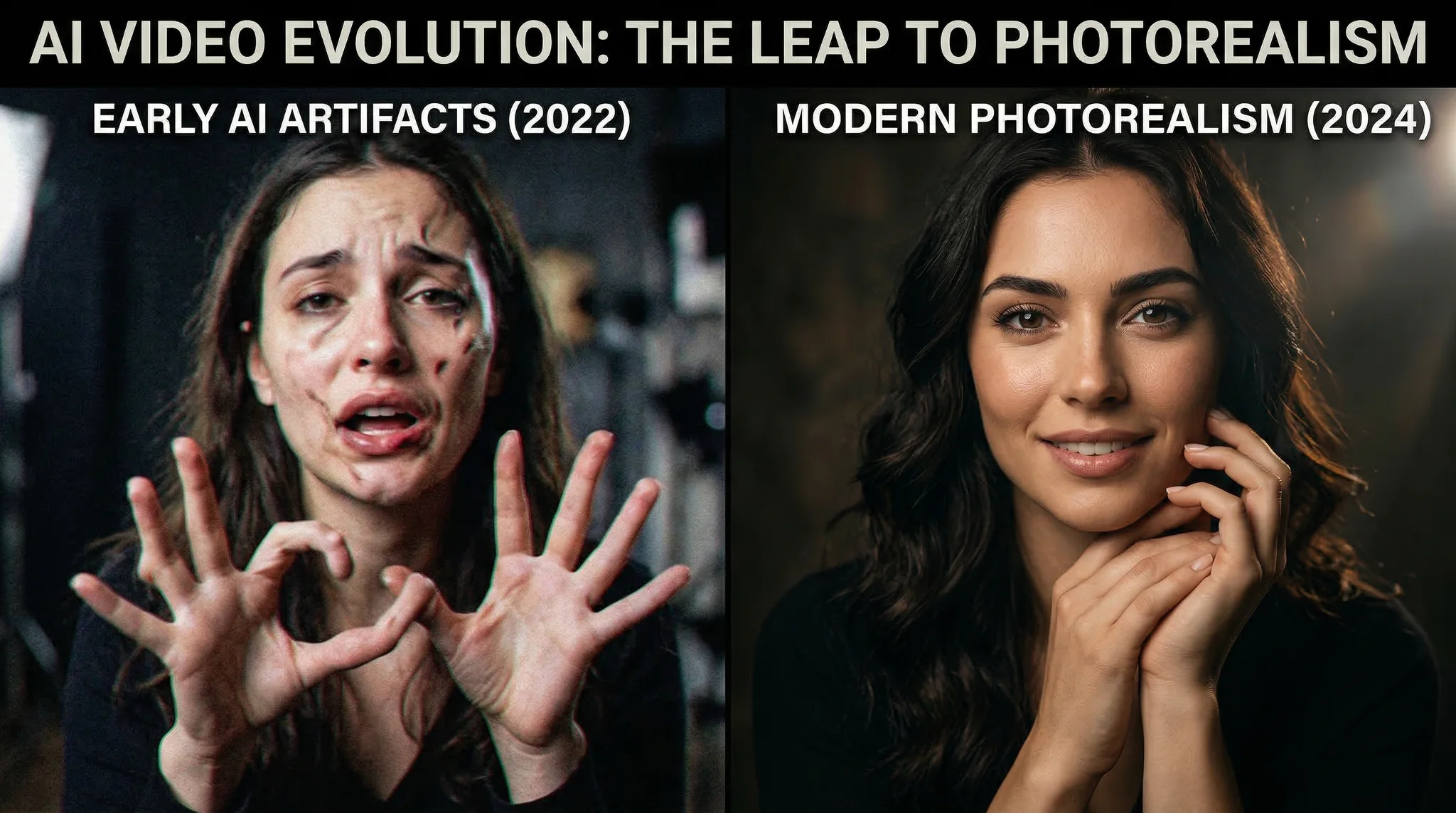
Hands and fingers were still problematic—characters would sometimes gain or lose digits mid-clip. Complex physics scenarios produced implausible results: water didn’t splash correctly, fabric didn’t drape naturally, and reflections in mirrors or glass often showed impossible scenes. Text rendered within videos was garbled more often than not.
Temporal consistency was the biggest challenge. Characters would subtly change appearance between frames—a shirt might shift color, hair might rearrange, or facial features could drift. These artifacts were especially noticeable in longer clips, which is why most creators stuck to sub-15-second generations.
The “uncanny valley” effect was real. You could appreciate the technical achievement while still immediately recognizing the output as AI-generated. That recognition gap had significant implications for professional use—AI video worked for concepts and rough drafts but rarely for final deliverables.
The Six Breakthroughs That Changed Everything
1. Temporal Attention Scaling
The most impactful improvement came from dramatically scaling temporal attention mechanisms within diffusion transformer architectures. Rather than processing video as a sequence of loosely connected frames, models treat video as a continuous 3D volume of spacetime tokens. This means every pixel in every frame is directly influenced by pixels in every other frame, creating a level of consistency that earlier architectures simply couldn’t achieve.
The computational cost of this approach is enormous, which is why it only became practical as inference optimization techniques—including distillation and architectural pruning—matured enough to make it economically viable.
2. Physics-Aware Training
Several leading models incorporated physics simulation data into their training pipelines during late 2025. By training on synthetic datasets that included accurate rigid body dynamics, fluid simulation, cloth physics, and particle effects alongside natural video data, models developed a much stronger intuitive understanding of how the physical world behaves.
The results are immediately visible: water now splashes convincingly, objects fall with appropriate acceleration, and fabrics fold and drape realistically. These aren’t perfect simulations, but they’re close enough to pass casual inspection.
3. Face and Hand Specialization
Dedicated fine-tuning on high-resolution face and hand datasets solved what had been one of AI video’s most persistent embarrassments. Modern models maintain accurate finger counts, natural hand poses, and consistent facial features throughout a clip. Face generation is now good enough for close-up dialogue scenes—something that was effectively impossible a year ago.
4. Resolution and Frame Rate Jumps
Native 4K generation arrived in early, alongside support for 30fps and even 60fps output. The previous standard of 720p at 24fps meant AI video always looked slightly inferior to smartphone footage. At 4K 30fps, AI-generated clips match the technical specifications of professional camera systems.
5. Prompt Understanding Depth
Language model improvements within the text encoder components of video generators dramatically improved prompt adherence. Complex multi-sentence prompts with specific staging, lighting, and action descriptions are now interpreted with far greater accuracy. Creators spend less time wrestling with prompts and more time creating.
6. Character Consistency Across Generations
Perhaps the most commercially significant breakthrough is the ability to maintain a character’s appearance across multiple separate video generations. Using reference images or character embedding techniques, models like Sora 2 can generate multiple clips featuring the same character in different scenes, wearing the same clothes, with consistent body proportions and facial features.
Real-World Impact on Content Creation
These quality improvements have triggered measurable shifts in how content is produced across industries.
Social media marketing has been transformed. Brands that previously needed to book studios, hire talent, and manage post-production for video ads can now generate test concepts in minutes. A/B testing video creative has gone from a luxury reserved for big-budget campaigns to something a solo marketer can do before lunch.
Independent filmmaking has embraced AI video for establishing shots, B-roll, and even some dialogue scenes. The cost savings are staggering—what once required location permits, travel budgets, and camera crews can be generated from a text description.
E-learning and training content has seen rapid adoption. Educational creators can illustrate complex concepts with custom video footage rather than relying on stock libraries or expensive animation studios.
Product visualization in e-commerce has shifted from 3D rendering pipelines to AI video generation for many use cases. Showing a product in different environments, lighting conditions, and usage scenarios takes seconds rather than hours.
What Quality Gaps Remain
Honesty about current limitations is important. While AI video quality evolution has been extraordinary, certain challenges persist.
Long-form coherence still degrades. Beyond 30 to 45 seconds, even the best models begin to drift in ways that careful viewers will notice. Multi-shot scenes require generating individual clips and editing them together.
Complex multi-character interactions remain difficult. Scenes with more than two or three characters interacting simultaneously can produce confused spatial relationships and action sequencing.
Fine text rendering in video—such as readable signage, book covers, or screen content within a scene—has improved but still isn’t reliable for every generation.
Audio synchronization is in its early stages. While some models now generate synchronized sound effects, lip-sync accuracy for dialogue scenes varies significantly.
Tools Making Quality Accessible
The quality improvements mean little if creators can’t access them. Fortunately, platforms like Vidzy have kept pace by integrating the latest models into user-friendly interfaces. Rather than needing to understand diffusion parameters or architecture differences, creators describe what they want and receive production-quality output.
The Veo and Sora model families powering these tools handle the technical complexity behind the scenes, letting creators focus entirely on creative decisions.
Frequently Asked Questions
How much has AI video resolution improved in the past year?
AI video generation has gone from 720p–1080p as the standard in mid-2025 to native 4K output being available from leading models today. Frame rates have similarly improved from 24fps to 30fps and 60fps options.
Can AI video pass for real camera footage today?
In many scenarios, yes. Short to medium-length clips with standard scenes—people walking, nature footage, product shots, urban environments—are frequently indistinguishable from camera footage at casual viewing distances. Extreme close-ups and complex interaction scenes can still reveal AI origins.
What caused the biggest quality improvement?
Scaling temporal attention mechanisms within diffusion transformer architectures had the single largest impact. By allowing every frame to directly influence every other frame during generation, models achieved unprecedented consistency and coherence.
Is the quality good enough for commercial use?
Absolutely. AI-generated video is being used in commercial advertising, social media marketing, e-commerce product visualization, and educational content production by major brands and independent creators alike.
Experience the Latest AI Video Quality
Seeing is believing. The best way to understand how far AI video quality has come is to try it yourself. Download Vidzy and generate your first video—the difference between what you might remember from a year ago and what’s possible today will speak for itself.
James Okafor is a tech journalist covering the AI generation space. With bylines in TechCrunch and The Verge, he brings an analytical lens to AI model reviews, industry trends, and the evolving landscape of creative AI tools.
AI Video Accessibility: How Generative AI Is Making Content Inclusive AI video accessibility is transforming how content creators think about inclusive design. For the first time, the same AI tools that generate stunning visual content can also make that content accessible to people with disabilities—automatically, affordably, and at scale. Captions, audio descriptions, sign language overlays, […]
AI Filmmaking Future: How Independent Cinema Is Being Reimagined The AI filmmaking future is unfolding right now in apartments, home offices, and coffee shops around the world. Independent filmmakers who once needed minimum budgets of $50,000 to $500,000 and months of production time are creating visually ambitious short films and web series for a fraction […]
AI Video Generation: Where We Are and Where We’re Heading If 2024 was the year AI video generation captured the public imagination, and 2025 was the year it became commercially viable, then is the year it became indispensable. AI video generation looks nothing like the flickering, artifact-laden clips that went viral two years ago. Today’s […]
James Okafor
11 min read
Your Next Video Is 30 Seconds Away
Download Vidzy free, pick a template, and create your first video right now.