AI Video Accessibility: How Generative AI Is Making Content Inclusive
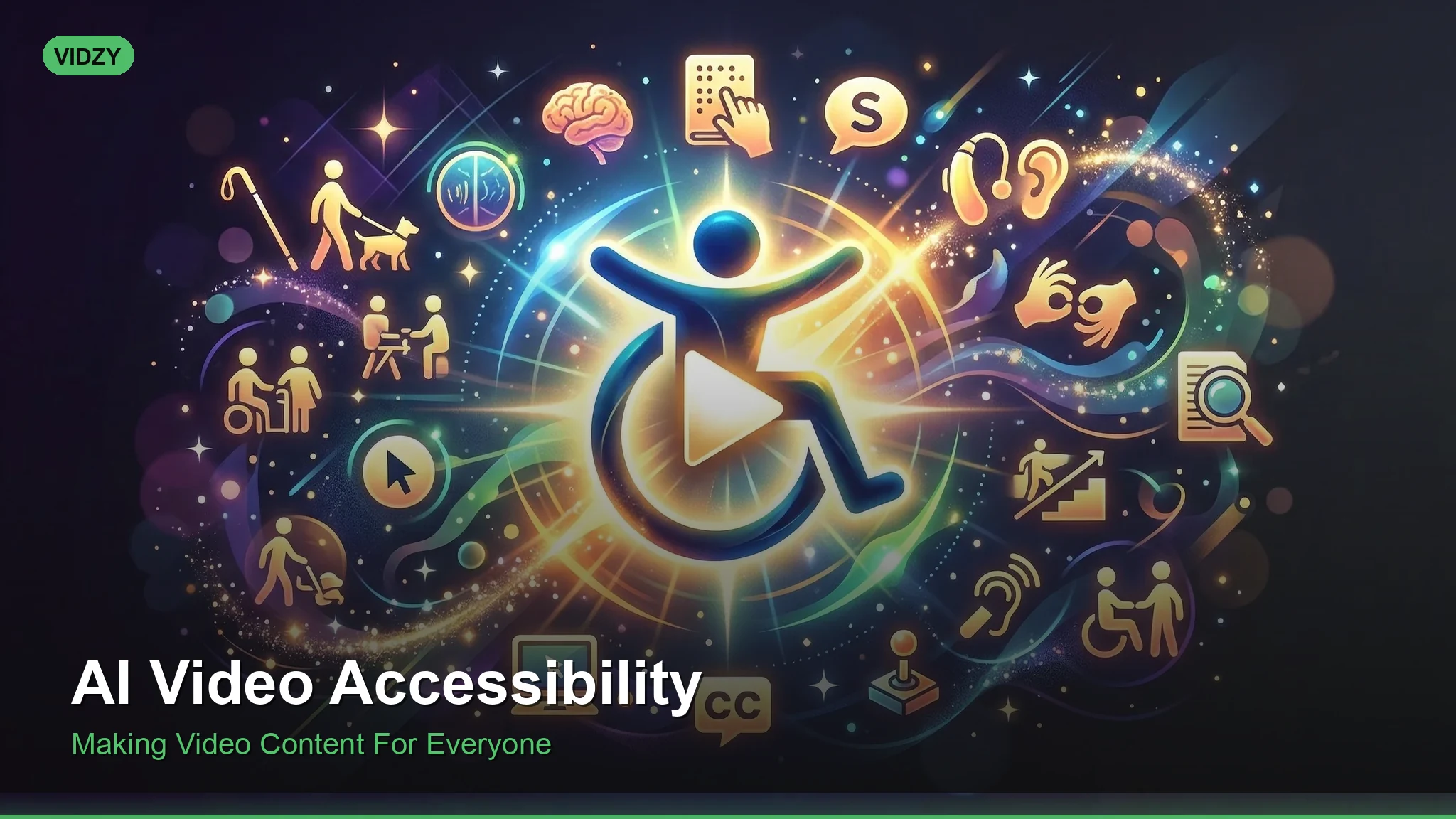
AI video accessibility is transforming how content creators think about inclusive design. For the first time, the same AI tools that generate stunning visual content can also make that content accessible to people with disabilities—automatically, affordably, and at scale. Captions, audio descriptions, sign language overlays, simplified visual alternatives, and multi-language adaptations that previously required specialized services and significant budgets are becoming built-in capabilities of AI generation platforms.
This matters for more than compliance. Over one billion people worldwide live with some form of disability. Aging populations in developed nations mean the number of people who benefit from accessible content grows every year. And accessibility features benefit everyone—captions help viewers in noisy environments, audio descriptions aid comprehension for visual learners, and clear visual design improves engagement across all audiences.
For creators and brands, understanding how AI enables accessibility isn’t just ethically important—it’s a competitive advantage in reaching the broadest possible audience.
The Traditional Accessibility Challenge
Before AI tools, making video content accessible was expensive, time-consuming, and often treated as an afterthought.
Closed captioning required manual transcription and timing—a process that cost $1 to $3 per minute of video for basic accuracy, with professional-grade captioning costing more. Turnaround times of 24 to 72 hours made real-time content accessibility impractical.
Audio description—narration that describes visual content for blind and visually impaired viewers—was even more expensive, requiring scriptwriting, voice talent, and careful timing. Most content creators simply didn’t offer it.
Sign language interpretation required hiring qualified interpreters and either shooting them alongside the original content or compositing them in post-production. The cost and logistics meant this was limited to broadcast content and major platforms.
Multi-language accessibility multiplied every cost by the number of languages served. Most creators could afford to make their content accessible in one language at most.
The result was predictable: most online video content was inaccessible to significant portions of the potential audience. Not because creators didn’t care, but because the cost and complexity were prohibitive.
How AI Is Solving Each Accessibility Challenge
AI-Powered Captioning
AI speech recognition has reached accuracy levels that match or exceed professional human transcription for most content types. Modern speech-to-text models handle multiple speakers, accents, technical terminology, and background noise with remarkable reliability.
The cost has dropped from dollars per minute to fractions of a cent. The turnaround has gone from days to seconds. This means every piece of video content—from a polished marketing video to a casual social media clip—can have accurate captions at effectively zero marginal cost.
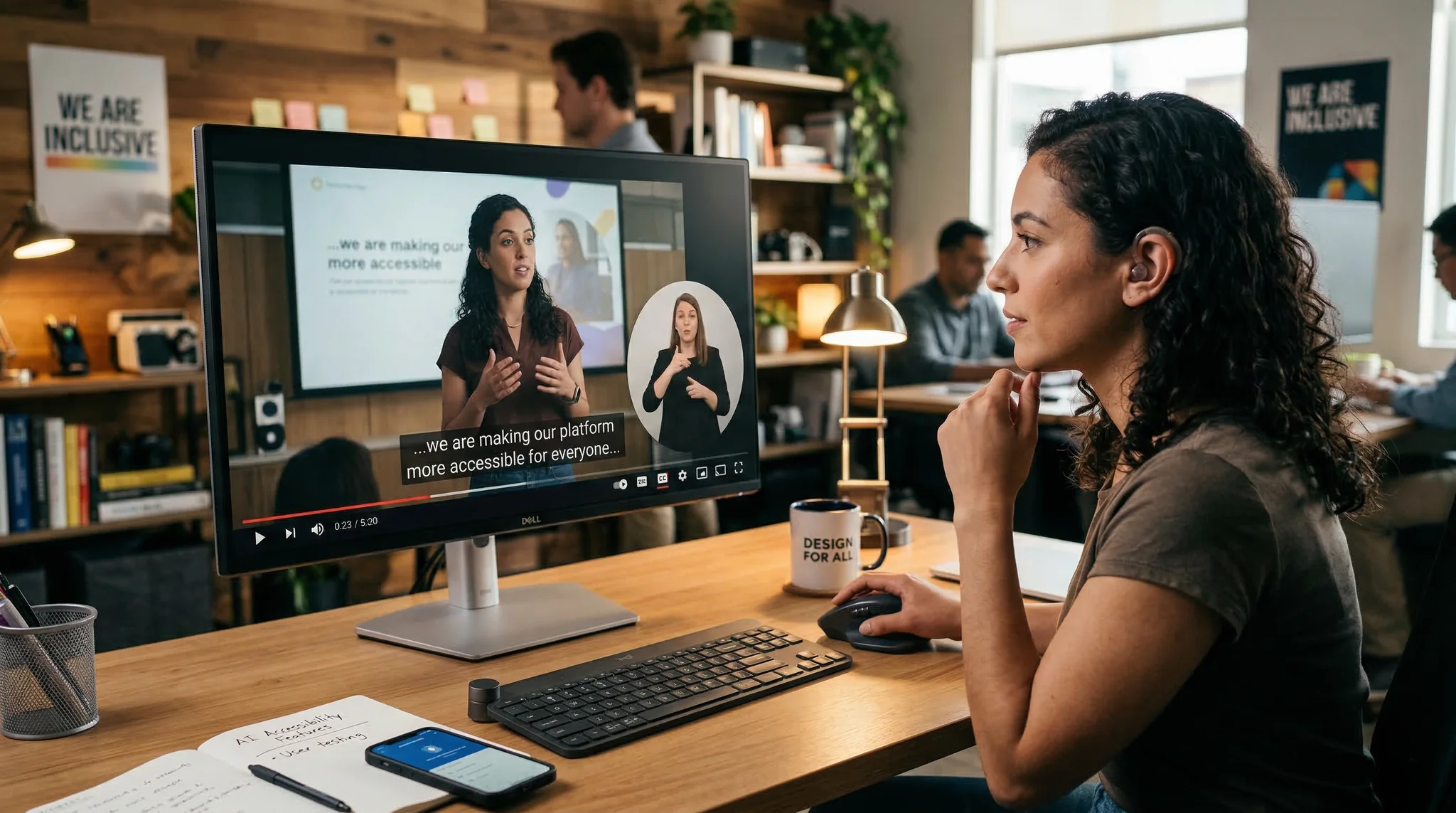
Beyond basic transcription, AI captioning tools now handle speaker identification (labeling who is speaking), sound effect description (noting [music playing], [door slams], [laughter]), and emotional context (indicating tone of voice for dialogue). These enriched captions provide a more complete experience for deaf and hard-of-hearing viewers.
AI Audio Description
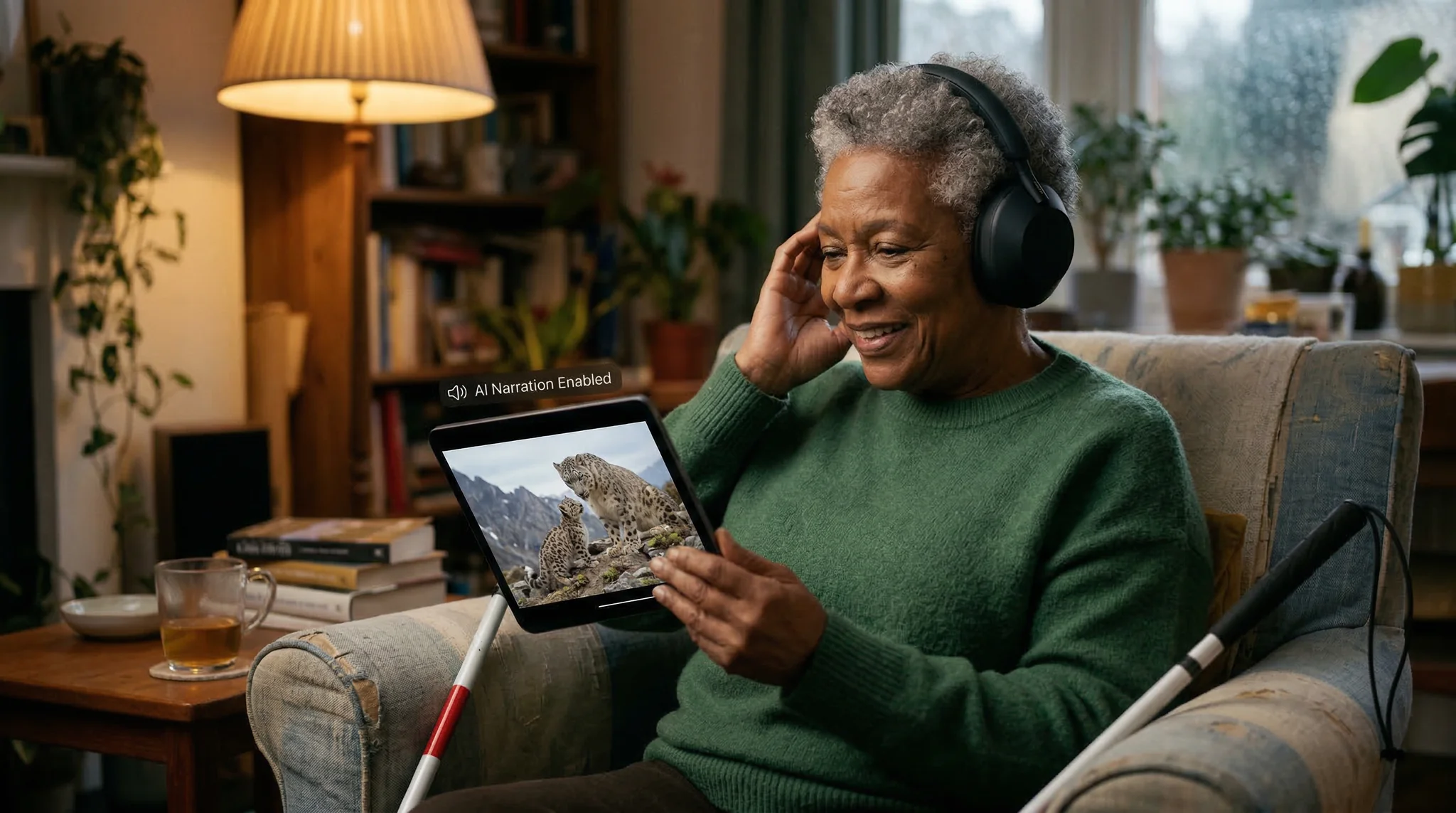
AI-generated audio description is the accessibility capability that has advanced most dramatically today. Modern multimodal AI models can “watch” a video, understand what’s happening visually, and generate natural-language descriptions that can be synthesized into speech and inserted during natural pauses in the audio.
The quality of these descriptions has improved from basic object identification (“a man walks across the room”) to contextually rich narration (“James crosses the living room, his expression tense, pausing at the window to look out at the darkening sky”). This contextual understanding comes from the same multimodal AI capabilities that enable image understanding in language models.
For creators using AI video generation tools like Vidzy, there’s a unique advantage: because the AI generated the visual content in the first place, it has complete understanding of what’s in each frame. The same system that creates the video can generate its audio description, ensuring perfect accuracy.
AI Sign Language Generation
AI-generated sign language avatars represent a newer but rapidly advancing capability. These systems translate spoken or written content into sign language performed by a computer-generated avatar, which can be overlaid on video content.
Current implementations support American Sign Language (ASL), British Sign Language (BSL), and several other national sign languages. While the avatar quality and sign accuracy haven’t yet reached the fluency of a human interpreter for complex content, they provide functional accessibility for straightforward informational content—a massive improvement over no sign language access at all.
Multi-Language Accessibility
AI translation and dubbing have made multi-language content accessibility practical at scales previously impossible. A video created in English can be automatically captioned, dubbed, and even have its visual text elements translated into dozens of languages with minimal human intervention.
The combination of AI translation, voice cloning (matching the original speaker’s vocal characteristics in the target language), and lip-sync adjustment produces dubbed content that feels native rather than translated. For accessibility, this means content can reach audiences regardless of language barriers.
Accessibility in AI-Generated Content Specifically
AI-generated video content has unique accessibility considerations that differ from traditionally produced content.
Advantage: Complete scene understanding. Because AI generated the visual content, full scene descriptions are available by default. There’s no ambiguity about what’s in the frame—the generation system knows exactly what it created.
Advantage: Prompt-based alt text. The text prompt used to generate an image or video serves as a natural starting point for alt text and audio description. A prompt like “a golden retriever running through a sunlit meadow with wildflowers” is already a serviceable visual description.
Consideration: Visual clarity. AI-generated content should be evaluated for visual accessibility just like any other content. Sufficient contrast between text and backgrounds, avoidance of rapid flashing or strobing effects, and clear visual hierarchy all apply.
Consideration: Representation. AI tools make it easy to generate content featuring diverse representation—different ethnicities, ages, body types, and abilities. This democratization extends to ensuring that people with visible disabilities are included in AI-generated imagery and video as a matter of course, not as a special accommodation.
Building an Accessible Content Workflow
Here’s a practical workflow for creating accessible AI-generated video content.
Step 1: Generate with accessibility in mind. When creating AI video content, consider visual clarity, contrast, and pacing. Avoid generating content with excessive visual complexity, rapid cuts, or elements that would be difficult to describe for audio description.
Step 2: Auto-generate captions. Run your video through AI captioning. Review for accuracy, especially for proper nouns, technical terms, and any speech that might be unclear. Most AI captioning tools now offer real-time editing interfaces for quick corrections.
Step 3: Generate audio description. Use AI audio description tools to create a description track. Review for completeness—ensure that all visually conveyed information that’s essential to understanding the content is described. Edit where necessary to improve clarity or add context.
Step 4: Add structured metadata. Include alt text for thumbnail images, descriptive titles, and content warnings for any elements that might affect viewers with photosensitive conditions.
Step 5: Test across platforms. Verify that your accessibility features (captions, audio description tracks) are correctly processed by each platform you publish to. Different platforms handle accessibility features differently, and what works on YouTube may need adjustment for Instagram or TikTok.
The Business Case for Accessible Content
Beyond the ethical imperative, accessible content delivers measurable business benefits.
Expanded audience. The World Health Organization estimates that 16 percent of the global population lives with significant disability. Making content accessible immediately expands your potential audience by hundreds of millions of people.
Improved SEO. Captions, transcripts, and descriptive metadata provide text content that search engines can index. Videos with captions consistently rank higher in search results and receive more engagement than identical videos without captions.
Legal compliance. Accessibility requirements are tightening globally. The European Accessibility Act, the ADA in the United States, and similar legislation in other jurisdictions increasingly require digital content accessibility. Proactive accessibility is cheaper and less disruptive than retroactive compliance.
Engagement metrics. Studies consistently show that captioned videos receive higher completion rates, more shares, and longer view times than uncaptioned equivalents. This holds true even among viewers without hearing disabilities—many people prefer captions for comprehension, language learning, or viewing in sound-off environments.
Brand perception. Brands that prioritize accessibility are perceived as more inclusive, more professional, and more trustworthy. In competitive markets, accessibility can be a meaningful differentiator.
Emerging Accessibility Technologies to Watch
Several AI-driven accessibility technologies are in development that will further transform content accessibility in the near future and beyond.
Real-time sign language avatars that can be embedded in live streams and video calls, making real-time video communication accessible to deaf viewers without human interpreters.
Personalized accessibility profiles that allow viewers to specify their needs (caption style, audio description verbosity, font size, contrast preferences) and have AI adapt content presentation in real time.
Haptic feedback integration that translates visual and audio content into tactile patterns for deafblind viewers, using smartphone haptics or specialized wearable devices.
Cognitive accessibility adaptations that use AI to simplify complex content—reducing reading levels, adding visual supports for abstract concepts, and providing supplementary explanations—for viewers with cognitive or learning disabilities.
Frequently Asked Questions
How accurate is AI-generated captioning today?
AI captioning accuracy for clear English speech exceeds 98 percent—comparable to professional human transcription. Accuracy is lower for heavily accented speech, very noisy environments, or highly technical content, but continues to improve. Quick human review catches remaining errors efficiently.
Is AI audio description good enough to replace human describers?
For informational and marketing content, AI audio description is generally sufficient. For complex narrative content—films, TV shows, theatrical productions—human description remains superior for capturing nuance, emotional context, and narrative significance. A hybrid approach (AI draft, human review) offers the best balance.
Do social media platforms support accessibility features for AI-generated content?
Yes, all major platforms support closed captions and alt text. YouTube supports audio description tracks. Instagram and TikTok support auto-captioning with editing capabilities. Platform support for advanced features like sign language overlays varies but is expanding.
What’s the cost of making AI-generated content fully accessible?
Using AI tools, the marginal cost of adding captions, alt text, and basic audio description to content is negligible—often included in platform subscription costs. The primary investment is the time for quality review and any necessary manual corrections, typically adding 10 to 20 minutes per piece of content.
Create Content That Reaches Everyone
Accessibility isn’t an add-on—it’s a fundamental aspect of quality content creation. AI has made accessible content creation faster, cheaper, and easier than ever before. Download Vidzy and start building content that truly reaches your entire audience.
James Okafor is a tech journalist covering the AI generation space. With bylines in TechCrunch and The Verge, he brings an analytical lens to AI model reviews, industry trends, and the evolving landscape of creative AI tools.
Image-to-Video AI: How Still Photos Are Coming to Life The ability to take a still photograph and transform it into a moving video seemed like science fiction just three years ago. In, image to video AI has become one of the most transformative and practical applications of generative AI. Upload a product photo and watch […]
AI Content Copyright: What Every Creator Needs to Know today AI content copyright is the single most important legal topic facing digital creators today. As AI-generated images, videos, and text become indistinguishable from human-made content, the legal frameworks governing ownership, licensing, and commercial use are evolving rapidly—and not always in predictable directions. Whether you’re using […]
AI Democratizing Content: Breaking Down the Barriers to Professional Creation AI democratizing content creation is the defining story of the creative economy today. For the first time in history, professional-quality video, images, and multimedia content can be produced by anyone with a smartphone and a creative idea. The equipment, expertise, and capital that once gatekept […]
James Okafor
8 min read
Your Next Video Is 30 Seconds Away
Download Vidzy free, pick a template, and create your first video right now.