Will AI Replace Video Editors? The Nuanced Truth Behind the Headlines
“Will AI replace video editors?” It’s a question that has generated anxiety in creative communities, clickbait headlines in tech media, and genuine uncertainty among professionals building careers in post-production. Now that AI video generation and editing tools have matured significantly through 2025 and into, we have enough data and real-world experience to move beyond speculation and provide an honest, evidence-based analysis.
The short answer is that AI will not replace video editors—but it will fundamentally transform what video editing means, which skills are valued, and how editors spend their time. If you’re a video editor, creative professional, or someone considering entering the field, this analysis will help you understand what’s actually changing, what’s staying the same, and how to position yourself for success.
What AI Can Already Do in Video Editing
To have an honest conversation about AI replace video editors concerns, we need to acknowledge how capable AI editing tools have become. Dismissing the technology’s current state does no one any favors.
Automated rough cuts. AI tools can analyze raw footage, identify usable takes, match clips to a script or music track, and assemble a rough cut that serves as a reasonable starting point. For talking-head videos, podcasts, and event coverage, these automated assemblies are sometimes 80 percent of the way to a finished product.
Intelligent B-roll insertion. AI can analyze a script or voiceover, identify moments that would benefit from supplementary footage, and either find appropriate stock footage or generate original B-roll using text-to-video models like Sora and Veo.
Automatic color grading. AI color grading tools can match the look of reference footage, maintain consistency across clips shot in different conditions, and apply professional-grade color corrections with minimal human input.
Audio cleanup and enhancement. Background noise removal, dialogue enhancement, and automatic audio leveling have reached professional quality. Tasks that once required a dedicated audio engineer can now be handled by AI in real time.
Object removal and background replacement. AI-powered tools can remove unwanted objects from video frames, replace backgrounds, and even change environmental conditions (adding rain, changing time of day) with results that pass casual inspection.
Subtitle and caption generation. Accurate transcription, translation, and styled caption generation is essentially a solved problem. What once took hours of manual work happens in minutes with near-perfect accuracy.
What AI Cannot Do (And Likely Won’t Soon)
The capabilities list above sounds impressive—and it is. But the gap between what AI can automate and what defines great video editing is significant and unlikely to close quickly.
Narrative judgment. The most important decision a video editor makes isn’t technical—it’s “what serves the story?” Knowing when to hold on a reaction shot, when to cut to a wide angle, when to let silence breathe, and when to accelerate pacing requires understanding of human psychology, narrative structure, and emotional resonance that current AI systems don’t possess.
Emotional intelligence. Great editing is fundamentally an empathetic act. An editor watches a performer’s face and knows which take has the genuine emotional moment versus the technically correct but emotionally flat one. This requires understanding human emotion at a depth that AI systems can approximate but not genuinely comprehend.
Client communication and interpretation. Professional video editing is as much about understanding client intent as it is about technical execution. When a client says “make it feel more premium” or “the energy is wrong in the middle section,” translating that subjective feedback into specific editing decisions requires human understanding.
Creative problem-solving. When footage is flawed—bad takes, missing coverage, technical problems—experienced editors find creative solutions that no one planned for. They might restructure a scene, use audio from one take with video from another, or find an entirely different approach to tell the same story. This adaptive creativity is beyond current AI capabilities.
Cultural context and sensitivity. Editing content for different audiences, cultural contexts, and platforms requires nuanced understanding of social norms, current events, and audience expectations. What works for a corporate audience may be completely wrong for a youth-oriented social media campaign.
The Real Impact: Transformation, Not Replacement
History provides useful guidance here. When digital editing replaced linear tape-to-tape editing in the 1990s, predictions of mass unemployment in editing suites proved wrong. Instead, the number of working editors increased as lower costs expanded the market for edited video content. The tools changed dramatically, the skills evolved, but the profession grew.
AI is triggering a similar transformation. Here’s what’s actually happening.
The floor is rising. Tasks that once required professional skill—basic cuts, color correction, audio cleanup, captioning—can now be done by anyone with AI tools. This compresses the market for basic editing services but expands the total volume of edited content being produced.
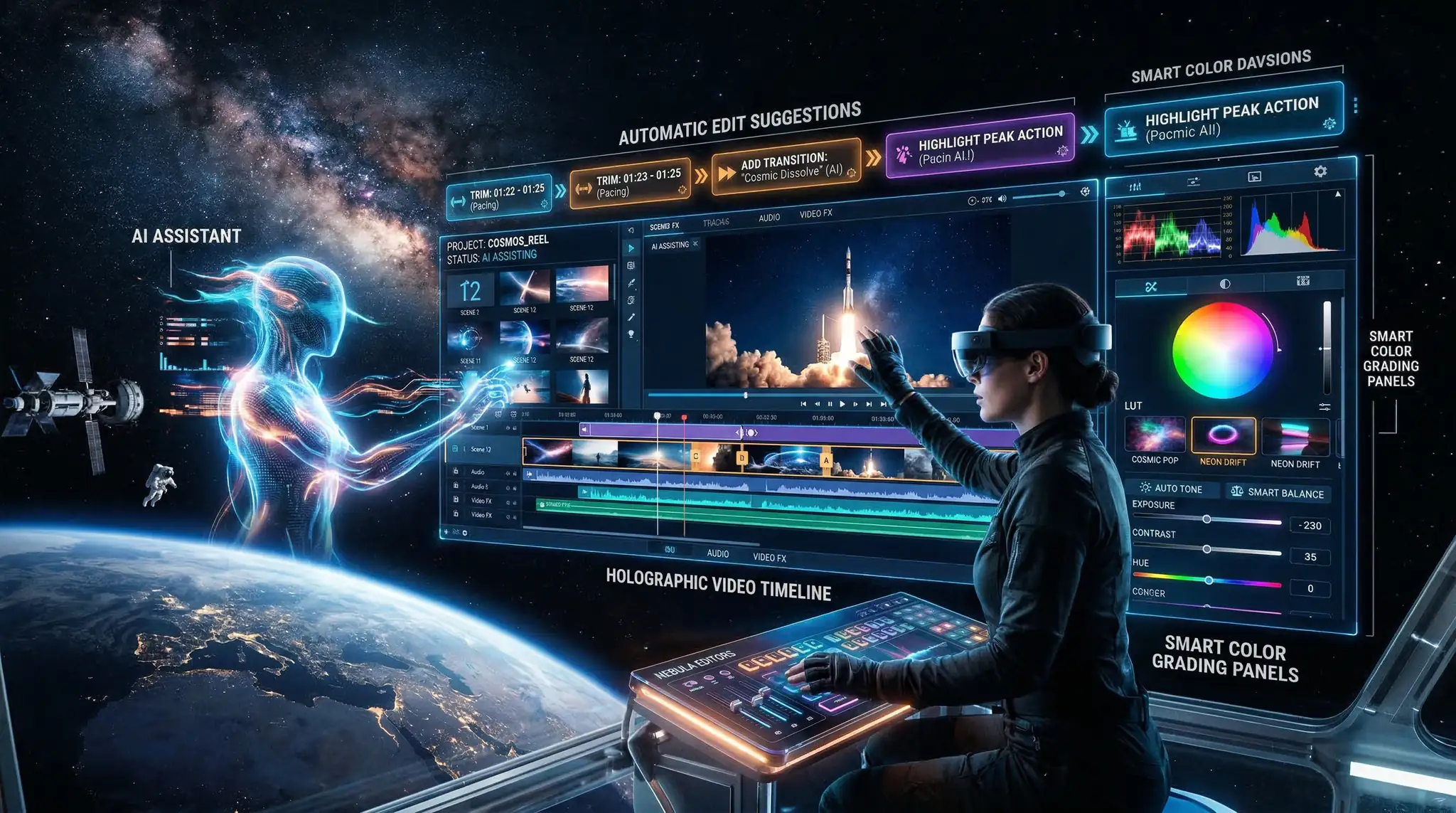
The ceiling is rising too. Professional editors who adopt AI tools become dramatically more productive. An editor who previously completed two projects per week might now complete five, because AI handles the tedious technical work while the editor focuses on creative decisions. This doesn’t eliminate editing jobs—it amplifies each editor’s output and value.
New roles are emerging. “AI content director”—a role that didn’t exist two years ago—now appears in job postings at major media companies. These positions require editorial judgment and creative sensibility combined with deep understanding of AI tool capabilities. Former editors are ideally positioned for these roles.
Volume is exploding. The demand for video content continues to grow faster than the supply of creators. AI tools are enabling content creation at scales that would be impossible with traditional workflows, but the creative direction and quality control for this content still requires human judgment.
What Video Editors Should Do Right Now
Rather than worrying about replacement, editors should focus on positioning themselves for the transformed landscape.
Master AI tools. Learn to use AI editing features in your current software and experiment with standalone AI tools. Understanding what AI can and cannot do well makes you more effective and more valuable.
Elevate your creative skills. Double down on storytelling, pacing, emotional resonance, and narrative structure. These are the skills that differentiate human editors from AI and that become more valuable as technical skills are automated.
Develop prompt engineering skills. As AI video generation becomes part of editorial workflows, the ability to write effective prompts that produce usable footage is becoming a core editorial skill. Understanding how to communicate with AI tools is the equivalent of understanding your editing software.
Embrace the director role. The editor’s role is evolving toward creative direction. Rather than spending hours on technical execution, you’ll spend your time making creative decisions and directing AI tools to implement them. This is a promotion, not a demotion.
Build client relationships. The human elements of professional editing—understanding client needs, managing revisions, providing creative consultation—become more important as technical execution is automated. Strong client relationships are AI-proof.
Industry Perspectives
The professional editing community’s response to AI has matured significantly. Early panic has given way to pragmatic adaptation. Major post-production houses report that AI has reduced project timelines by 30 to 50 percent without reducing headcount—editors are simply working on more projects and delivering higher-quality results.
Independent editors report mixed experiences. Some have lost clients who moved to fully automated AI workflows for simple content. Others have gained clients who need human judgment to manage increasingly complex AI-augmented production pipelines.
The consensus among experienced professionals is clear: the editors at risk are those doing purely technical work that follows predictable patterns. The editors thriving are those bringing creative vision, storytelling skill, and client partnership to their work.
Frequently Asked Questions
Will AI completely replace video editors?
No. AI will automate many technical aspects of video editing—rough cuts, color correction, audio cleanup, captioning—but the creative judgment, narrative sensibility, and client communication that define professional editing remain beyond AI capabilities. The role will transform rather than disappear.
Should I still pursue a career in video editing?
Yes, but with updated expectations. The future video editor is more creative director than technical operator. Focus on storytelling, emotional intelligence, and understanding AI tools alongside traditional editing skills.
What editing tasks is AI best at automating?
AI excels at repetitive, pattern-based tasks: assembling rough cuts from scripted footage, color matching across clips, audio noise removal, caption generation, and basic transitions. These tasks follow predictable rules that AI handles efficiently.
How can video editors adapt to AI tools?
Start by integrating AI features available in your current editing software. Experiment with AI video generation tools like Vidzy to understand what AI-generated footage can contribute to your projects. Focus on developing the creative and interpersonal skills that AI cannot replicate.
The Future Belongs to Augmented Creators
AI isn’t the enemy of video editors—it’s the most powerful tool they’ve ever been given. The creators who thrive will be those who harness AI capabilities to amplify their creative vision. Explore what’s possible with Vidzy and start building the skills that will define the next era of video creation.
James Okafor is a tech journalist covering the AI generation space. With bylines in TechCrunch and The Verge, he brings an analytical lens to AI model reviews, industry trends, and the evolving landscape of creative AI tools.
AI Video Quality Evolution: A Year That Rewrote the Playbook The AI video quality evolution between mid-2025 and recently is one of the most dramatic improvement arcs in the history of generative AI. In just twelve months, the technology went from producing clips that needed careful prompt engineering and cherry-picking to generating videos that regularly […]
AI Democratizing Content: Breaking Down the Barriers to Professional Creation AI democratizing content creation is the defining story of the creative economy today. For the first time in history, professional-quality video, images, and multimedia content can be produced by anyone with a smartphone and a creative idea. The equipment, expertise, and capital that once gatekept […]
AI Video Generation History: From Blurry Pixels to Cinematic Brilliance The story of AI video generation history reads like science fiction compressed into just four years. What began as stuttering, seconds-long clips of barely recognizable shapes in 2022 has evolved into a technology capable of producing photorealistic, minute-long cinematic sequences by recently. This transformation didn’t […]
James Okafor
7 min read
Your Next Video Is 30 Seconds Away
Download Vidzy free, pick a template, and create your first video right now.