



Why Flux Landscape Prompts Produce Stunning Nature Images
If you’ve ever tried to generate nature and landscape images with AI, you know the challenge: most outputs look flat, oversaturated, or unnervingly artificial. That changes when you master flux landscape prompts. Flux’s architecture excels at rendering natural scenes because it understands light, depth, and organic textures in ways that older models simply cannot match. The result is landscape photography that could pass for a National Geographic cover.
Whether you want to capture the golden hour glow of a mountain range, the quiet drama of a misty forest, or the raw power of coastal cliffs, the right prompt structure makes all the difference. In this guide, you’ll get ready-to-use prompts, advanced techniques for controlling atmosphere, and the specific vocabulary that unlocks Flux’s best landscape work.
Understanding What Makes Flux Landscape Prompts Different
Flux processes descriptive language with remarkable fidelity when it comes to natural environments. Unlike models that treat landscape keywords as generic scene-setters, Flux interprets geographic specificity, atmospheric conditions, and photographic parameters with precision. Saying “Dolomites at sunrise” produces a meaningfully different result from “mountain at sunrise” — the rock formations, the characteristic jagged peaks, and the warm Mediterranean light all come through.
The key principle is layered description. You build a Flux landscape prompt in layers: subject, environment, atmosphere, light, and camera. Each layer adds fidelity without creating contradictions that confuse the model.
Golden Hour & Sunrise Landscape Prompts
Golden hour is the holy grail of landscape photography, and Flux handles it beautifully when you provide the right cues. These flux landscape prompts are designed for professional results.
Prompt: “Panoramic landscape photograph of lavender fields in Provence, France, during golden hour. Warm amber and violet light washing across rows of purple flowers stretching to the horizon. A solitary stone farmhouse sits in the middle distance. Shot on Hasselblad X2D 100C, 45mm lens, f/8, deep focus. Soft golden rim light on flower tops, long shadows, wispy cirrus clouds catching pink and orange light.”
Prompt: “Sunrise over the Grand Teton mountain range reflected in the still waters of Jenny Lake. The sky transitions from deep indigo at the top to vivid coral and gold near the peaks. Morning mist hovers low over the lake surface. Shot on Phase One IQ4 150MP, 90mm lens, f/11. Mirror-perfect reflection, crystal-clear water, frost on shoreline grasses.”
Prompt: “Wide-angle landscape of rice terraces in Bali during early morning golden light. Emerald green paddies curve along the mountainside in cascading tiers. A farmer in a traditional conical hat walks along a narrow path between fields. Soft mist rising from the valleys below. Canon EOS R5, 16-35mm at 20mm, f/9, Fuji Velvia color profile.”
Moody & Atmospheric Landscape Prompts
Drama in landscape photography comes from weather and atmosphere. Flux is especially strong at rendering fog, storm light, and the kind of brooding skies that make viewers pause. Using the right flux landscape prompts makes all the difference in your output quality.
Prompt: “Dark and moody landscape photograph of the Scottish Highlands. A lone ancient castle ruin sits on a rocky outcrop surrounded by rolling heather-covered hills. Dramatic storm clouds break apart to reveal a single beam of sunlight illuminating the castle. Heavy rain visible in the background. Shot on Nikon Z9, 70-200mm at 135mm, f/5.6. Desaturated tones, deep shadows, cinematic color grading.”
Prompt: “Misty ancient redwood forest in Northern California. Towering sequoia trees disappear into thick fog above. Volumetric light rays pierce through the canopy creating god rays on the forest floor. Ferns and moss cover everything in deep emerald green. Wide-angle perspective looking upward. Shot on Sony A7R V, 14mm, f/4. Ethereal, mysterious atmosphere.”
Prompt: “Desolate Icelandic black sand beach at Reynisfjara during an approaching storm. Massive basalt columns rise from the sand. Enormous waves crash against sea stacks in the distance. The sky is a swirl of dark gray and deep purple clouds. Long exposure effect on the water creating a silky, ghostly texture. Fujifilm GFX100 II, 23mm, f/16, ND filter effect.”
Mountain & Alpine Landscape Prompts
Mountains test a model’s ability to render scale, geological detail, and extreme lighting conditions. These prompts leverage Flux’s strength with complex terrain. With these flux landscape prompts, you can achieve stunning results every time.
Prompt: “Epic aerial perspective of the Swiss Alps in winter. Snow-covered peaks extend in all directions under a perfectly clear cobalt blue sky. The Matterhorn stands prominent in the center frame. Deep valleys with frozen rivers visible far below. Crisp, ultra-sharp detail on rock faces and snow textures. Shot from helicopter, Phase One XT, 32mm, f/8. National Geographic quality.”
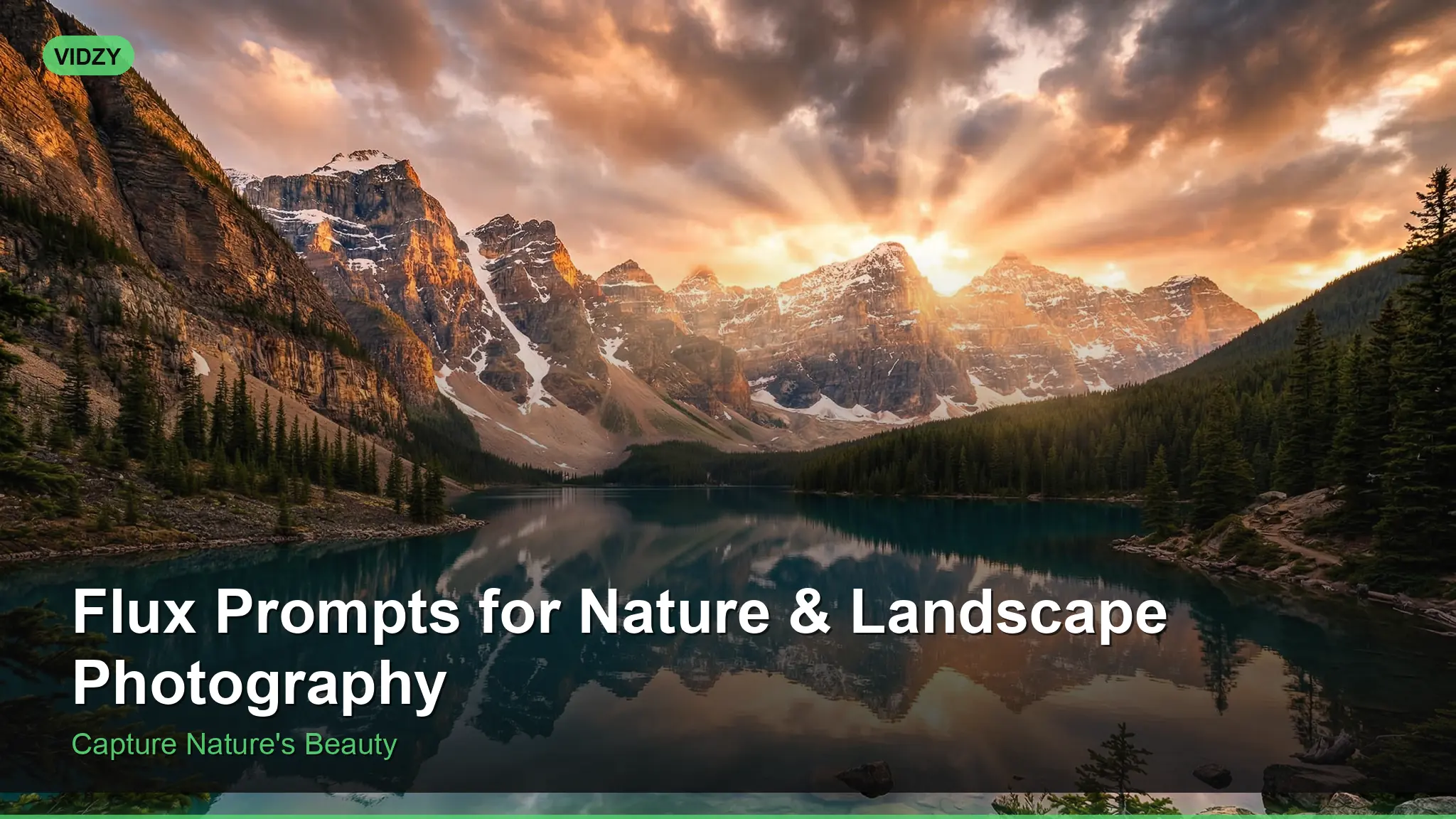
Prompt: “Autumn landscape in the Canadian Rockies. Larch trees in brilliant gold line the shores of Moraine Lake. The turquoise glacial water contrasts sharply with the warm autumn foliage. Snow-dusted peaks of the Valley of the Ten Peaks rise behind. Perfect reflection in the still morning water. Medium format film look, Mamiya 7 II, Kodak Portra 400.”
Coastal & Ocean Landscape Prompts
Water is notoriously difficult for AI to render convincingly, but Flux handles it with remarkable realism when you specify the right motion and texture cues.
Prompt: “Dramatic seascape of the Na Pali Coast, Kauai, at sunset. Towering emerald-green cliffs plunge into deep blue Pacific waters. Waves crash against the base of the cliffs sending white spray upward. The sky is ablaze with coral, magenta, and deep gold. Aerial perspective from a slight elevation. Shot on Hasselblad X2D, 90mm, f/7.1. Ultra-high resolution, vivid but natural colors.” Master flux landscape prompts to take your AI generation to the next level.
Prompt: “Long exposure photograph of a rocky Mediterranean coastline at blue hour. Smooth, milky water flows around dark volcanic rocks in the foreground. A distant lighthouse emits a warm amber glow. The sky transitions from deep navy to soft lavender near the horizon. Stars beginning to appear. Sony A7R V, 24mm, f/11, 30-second exposure effect.”
Desert & Arid Landscape Prompts
Desert environments showcase Flux’s ability to render subtle color variations and extreme textural detail.
Prompt: “Sweeping aerial photograph of the Namib Desert at sunrise. Towering red sand dunes cast long, deep shadows across the desert floor. The contrast between the sunlit dune ridges (vivid orange-red) and shadowed valleys (deep blue-black) creates a dramatic abstract pattern. A cluster of dead camel thorn trees at Deadvlei visible in one valley. Shot on DJI Mavic 3 Pro, Hasselblad lens, f/5.6.”
Prompt: “Night sky landscape over Monument Valley, Utah. The Milky Way arcs brilliantly across the sky above the iconic mitten buttes. Warm amber light from a distant campfire illuminates the base of one butte. Star trails visible in a long exposure. The desert floor glows faintly under starlight. Nikon Z8, 14mm, f/1.8, ISO 3200, tracked astro shot.” The best flux landscape prompts combine technical precision with creative vision.
Advanced Techniques for Better Flux Landscape Prompts
After testing hundreds of variations, these techniques consistently produce the most photorealistic landscape results:
Specify real camera systems. Flux responds strongly to camera and lens combinations. “Hasselblad X2D, 90mm” produces a distinctly different look from “iPhone 15 Pro, 24mm.” The medium format references tend to produce the most landscape-appropriate rendering with natural depth of field and color science.
Name real locations. Geographic specificity dramatically improves results. “Yosemite Valley” activates a much richer visual vocabulary than “mountain valley.” Flux has learned from millions of photographs of famous locations and can reproduce their characteristics accurately.
Describe light direction, not just time of day. Instead of just saying “sunset,” describe where the light falls: “low-angle sidelight from the west casting long shadows eastward.” This gives Flux precise rendering instructions. These flux landscape prompts are designed for professional results.
Include foreground interest. The best landscape photographs have strong foreground elements. Mentioning “wildflowers in the immediate foreground, sharp focus” or “smooth river rocks leading the eye toward the mountains” creates more compelling compositions.
Reference film stocks for color. “Fuji Velvia 50” produces saturated, punchy landscapes. “Kodak Portra 400” gives warmer, softer tones. “Kodak Ektar 100” delivers vivid but natural color. These references act as powerful color grading shortcuts.
Seasonal Landscape Prompts
Spring: “Japanese cherry blossom landscape along the Philosopher’s Path in Kyoto. Pink sakura petals falling gently onto a narrow canal. Stone lanterns line the walkway. Soft overcast light creating even, diffused illumination. Fujifilm X-T5, 56mm, f/2.8, shallow depth of field on foreground blossoms.”
Summer: “Vast sunflower field in Tuscany under a brilliant blue sky with puffy white cumulus clouds. A cypress-lined dirt road cuts through the field toward a distant hilltop villa. Intense midday Mediterranean light. Bright, warm, saturated colors. Leica Q3, 28mm, f/5.6.” Using the right flux landscape prompts makes all the difference in your output quality.
Autumn: “New England autumn landscape along a winding country road in Vermont. Sugar maples in peak fall color — brilliant orange, deep crimson, and golden yellow. A white church steeple rises above the tree line. Low afternoon sun creating warm backlight through translucent leaves. Nikon Z8, 85mm, f/4.”
Winter: “Frozen Lake Baikal in Siberia. Perfectly transparent ice revealing deep blue water beneath. Intricate frost patterns and air bubble formations trapped in the ice. Snow-covered mountains on the far shore under a pale winter sun. Extreme wide angle, low perspective on the ice surface. Sony A1, 12mm, f/8.”
FAQ About Flux Landscape Prompts
What resolution should I generate Flux landscape images at?
For landscapes, wider aspect ratios work best. Use 16:9 or 3:2 ratios to mimic traditional landscape photography framing. Flux handles high resolutions well, so generate at the maximum available size for the best detail in terrain and textures.
How do I avoid the “AI look” in landscape generations?
Three techniques help: specify real camera systems and lenses, reference actual film stocks for color science, and include subtle imperfections like “slight atmospheric haze” or “natural lens vignetting.” Perfect images look artificial — slight character adds realism.
Can I create panoramic landscapes with Flux?
Yes. Use terms like “panoramic format,” “ultra-wide aspect ratio,” and “stitched panorama look” in your prompt. Specifying a wide-angle lens (14-24mm range) reinforces the expansive feel. Generate at a wide aspect ratio for best results.
What’s the difference between Flux landscape prompts and Midjourney?
Flux tends to produce more photorealistic results with better adherence to camera-specific rendering. Midjourney often stylizes landscapes with artistic interpretation. For nature photography that looks indistinguishable from real photographs, Flux generally outperforms with the right prompt structure.
How do I control the mood of a landscape image?
Mood is controlled primarily through lighting and weather descriptions. For drama, use “storm light,” “brooding clouds,” and “desaturated palette.” For serenity, use “soft diffused light,” “still water,” and “pastel sky.” Always describe both the light quality and the emotional tone you want.
Start Creating Stunning Landscapes with Vidzy
These flux landscape prompts are designed to produce professional-quality nature photography straight from text. But prompts are just the beginning. With Vidzy, you can generate breathtaking landscape images and even photorealistic scenes with Flux directly from your phone. Combine these landscape prompts with prompt engineering best practices to push the quality even further.
Download Vidzy from the App Store and turn these prompts into gallery-worthy landscape art today.
![50 Best Nano Banana 2 Prompts for Stunning Images [2026]](https://getvidzy.com/wp-content/uploads/2026/03/nb2-featured-768x432.webp "50 Best Nano Banana 2 Prompts for Stunning Images [2026] 4")