AI Video Trends: Five Shifts That Will Reshape Content Creation
Predicting AI video trends requires looking beyond incremental quality improvements and examining the structural shifts that will fundamentally change how video content is conceived, produced, and consumed. The pace of advancement from 2024 through gives us a reliable trajectory, and the research papers, prototype demonstrations, and industry roadmaps published in the first half point clearly toward five specific trends that will define the next phase of AI video generation.
These aren’t speculative wishes. Each trend is grounded in technology that already exists in limited form, with clear development pathways toward mainstream availability within the next 12 to 18 months. Understanding these trends now gives creators, marketers, and filmmakers a strategic advantage in preparing for what comes next.
Trend 1: Real-Time Video Generation
The most transformative AI video trend is the emergence of real-time or near-real-time video generation. Current generation speeds—typically 30 seconds to several minutes per clip—create a workflow that’s fundamentally asynchronous: you write a prompt, wait, and then evaluate the result. Real-time generation will change this dynamic entirely.
Research from multiple AI labs has demonstrated diffusion models running at 15 to 30 frames per second on optimized hardware. While these demonstrations currently sacrifice some quality compared to slower generation, the trajectory of optimization techniques—including consistency distillation, speculative decoding, and hardware-specific model compilation—points toward production-quality real-time generation becoming available in the near future.
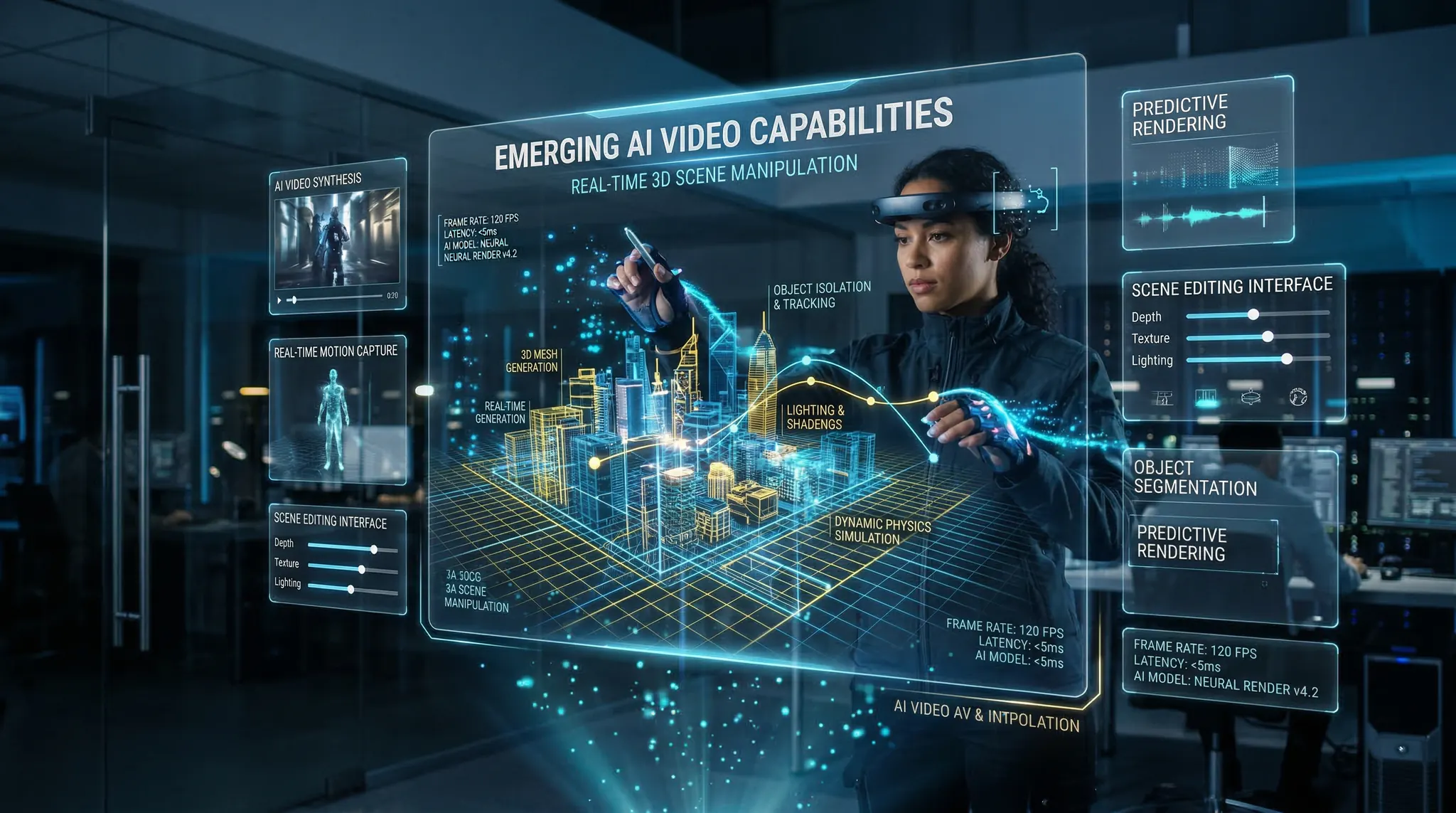
The implications are profound. Imagine directing a virtual scene in real time, adjusting camera angles, lighting, and character actions through natural language while watching the result update live. Pre-visualization for filmmakers becomes an interactive experience rather than a batch process. Live streaming with AI-generated visual elements becomes possible. Interactive storytelling experiences where viewers influence the visual narrative in real time become practical.
For creators, this means the feedback loop between creative intention and visual output shrinks from minutes to milliseconds. The iterative process of prompt, wait, evaluate, adjust that defines current AI video workflows will feel antiquated by comparison.
Trend 2: Multi-Shot Narrative Coherence
Current AI video generation operates on a shot-by-shot basis. Each clip is generated independently, and maintaining visual coherence across multiple shots—consistent characters, environments, lighting, and time-of-day—requires careful prompt engineering and often multiple attempts. In the near future, this limitation is expected to dissolve.
Next-generation models are being designed to accept scene-level or sequence-level descriptions rather than individual shot prompts. You’ll describe a sequence—”A woman enters a coffee shop, orders a drink, sits by the window, and opens her laptop”—and the model will generate a coherent series of shots covering the entire sequence, with consistent character appearance, set design, and cinematic continuity.
This capability builds on the character consistency breakthroughs and extends them to environmental and narrative consistency. The technical foundation involves extended context windows for video generation models, allowing them to “remember” and reference earlier generated frames when producing subsequent shots.
For filmmakers and content creators, this means AI video generation will move from a tool for creating individual clips to a tool for creating coherent scenes and sequences—a qualitative leap in creative utility.
Trend 3: Audio-Visual Co-Generation
Today, AI video generation produces silent clips. Sound design, dialogue, music, and ambient audio must be added separately through manual editing or additional AI audio tools. The landscape will see the emergence of unified audio-visual generation, where video and its accompanying soundtrack are generated simultaneously from a single prompt.
Several models demonstrated prototype audio-visual co-generation capabilities in late 2025 and early. The results were impressive but limited—ambient sounds and simple music could be generated alongside video, but dialogue and complex soundscapes remained separate processes.
In the near future, expect significant advances in synchronized generation. Environmental sounds matched to on-screen actions (footsteps on different surfaces, doors opening, water flowing), background music that responds to the visual mood, and possibly basic dialogue generation synchronized with character lip movements.
This convergence matters because sound is responsible for roughly half of a video’s emotional impact. When visual and audio generation happen together, the resulting content will feel significantly more complete and professional, reducing the post-production work required to turn generated clips into finished content.
Trend 4: Interactive and Conditional Video
The fourth trend bridges AI video generation with interactive media. Rather than generating fixed, linear video, models will be capable of generating branching narratives—video content that adapts based on viewer choices or contextual inputs.
This capability has obvious applications in gaming, where AI-generated cutscenes could adapt to player choices in real time. But the marketing applications are equally compelling: product demonstrations that adapt to the viewer’s specific interests, training videos that branch based on learner responses, and personalized video advertisements that adjust their visual content based on viewer demographics or preferences.
The technical foundation combines conditional generation (where the model receives both a prompt and contextual signals) with the real-time capabilities described in Trend 1. Early prototypes have demonstrated branching video experiences that maintain visual consistency across different narrative paths.
For creators, interactive video opens entirely new formats. Social media posts that respond to comments with generated visual content, stories with viewer-chosen endings, and educational content that adapts to individual learning paths all become feasible.
Trend 5: Creator-Controlled Style Models
The final major trend is the democratization of custom model training for individual creators. Currently, fine-tuning AI video models requires significant technical expertise and computational resources. In the near future, platforms will offer simple interfaces for creators to train personal style models—AI video generators that produce content matching their specific visual aesthetic.
Imagine feeding a video model 20 to 50 examples of your visual style—your color grading preferences, your preferred camera movements, your compositional tendencies—and receiving a personalized generator that produces new content indistinguishable from your existing work. This isn’t fine-tuning in the traditional sense; it’s more akin to teaching the model your creative fingerprint.
For brands, this means AI-generated content that perfectly matches brand guidelines without manual enforcement. For individual creators, it means scaling content production without diluting the visual identity that defines their work. For independent filmmakers, it means maintaining a consistent cinematic style across AI-generated sequences without spending hours on prompt engineering.
The business model implications are significant. Creators who develop distinctive visual styles will be able to monetize those styles as trainable models—creating a new form of creative IP where your aesthetic itself becomes a licensable product.
How These Trends Converge
The truly exciting aspect of these five AI video trends isn’t any individual advancement—it’s how they combine. Real-time generation plus multi-shot coherence means directing complete scenes live. Audio-visual co-generation plus interactive capabilities means immersive branching experiences with full soundscapes. Creator-controlled style models plus all of the above means personalized creative tools that produce content indistinguishable from hand-crafted work.
The compound effect of these trends will make AI video generation feel less like a standalone tool and more like a creative partner that understands your vision, responds to your direction, and produces content that feels authentically yours.
What Creators Should Do Now to Prepare
Build your prompt engineering skills. As models become more capable, the quality of your creative input becomes the primary differentiator. Creators who can articulate precise visual intentions will get dramatically better results from next-generation models.
Develop a distinctive visual style. When creator-controlled style models arrive, having a well-defined and documented visual aesthetic will let you create a personal AI tool immediately. Start curating examples of your preferred visual approach now.
Experiment with multi-shot workflows. Even with current tools, practicing the discipline of maintaining consistency across multiple generated clips prepares you for native multi-shot generation capabilities. Use tools like Vidzy to build this skill today.
Think in experiences, not just content. Interactive and real-time generation will reward creators who think beyond linear video. Start exploring branching narratives, viewer-responsive content, and interactive storytelling concepts.
Stay informed. The pace of change means that capabilities arriving in the near future will be announced and previewed throughout the second half . Following AI research labs, subscribing to industry analysis, and experimenting with beta features keeps you ahead of the curve.
Frequently Asked Questions
Will real-time AI video generation be available to consumers in the near future?
Cloud-based real-time generation is likely to be available through consumer platforms by late. Local real-time generation will require high-end hardware. Expect initial availability through API services and creative platforms before standalone consumer tools emerge.
How will AI video trends affect professional videographers?
Professional videographers who adapt their skills to incorporate AI tools will find their capabilities dramatically amplified. The trends point toward AI as a production multiplier rather than a replacement—professionals who understand both traditional cinematography and AI generation will be uniquely valuable.
What hardware will be needed AI video capabilities?
Cloud-based services will handle the computational demands for most users. For local generation, next-generation consumer GPUs (expected from NVIDIA and AMD in late and early) will be designed with AI inference workloads in mind, making local real-time generation feasible on high-end consumer hardware.
Are these predictions reliable, or just speculation?
Each trend is based on technology demonstrated in research or prototype form during 2025 and. The timeline for mainstream availability could shift by 6 to 12 months, but the directional trends are well-supported by current research trajectories and industry investment patterns.
The Future Is Closer Than You Think
The best preparation for tomorrow’s AI video capabilities is mastering today’s tools. Download Vidzy and start building the creative skills that will compound as these trends materialize—the creators who are fluent in AI video generation now will lead the next wave of content innovation.
James Okafor is a tech journalist covering the AI generation space. With bylines in TechCrunch and The Verge, he brings an analytical lens to AI model reviews, industry trends, and the evolving landscape of creative AI tools.
AI Content Copyright: What Every Creator Needs to Know today AI content copyright is the single most important legal topic facing digital creators today. As AI-generated images, videos, and text become indistinguishable from human-made content, the legal frameworks governing ownership, licensing, and commercial use are evolving rapidly—and not always in predictable directions. Whether you’re using […]
AI Video Accessibility: How Generative AI Is Making Content Inclusive AI video accessibility is transforming how content creators think about inclusive design. For the first time, the same AI tools that generate stunning visual content can also make that content accessible to people with disabilities—automatically, affordably, and at scale. Captions, audio descriptions, sign language overlays, […]
Open Source AI Models vs Closed Source: A Creator’s Decision Guide The debate over open source AI models versus closed source alternatives has moved from academic circles to practical relevance for every creator working with generative AI. Whether you’re generating images for social media, producing marketing assets, or exploring AI art as a creative medium, […]
James Okafor
8 min read
Your Next Video Is 30 Seconds Away
Download Vidzy free, pick a template, and create your first video right now.