


Why AI Black White Photography Prompts Demand a Different Approach
Black and white photography isn’t color photography with the saturation removed. It’s an entirely different visual language — one built on tonal range, contrast, texture, form, and the interplay of light and shadow. When you strip away color, everything that remains must work harder. Composition becomes more critical, texture becomes more visible, and emotional impact shifts to a rawer, more fundamental register. AI black white photography prompts need to account for this fundamental difference to produce images that feel intentionally monochrome rather than accidentally desaturated.
This guide provides prompts across every major black and white tradition — from high-contrast street photography to delicate fine-art nudes, from gritty photojournalism to ethereal long-exposure landscapes. You’ll learn the specific tonal and technical vocabulary that makes AI monochrome images genuinely compelling. These AI black white photography prompts are designed for professional results.
Understanding Tonal Language for Black and White Prompts
Color prompts rely on hue. Black and white prompts rely on tonal relationships. Learning to describe images in terms of tones rather than colors is the single most important skill for monochrome AI work. Using the right AI black white photography prompts makes all the difference in your output quality.
High key means predominantly bright tones — whites and light grays with minimal dark areas. It creates an airy, ethereal, or hopeful mood. Low key means predominantly dark tones — deep shadows with small areas of bright highlight. It creates drama, mystery, and intensity. Full tonal range means the image spans from pure black to pure white with smooth gradation between. Zone System references (Ansel Adams’ method of controlling tonal values) signal to the AI that you want precise, intentional tonality. With these AI black white photography prompts, you can achieve stunning results every time.
High-Contrast Street & Documentary Prompts
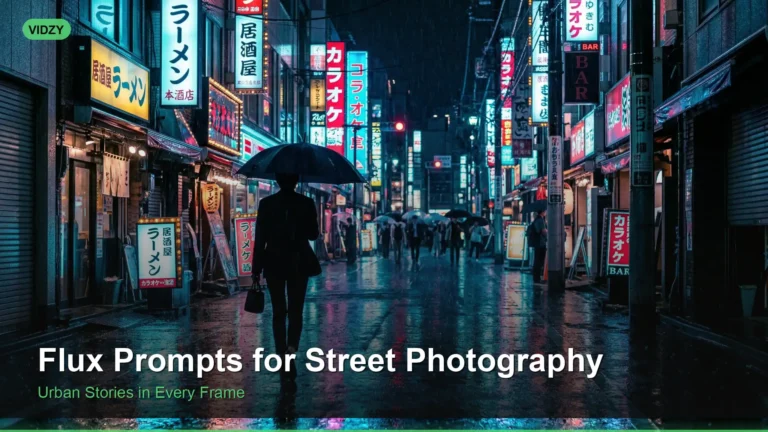
High-contrast black and white is the soul of street photography — bold, graphic, and immediate. Master AI black white photography prompts to take your AI generation to the next level.
Prompt: “High-contrast black and white street photograph. A man in a dark suit descends into a subway entrance, his figure a stark black silhouette against the bright white light emanating from the tunnel below. Strong geometric shadows from the railing create parallel diagonal lines across the steps. Deep blacks, bright whites, almost no mid-tones. Harsh midday sun creating extreme contrast. Shot on Leica M Monochrom with 35mm Summilux. Pushed Tri-X 400 grain visible. Unflinching, graphic, Daido Moriyama inspired.” The best AI black white photography prompts combine technical precision with creative vision.
Prompt: “Gritty black and white documentary photograph of a boxing gym. A fighter skipping rope in the center of a worn training ring, body glistening with sweat catching light from a single overhead bulb. Heavy bag and speed bag visible in the shadowy background. Concrete walls with peeling paint. Heavy grain, pushed film look. The light carves the fighter’s muscular definition against the dark gym interior. Shot on Nikon F3, 50mm f/1.4 wide open, Kodak Tri-X pushed to 1600. Raw, physical, honest.” These AI black white photography prompts are designed for professional results.
Prompt: “Black and white photograph of a rainy city intersection from above. Pedestrians with dark umbrellas create organic circular shapes against the wet, reflective pavement. Long shadows and bright reflections of unseen lights create a pattern of dark and light. The composition is almost abstract — the human figures reduced to geometric elements in a study of contrast and rhythm. Bird’s eye view from a high building. Smooth tones in the wet street, hard-edged umbrella shapes. Inspired by Andre Kertesz.” Using the right AI black white photography prompts makes all the difference in your output quality.
Fine Art Portrait Prompts in Black and White
Monochrome portraiture is all about light on skin, the geometry of the face, and emotional rawness that color can sometimes disguise. With these AI black white photography prompts, you can achieve stunning results every time.
Prompt: “Classic black and white studio portrait. An elderly man’s face photographed in Rembrandt lighting — a triangle of light on the shadowed cheek, one eye fully lit and the other in shadow. Deep wrinkles and weathered skin texture rendered in exquisite tonal detail. Silver-white stubble catching the light. Full tonal range from deep velvet blacks in the background to bright highlights on the brow and cheekbone. Large format camera quality — 4×5 film, Schneider 210mm lens, Ilford FP4+ developed in Rodinal for sharp acutance. Studio single-source lighting.” Master AI black white photography prompts to take your AI generation to the next level.
Prompt: “High-key black and white portrait of a dancer in motion. The figure draped in flowing white fabric that swirls around the body, captured mid-spin. Predominantly bright tones — soft white and pale gray with minimal shadows. The dancer’s form is sculpted by subtle tonal shifts rather than hard shadows. Clean white background merging with the fabric at the edges. Long exposure slight motion blur on the fabric extremities while the face remains sharp. Ethereal, weightless, dreamlike. Shot on Hasselblad 500C/M, 80mm Planar, Ilford Delta 100.” The best AI black white photography prompts combine technical precision with creative vision.
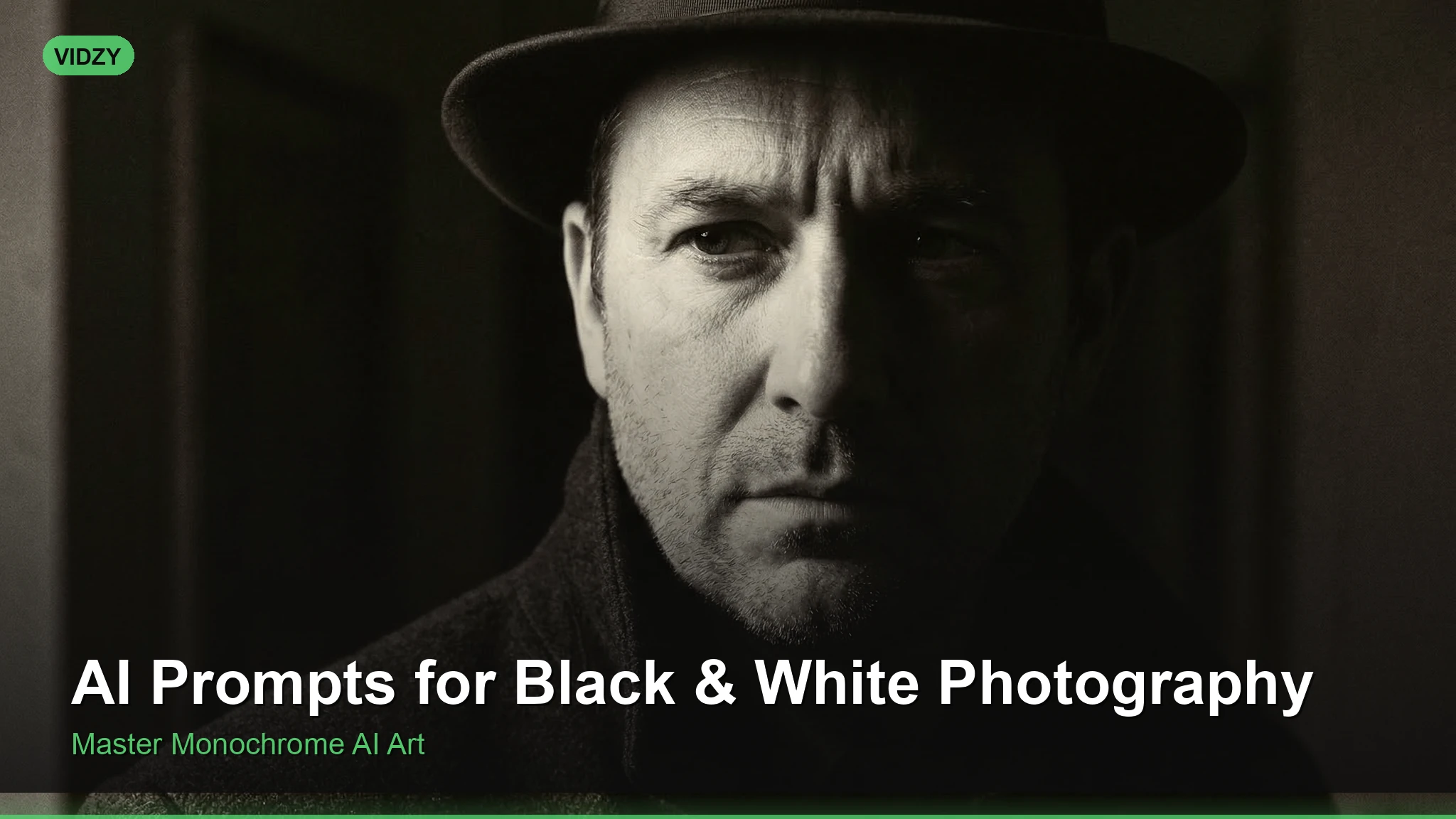
Prompt: “Dramatic low-key black and white portrait of a woman. Only half of her face visible, emerging from complete darkness. A single narrow beam of light illuminates one eye, the bridge of the nose, and part of the lip. Everything else falls into deep, rich black. The visible eye is sharp and intense, reflecting the single light source. Skin tones rendered as smooth, luminous mid-grays. Minimal but precise lighting — one focused spotlight with no fill. Platinum print quality with rich, deep blacks. Inspired by Bill Brandt.” These AI black white photography prompts are designed for professional results.
Landscape & Nature Black and White Prompts
Ansel Adams proved that black and white landscape photography could be as powerful as any color work. These prompts channel that tradition. Using the right AI black white photography prompts makes all the difference in your output quality.
Prompt: “Ansel Adams-style black and white landscape. Yosemite Valley from Tunnel View — El Capitan and Half Dome framing the valley. Dramatic cumulus clouds building above the peaks, rendered in full tonal range using the Zone System approach. Pure white snow on peaks (Zone IX), textured mid-gray granite walls (Zone V-VI), deep black shadows in the valley floor forests (Zone II-III). Sharp throughout from foreground to infinity using hyperfocal distance technique. Shot on 8×10 large format camera, f/64. Selenium-toned silver gelatin print quality.” With these AI black white photography prompts, you can achieve stunning results every time.
Prompt: “Minimalist long-exposure black and white seascape. A single wooden post stands in perfectly smooth, silky water rendered as a uniform pale gray by a very long exposure (several minutes). The horizon line bisects the image precisely. The sky is a smooth gradient from slightly darker at the top to lighter near the horizon. The post’s reflection creates a subtle vertical line in the water. Ultra-minimal — just post, water, sky. High-key tonality, serene and meditative. Shot with ND 10-stop filter. Inspired by Michael Kenna.” Master AI black white photography prompts to take your AI generation to the next level.
Prompt: “Black and white photograph of a lone tree in a snow-covered field. The tree is bare, its intricate branch structure forming a complex fractal pattern against a uniform bright gray sky. Fresh snowfall creates smooth, unbroken white ground. The tree’s shadow stretches long across the snow in mid-tones. Simple, stark, graphically powerful. The isolation of the tree conveys both vulnerability and resilience. Full tonal range with emphasis on the mid-to-high register. Medium format quality, Ilford Delta 100.” The best AI black white photography prompts combine technical precision with creative vision.
Architectural Black and White Prompts
Prompt: “Black and white architectural photograph of a brutalist concrete building. Massive geometric forms — cantilevered slabs, deep recesses, raw concrete surfaces with formwork patterns visible. The building photographed from a low angle making it loom against the sky. Hard shadows create strong geometric patterns on the concrete surfaces. Full tonal range with emphasis on the rich gray tones of raw concrete (béton brut). No people, no signage — pure architectural form. Shot on Mamiya RZ67, 50mm wide angle, Ilford HP5. Inspired by Lucien Hervé’s photographs of Le Corbusier buildings.” These AI black white photography prompts are designed for professional results.
Prompt: “Abstract black and white photograph of a modern building’s curved glass facade. The building’s surface reflects clouds and sky in distorted, flowing patterns. The curved glass creates abstract organic shapes from the rigid architecture. Strong contrast between the dark window frames (pure black) and the bright reflected sky (near white). The repetitive pattern of floors creates a rhythm that the reflections disrupt. Tight framing excluding the ground and sky — the building fills the entire frame as an abstract composition. Leica SL2-S, 90mm Summicron.” Using the right AI black white photography prompts makes all the difference in your output quality.
Film Noir & Cinematic Prompts
Prompt: “Film noir black and white photograph. A woman in a dark coat stands under a single streetlamp on an empty rain-wet street. The lamplight creates a cone of bright illumination around her while the rest of the scene falls into deep darkness. Her face is partially shadowed by a hat brim — only the chin, lips, and jawline caught in light. Venetian blind shadows from a nearby window stripe across the wet sidewalk. Cigarette smoke curls upward through the light beam. Heavy chiaroscuro, dramatic contrast. 1940s Hollywood cinematography aesthetic. Shot on 35mm film, high-contrast development.” With these AI black white photography prompts, you can achieve stunning results every time.
Prompt: “Cinematic black and white scene of a dimly lit jazz club interior. A spotlight illuminates a saxophone player on a small stage, everything beyond the light falling into smoky darkness. Audience members visible as silhouettes and half-lit faces at small round tables. Smoke creates visible light rays from the spot. The musician’s eyes are closed in concentration, fingers precisely positioned on the instrument’s keys. Deep, rich blacks dominate with selective bright highlights. Anamorphic lens quality with subtle horizontal flare. Film still quality, 35mm motion picture film grain.”
Tips for Compelling Black and White AI Photography
Think in zones, not colors. When composing a black and white prompt, mentally assign tonal values to your subject elements. What should be near-white? What should be mid-gray? What should be deep black? Describing these tonal assignments explicitly (“the skin rendered as luminous Zone VI, the background as Zone II”) produces dramatically better results.
Specify film stocks for grain and tonality. Each film stock has a distinct character: Kodak Tri-X 400 gives chunky, visible grain with rich mid-tones. Ilford Delta 100 produces fine grain with high acutance (edge sharpness). Fuji Neopan Acros has extremely fine grain with extended highlight range. Ilford HP5+ pushed to 1600 gives heavy, atmospheric grain. These references control the texture of the final image.
Describe light, not color. Replace color descriptions with light descriptions. Instead of “a red dress,” say “a dark-toned dress that contrasts against the bright background.” Instead of “blue sky,” say “the sky rendered as a smooth gradient from medium gray at the horizon to dark gray at the zenith.”
Reference specific monochrome photographers. Ansel Adams (precision, landscapes), Henri Cartier-Bresson (decisive moments, street), Sebastiao Salgado (documentary, human dignity), Helmut Newton (fashion, contrast), Fan Ho (geometric, light and shadow) — each name activates a distinct aesthetic approach.
Specify the print process. “Silver gelatin print,” “platinum/palladium print,” “carbon print” — each has a distinct tonal character. Silver gelatin is the standard, platinum prints have extended highlights and warm tones, carbon prints have the deepest blacks possible.
FAQ About AI Black and White Photography Prompts
Should I generate in color and convert to black and white?
No. Always specify black and white in the prompt itself. AI models trained on black and white photographs have learned the specific tonal relationships, contrast patterns, and compositional approaches that define great monochrome work. Converting a color generation loses this intentionality.
How do I control contrast in black and white prompts?
Use explicit terms: “high contrast” for graphic, punchy images; “low contrast” for soft, atmospheric results; “full tonal range” for images that span from pure black to pure white. You can also reference development techniques: “push processed for higher contrast” or “pulled development for lower contrast, extended tonal range.”
What makes a good subject for black and white?
Subjects with strong form, texture, and tonal contrast work best. Portraits with dramatic lighting, architecture with strong geometric shadows, landscapes with dramatic skies, and street scenes with hard light all excel in monochrome. Subjects that rely primarily on color impact (sunsets, flowers, food) generally work less well without color.
How do I get realistic film grain in AI black and white images?
Name specific film stocks: “Kodak Tri-X 400 grain” produces recognizable medium grain, “Ilford HP5 pushed to 3200” produces heavy, atmospheric grain, “Ilford Pan F 50” produces nearly grain-free results. Adding “shot in low light, high ISO” reinforces the grainy look. Including “visible film grain structure” as an explicit instruction also helps.
Which AI model produces better black and white results?
Flux generally produces more photorealistic monochrome images with better tonal accuracy and more convincing film grain simulation. Its strength with photographic parameters (specific lenses, film stocks, development processes) translates directly to better black and white work. DALL-E handles more artistic, illustrated monochrome styles effectively.
Master Monochrome with Vidzy
These AI black white photography prompts will help you create stunning monochrome images that carry the weight and artistry of traditional film photography. Vidzy makes it effortless — generate gallery-quality black and white photographs from your iPhone using Flux. Combine monochrome technique with our street photography prompts for the ultimate documentary style, or explore photorealistic Flux techniques for maximum realism.
Download Vidzy from the App Store and discover the timeless power of black and white.
![30 Best AI Portrait Prompts [Copy & Paste Ready]](https://getvidzy.com/wp-content/uploads/2026/03/post37-featured-768x432.webp "30 Best AI Portrait Prompts [Copy & Paste Ready] 2")