


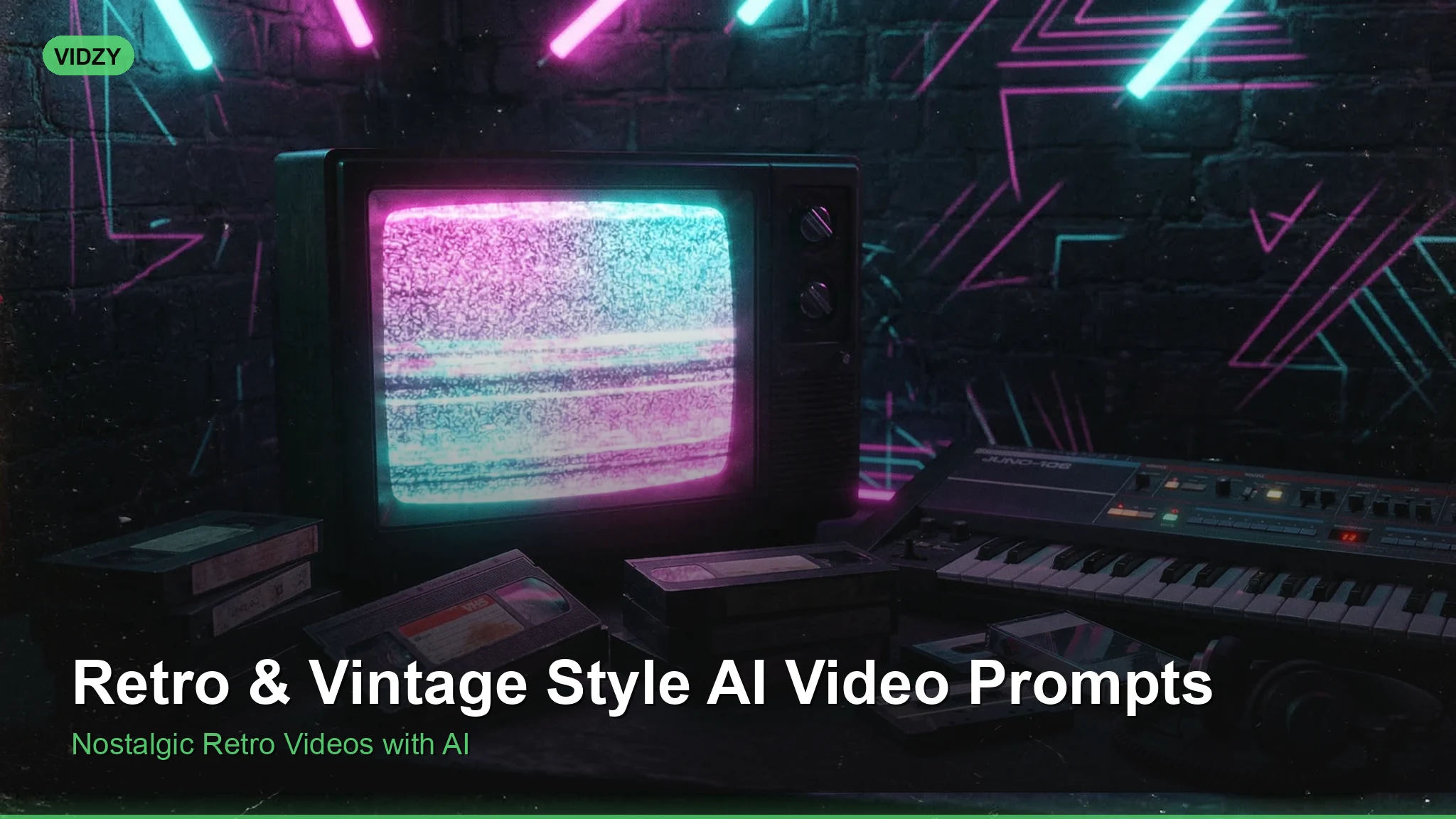
Transport Your Content Back in Time with Retro AI Video Prompts
There is something magnetic about vintage aesthetics. The warm grain of Super 8 film, the saturated glow of 1980s neon, the faded pastel palette of a 1970s Polaroid — these visual styles carry an emotional weight that modern digital footage often lacks. Retro AI video prompts allow creators to tap into that nostalgic power without hunting down vintage cameras, expired film stock, or analog editing equipment.
AI video generators have become remarkably skilled at replicating the technical characteristics of different film eras — the grain patterns, color shifts, aspect ratios, lens distortions, and lighting styles that define each decade. The secret is knowing which visual markers to describe in your prompts.
This comprehensive guide provides a library of retro AI video prompts organized by era and style, from silent film aesthetics to VHS tracking artifacts. Each prompt has been designed to trigger authentic period-specific visual qualities.
Understanding the Visual Language of Each Era
Different decades have distinct visual signatures. Before writing your prompts, understanding these characteristics will help you target the right look:
- 1920s-1940s: Black and white, high contrast, 4:3 aspect ratio, visible film scratches, slightly overcranked or undercranked frame rates, soft focus lenses
- 1950s-1960s: Technicolor saturation, rich reds and blues, anamorphic widescreen, bright studio lighting, painted backdrops
- 1970s: Warm amber tones, heavy film grain, soft contrast, zooms instead of dollies, natural and available light, earth-tone color palettes
- 1980s: Neon colors, hard lighting with colored gels, VHS scan lines, synthesizer-era aesthetic, chrome and glass reflections
- 1990s: Grunge desaturation, handheld camera shake, indie film grain, cool blue-green color grading, 16mm film texture
The AI Video Prompt Generator can help you layer these era-specific details into well-structured prompts.
Silent Film and Black & White Era Prompts
The earliest era of cinema has a distinctive look defined by high-contrast black and white photography, visible film artifacts, and exaggerated performance style.
A black and white silent film scene of a man in a bowler hat and suit walking down a busy city street in the 1920s. The footage has visible film grain, occasional vertical scratches, and slight frame flicker. The motion is slightly fast, as if projected at the wrong speed. Title cards appear between scenes in ornate art deco typography. 4:3 aspect ratio, high contrast, iris wipe transitions, piano accompaniment era aesthetic.
A German Expressionist-style scene in stark black and white. A figure in a long dark coat walks through a distorted cityscape with sharp angular shadows painted directly onto the walls and floor. The lighting is extreme — deep blacks and blown-out whites with almost no midtones. The camera tilts at a disorienting Dutch angle. Heavy film grain, 4:3 frame, 1920s avant-garde cinema aesthetic.
A film noir detective scene. A lone figure stands under a streetlight on a rain-slicked cobblestone street at night. The light creates a perfect cone of illumination surrounded by deep darkness. Smoke from a cigarette curls upward into the light beam. The camera is low, looking up at the figure. High contrast black and white, venetian blind shadow patterns, 1940s Hollywood noir, 35mm film texture.
Technicolor and Mid-Century Prompts
The Technicolor era of the 1950s and 1960s produced some of the most vivid, saturated imagery in cinema history. These prompts target that hyper-real, almost painterly color quality.
A 1950s suburban street in full Technicolor glory. Pastel-colored houses with manicured lawns line a tree-shaded avenue. A cherry-red convertible with chrome bumpers and whitewall tires cruises slowly past. A woman in a full skirt waves from a porch. The colors are deeply saturated — the grass is impossibly green, the sky is vivid blue, the car gleams like a jewel. Anamorphic widescreen, Hollywood studio lighting, classic American cinema aesthetic.
A Technicolor musical dance number filmed on a sound stage. A man in a tuxedo and a woman in a flowing emerald gown waltz across a polished marble floor under crystal chandeliers. The camera cranes upward slowly, revealing the full set — sweeping staircases, gold columns, and a painted sky backdrop. Rich saturated colors, sharp focus, perfect three-point lighting, 1950s MGM musical grandeur.
1970s Film Grain and Warm Tone Prompts
The 1970s brought a grittier, more naturalistic approach to filmmaking with heavy grain, warm color casts, and a preference for available light.
A 1970s street scene filmed on 35mm Kodak stock. A yellow taxi idles at a traffic light on a gritty New York City street. The image has heavy warm grain, slightly faded contrast, and a golden amber color cast. Neon signs reflect in puddles on the sidewalk. The camera is handheld with a subtle organic sway. Lens flares bloom from streetlights. 1970s American New Wave cinema aesthetic, raw and authentic.
A woman driving a wood-paneled station wagon along a California coastal highway at sunset in the 1970s. She wears oversized sunglasses and her hair blows in the wind through the open window. The dashboard is brown vinyl and analog gauges. The film has warm golden tones, visible grain, and soft lens focus. The ocean glows amber through the passenger window. 35mm film, wide angle from the passenger seat, easy rider road trip aesthetic.
A 1970s kitchen scene. Avocado-green appliances, orange floral wallpaper, and a Formica countertop. A woman pours coffee from a glass percolator while sunlight streams through yellow curtains, creating warm patches of light on the linoleum floor. The image has a soft, slightly overexposed quality with warm color shifts typical of aged Ektachrome film. Medium shot, natural light only, domestic realism.
1980s Neon and VHS Prompts
The 1980s aesthetic has experienced a massive resurgence in popular culture. These prompts target the era’s iconic visual elements — neon, chrome, synthesizers, and VHS artifacts.
An establishing shot of a 1980s city skyline at night, bathed in neon. Pink and blue neon signs reflect off wet streets and chrome-detailed cars. A DeLorean sits at a red light, its stainless steel body catching every color. The image has subtle VHS scan lines, slight color bleeding at the edges, and a warm magenta cast. Anamorphic widescreen, synthwave aesthetic, Blade Runner meets Miami Vice.
A VHS recording of a 1980s aerobics class. Women in colorful leotards, headbands, and leg warmers perform synchronized exercises in a gym with mirrored walls. The footage has visible VHS tracking lines, slight color distortion, and the date stamp reads “JAN 15 1986” in the corner. The image occasionally wobbles as if the tape is worn. 4:3 aspect ratio, fluorescent lighting, authentic home video quality.
A retro arcade in 1985, shot on VHS camcorder. Rows of glowing arcade cabinets cast colored light on the faces of teenage players. Pac-Man, Space Invaders, and Galaga screens flash in the background. The carpet is wild geometric patterns. The footage has typical camcorder qualities — auto-focus hunting, slight bloom on bright lights, visible scan lines. Handheld POV, warm tungsten color cast, VHS camcorder aesthetic.
To make sure your retro-styled videos look correct across all platforms, use the AI Video Size Guide — especially important when working with non-standard aspect ratios like 4:3.
1990s Indie Film and Grunge Prompts
The 1990s independent film movement brought a raw, desaturated, often handheld visual style that defined a generation of cinema.
A 1990s indie film scene in a diner at night. Two characters sit across from each other in a vinyl booth under harsh fluorescent lighting. Coffee cups and an ashtray on the table. The film stock is 16mm with visible heavy grain, slightly desaturated with a cool blue-green tint. The camera is handheld with subtle movement, shooting through the diner window from outside. Tarantino-era indie aesthetic, raw and conversational.
A grainy 1990s skate video. A skateboarder in baggy jeans and a band t-shirt performs a kickflip on a concrete ledge in an empty parking lot. The footage is shot on a consumer MiniDV camcorder — slightly soft focus, auto-exposure adjusting between the bright sky and shadowed ground. A fisheye lens distorts the edges. The color is desaturated with a slight yellow cast. Handheld follow cam, punk rock DIY aesthetic.
Super 8 and Home Movie Prompts
Super 8 home movie footage has a universally recognizable warmth and intimacy. These prompts capture that personal, familial quality.
A Super 8 home movie of a family barbecue in the backyard, circa 1972. Children run through a lawn sprinkler while adults tend a charcoal grill. The footage has the distinctive Super 8 look — warm oversaturated colors, heavy grain, slight overexposure in highlights, and occasional light leaks along the film edges. The motion is slightly uneven due to the hand-cranked camera. No sound, 4:3 aspect ratio, pure nostalgia.
Super 8 footage of a European vacation in the 1960s. A couple walks through the streets of Rome past the Colosseum. The woman turns to the camera and waves, slightly out of focus. The film has rich, warm Kodachrome color — saturated reds and blues with that unmistakable golden warmth. Light leaks flash orange at the film edges. The camera pans jerkily to follow them. Authentic amateur travel film aesthetic.
Tips for Authentic Retro AI Video Results
- Name the film stock. Specifying “Kodak Ektachrome,” “Kodachrome,” “Tri-X black and white,” or “Fujifilm” gives AI generators a concrete visual reference that produces more authentic color and grain characteristics.
- Describe artifacts explicitly. Film scratches, VHS tracking lines, light leaks, lens flare, color bleeding — these imperfections are what sell the vintage look. Include them in your prompt.
- Match aspect ratio to era. 4:3 for anything pre-1950s and home video, 2.39:1 anamorphic for epic cinema, 16:9 for 1990s-2000s. The wrong aspect ratio immediately breaks the illusion.
- Include era-appropriate props and fashion. Vintage aesthetics are not just about the film quality — they require period-accurate costumes, vehicles, technology, and set design. A modern smartphone in a 1970s scene destroys the illusion.
- Reference specific directors or films. “In the style of Stanley Kubrick” or “Wes Anderson color palette” provides strong aesthetic anchors that AI models understand well.
Frequently Asked Questions
Which era is easiest for AI to replicate?
The 1980s neon/synthwave aesthetic tends to produce the most consistently impressive results because its visual markers — bright neon, chrome reflections, saturated color — are dramatic and unambiguous. VHS artifacts are also well-understood by current AI models. Black and white film noir is another reliable style due to its high-contrast, graphic nature.
Can I mix eras in a single prompt?
Yes, and this can produce interesting creative results. “A 1920s silent film scene but with 1980s neon lighting” or “A Victorian-era setting filmed on VHS camcorder” creates deliberate anachronistic tension. However, be specific about which era elements you want from each period to avoid confusing the generator.
How do I maintain a consistent retro look across multiple clips?
Create a template prompt that includes your core visual style descriptors — film stock, color grading, grain level, aspect ratio — and reuse it across all prompts, changing only the subject and scene description. This acts as a visual style guide for your AI-generated series.
Are retro AI videos good for social media?
Extremely. Vintage aesthetics consistently perform well on Instagram, TikTok, and YouTube because they stand out from the polished digital content that dominates these platforms. The nostalgia factor also drives engagement — viewers are drawn to content that evokes emotional memories and cultural touchstones.
Make the Past Present
Retro AI video prompts unlock every era of visual history for modern creators. Whether you want the warmth of Super 8 home movies, the grit of 1970s New Hollywood, or the neon electricity of 1980s synthwave, a well-crafted prompt is your time machine.
Start experimenting with the prompts in this guide, customize them for your specific projects, and build a visual library that spans decades of cinematic style. For additional prompt ideas and instant structuring help, try the AI Hashtag Generator to find the perfect retro-themed tags for your content.
Every era has a look. Now every era is yours to create.
![Best AI Video Prompts for Instagram Reels [2026]](https://getvidzy.com/wp-content/uploads/2026/03/post19_featured-768x432.webp "Best AI Video Prompts for Instagram Reels [2026] 2")