

Nano Banana 2 vs Flux vs Midjourney: Which AI Image Generator Gives You the Best Results?
Choosing between AI image generators is no longer about finding one that works — they all work. The real question today is which tool gives you the best results for your specific use case. The nano banana vs flux prompts debate has intensified since Nano Banana 2 launched with impressive photorealistic capabilities, directly challenging Flux and Midjourney on their home turf.
Each of these three tools interprets prompts differently, excels in different areas, and struggles with different challenges. A prompt that produces a stunning image in Midjourney might give you mediocre results in Flux, and vice versa. Understanding these differences is not just academic — it directly impacts the quality of your output and how much time you spend iterating.
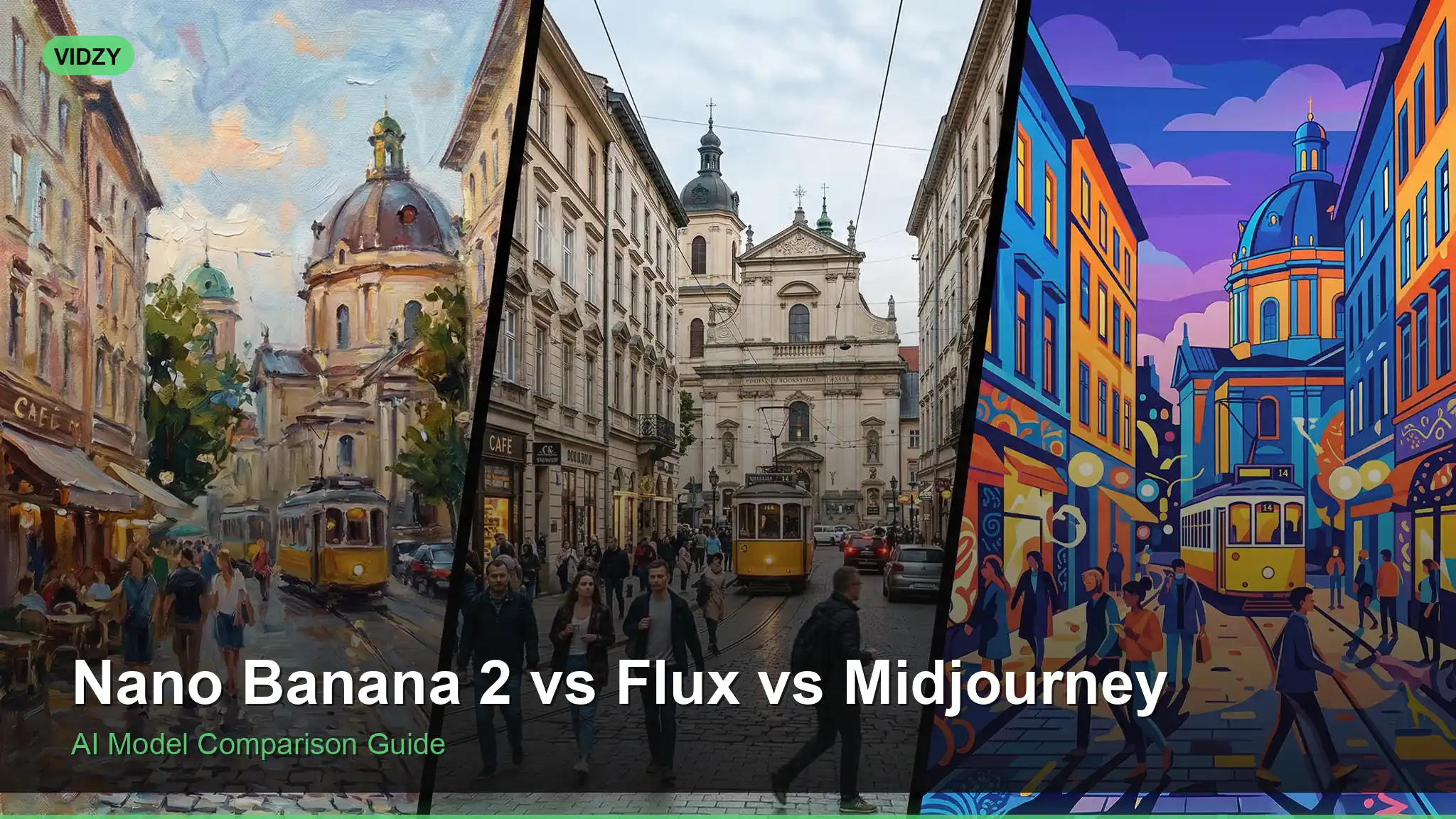
This guide puts all three head-to-head across the categories that matter most: photorealism, artistic styles, prompt adherence, text rendering, speed, and practical use cases. We tested identical prompts across all three platforms and share what we found.
Quick Overview: What Sets Each Tool Apart
Nano Banana 2 is the newest contender. It made waves with its ability to produce incredibly detailed photorealistic images and its strong understanding of complex multi-subject compositions. It runs fast, handles natural language well, and has particularly impressive skin texture and material rendering.
Flux (by Black Forest Labs) has been the go-to for photorealism and prompt accuracy. It follows instructions precisely, handles complex prompts without ignoring elements, and produces clean, commercially usable outputs. Its text-in-image rendering is among the best available.
Midjourney remains the artist’s choice. No other tool matches its aesthetic sensibility — the way it handles color, composition, and atmospheric quality. It tends to “beautify” prompts, adding artistic polish that makes outputs feel like finished works of art rather than literal interpretations.
Head-to-Head Comparison: Photorealism
We tested all three with identical photorealistic prompts to see how they handle the challenge of generating images indistinguishable from real photographs.
Test Prompt: “Photorealistic portrait of a middle-aged woman with silver hair, natural smile, soft window light from the left, shallow depth of field, shot on Canon EOS R5 with 85mm f/1.4, natural skin texture, editorial photography”
Nano Banana 2: Impressive skin rendering with natural pores and subtle color variation. Eye detail was exceptional — iris texture, catchlights, and subtle moisture all present. Hair rendering showed individual strands convincingly. The overall result was highly photorealistic with a slight tendency toward warm color temperature.
Flux: Extremely precise interpretation of the prompt. Lighting matched the specified window light setup accurately. Depth of field was natural and consistent. Skin texture was excellent, though slightly less detailed than Nano Banana 2’s output at extreme close inspection. The strongest adherence to the specific camera and lens characteristics.
Midjourney: Produced the most aesthetically pleasing result, but with a noticeable “Midjourney look” — slightly idealized features, smooth color transitions, and artistic color grading not specified in the prompt. Beautiful, but less photorealistic than the other two. Hair and fabric rendering were stunning.
Winner for photorealism: Nano Banana 2 edges out Flux for raw realism, but Flux wins for faithful prompt interpretation. Midjourney is third for pure photorealism but first for visual appeal.
Head-to-Head Comparison: Artistic and Stylized Images
Test Prompt: “Oil painting of a stormy seascape in the style of the Romantic era, dramatic crashing waves against dark cliffs, turbulent sky with breaks of golden light, visible thick brushstrokes, museum-quality fine art, dramatic and sublime”
Nano Banana 2: Good stylistic interpretation with recognizable oil painting characteristics. Brushstroke simulation was adequate but felt somewhat uniform — lacking the varied texture of real oil paint application. The composition was strong, with good use of dramatic lighting.
Flux: Accurate reproduction of oil painting texture with visible impasto effects. The color palette was historically appropriate, and the composition followed Romantic era conventions. Technically proficient but slightly lacking in the emotional “punch” that defines Romantic painting.
Midjourney: This is where Midjourney shines. The output felt like it could hang in a gallery. The brushwork variation was natural, the color harmonies were sophisticated, and the emotional atmosphere was exactly right. Midjourney understood “sublime” not just as a word but as an aesthetic concept.
Winner for artistic styles: Midjourney by a clear margin. Its artistic DNA produces outputs that feel genuinely crafted rather than simulated.
Head-to-Head Comparison: Prompt Adherence
This test measures how faithfully each tool follows specific, detailed instructions.
Test Prompt: “A red bicycle leaning against a yellow wall, a black cat sitting in the bicycle basket, morning sunlight casting a long shadow to the right, a small potted cactus on the ground next to the front wheel, blue sky visible above the wall, shot from a low angle”
Nano Banana 2: Included all specified elements. The bicycle was red, the wall was yellow, the cat was black and in the basket. Shadow direction was correct. The cactus was present and positioned correctly. The low angle was approximated but not as extreme as expected. Score: 9/10.
Flux: Perfect element inclusion and placement. Every specified detail was present and correctly positioned. The shadow direction matched the light source. The low angle perspective was accurately rendered. Flux demonstrated its reputation for prompt precision. Score: 10/10.
Midjourney: Most elements were present, but the cactus was placed slightly behind the bicycle rather than next to the front wheel. The “low angle” was interpreted as a slight downward tilt rather than a truly low perspective. The artistic quality was high, but prompt accuracy was the weakest of the three. Score: 7/10.
Winner for prompt adherence: Flux. It remains the most reliable tool for precise prompt following, which matters enormously for commercial and technical applications.
Head-to-Head Comparison: Text Rendering
Generating readable text within images is one of the hardest challenges for AI image generators.
Test Prompt: “A neon sign reading ‘OPEN LATE’ hanging in the window of a dimly lit bar, red neon glow, rain on the window glass, moody atmosphere”
Nano Banana 2: Text was legible and correctly spelled. The neon effect was convincing with appropriate glow and reflection. Minor inconsistency in letter thickness but overall very usable. The rain and mood were handled well.
Flux: Cleanest text rendering of the three. Letters were evenly spaced, correctly formed, and the neon effect included realistic tube shapes and gas glow. Text was perfectly legible and commercially usable without retouching.
Midjourney: Text was partially correct but showed the typical Midjourney text struggle — one letter was slightly malformed. The artistic quality of the overall scene was the best of the three, but the text itself needed correction in post-processing.
Winner for text rendering: Flux, followed closely by Nano Banana 2. Midjourney continues to struggle with text accuracy.
Prompt Style Differences: How to Optimize for Each Tool
Each tool responds best to different prompting styles. Here is how to adjust your approach.
Optimizing Prompts for Nano Banana 2
Nano Banana 2 responds well to natural, conversational language. You do not need as many technical keywords.
Nano Banana optimized: “A cozy cafe interior with morning light streaming through large windows, a steaming cup of coffee on a wooden table, an open book beside it, the atmosphere is warm and inviting, everything is in sharp detail with a slightly warm color palette”
It handles complex scenes with multiple subjects well. Specify spatial relationships clearly (“to the left of,” “behind,” “in the foreground”).
Optimizing Prompts for Flux
Flux rewards technical precision. Photography terminology, specific measurements, and structured prompts produce the best results.
Flux optimized: “Interior photography of a cafe, morning directional sunlight from left windows creating warm highlights and soft shadows, steaming latte in ceramic cup on reclaimed wood table, open hardcover book beside the cup, shot on 35mm f/1.8 lens, warm color temperature (5200K), shallow depth of field with sharp foreground, photorealistic, 8K detail”
Optimizing Prompts for Midjourney
Midjourney responds best to mood, emotion, and artistic references. Focus less on technical specs and more on feel.
Midjourney optimized: “A peaceful morning in a sunlit cafe, golden light painting everything in warmth, a forgotten coffee and open book on a worn wooden table, intimate and nostalgic atmosphere, like a scene from a European film, soft dreamy quality, warm earth tones –ar 3:2 –style raw”
Use our AI Prompt Generator to quickly create optimized prompts tailored for each platform.
Practical Recommendations by Use Case
Product photography and e-commerce: Flux or Nano Banana 2. Both produce clean, accurate, commercially viable images. Flux offers more control over exact specifications.
Social media content: Midjourney or Nano Banana 2. Midjourney’s aesthetic quality drives engagement. Nano Banana 2 offers a good balance of quality and speed.
Fine art and illustration: Midjourney. Its artistic sensibility is unmatched for creative and expressive work.
Technical and architectural visualization: Flux. Precision matters more than artistic interpretation for technical subjects.
Marketing materials with text: Flux. Reliable text rendering is non-negotiable for marketing assets.
Portrait photography: Nano Banana 2 for raw realism, Midjourney for flattering artistic portraits, Flux for consistent headshots.
Speed and Efficiency Comparison
Generation speed matters when you are producing content at scale.
Nano Banana 2: Fast generation times, typically 10-20 seconds per image. Efficient for batch production.
Flux: Moderate speed, typically 15-30 seconds depending on complexity. The precision makes up for slightly slower generation.
Midjourney: Variable speed through Discord interface. The v6 web interface has improved speed significantly. Typically 30-60 seconds including the upscaling step.
For high-volume content creation, Nano Banana 2 and Flux offer better throughput. Midjourney’s quality-per-generation often means fewer reruns, which can offset its slower speed.
Frequently Asked Questions
Can I use the same prompt across all three tools?
You can, but you will get better results by optimizing your prompt for each platform. Flux rewards technical photography terms, Midjourney responds to mood and artistic references, and Nano Banana 2 handles natural language well. A generic prompt will work across all three but won’t produce any tool’s best output.
Which tool is most cost-effective?
This depends on your volume and use case. All three offer subscription models with different generation limits. For most users, the tool that gives you usable results on the first or second attempt is the most cost-effective — fewer wasted generations means more value per dollar.
Is Nano Banana 2 really better than Flux for photorealism?
In our testing, Nano Banana 2 produces slightly more realistic skin textures and material rendering in portraits and product shots. However, Flux offers superior prompt adherence, meaning you get exactly what you asked for more consistently. “Better” depends on whether you prioritize raw realism or precise control.
Should I use multiple AI image generators?
Yes, if your workflow involves diverse content types. Many professional creators use Midjourney for creative and artistic work, Flux for commercial and text-heavy content, and Nano Banana 2 for photorealistic scenes. Specializing your tool choice by task produces the best overall results.
Which tool has the fastest learning curve?
Nano Banana 2 is the most forgiving for beginners because it interprets natural language well. Flux requires learning photography terminology for best results. Midjourney has its own parameter syntax (–ar, –style, –chaos) that takes time to master.
Choosing the Right Tool for Your Creative Vision
The nano banana vs flux prompts comparison ultimately comes down to what you are making and what matters most to you. There is no single “best” tool — only the best tool for a specific job.
If you demand photographic precision and exact prompt following, Flux is your workhorse. If you want the most beautiful, artistic outputs with minimal prompt engineering, Midjourney remains king. If you want cutting-edge photorealism with natural language convenience, Nano Banana 2 delivers.
The smartest approach is to learn the strengths of each and choose accordingly. Try the same prompt across all three, see which output matches your vision, and build your workflow around that tool for that category of work.
Explore more prompt inspiration and generate optimized prompts for any AI tool with our AI Prompt Generator, and maximize your content’s reach with the Hashtag Generator.
![Best Midjourney Prompts: Complete Collection [2026]](https://getvidzy.com/wp-content/uploads/2026/03/post59-featured-768x432.webp "Best Midjourney Prompts: Complete Collection [2026] 3")