

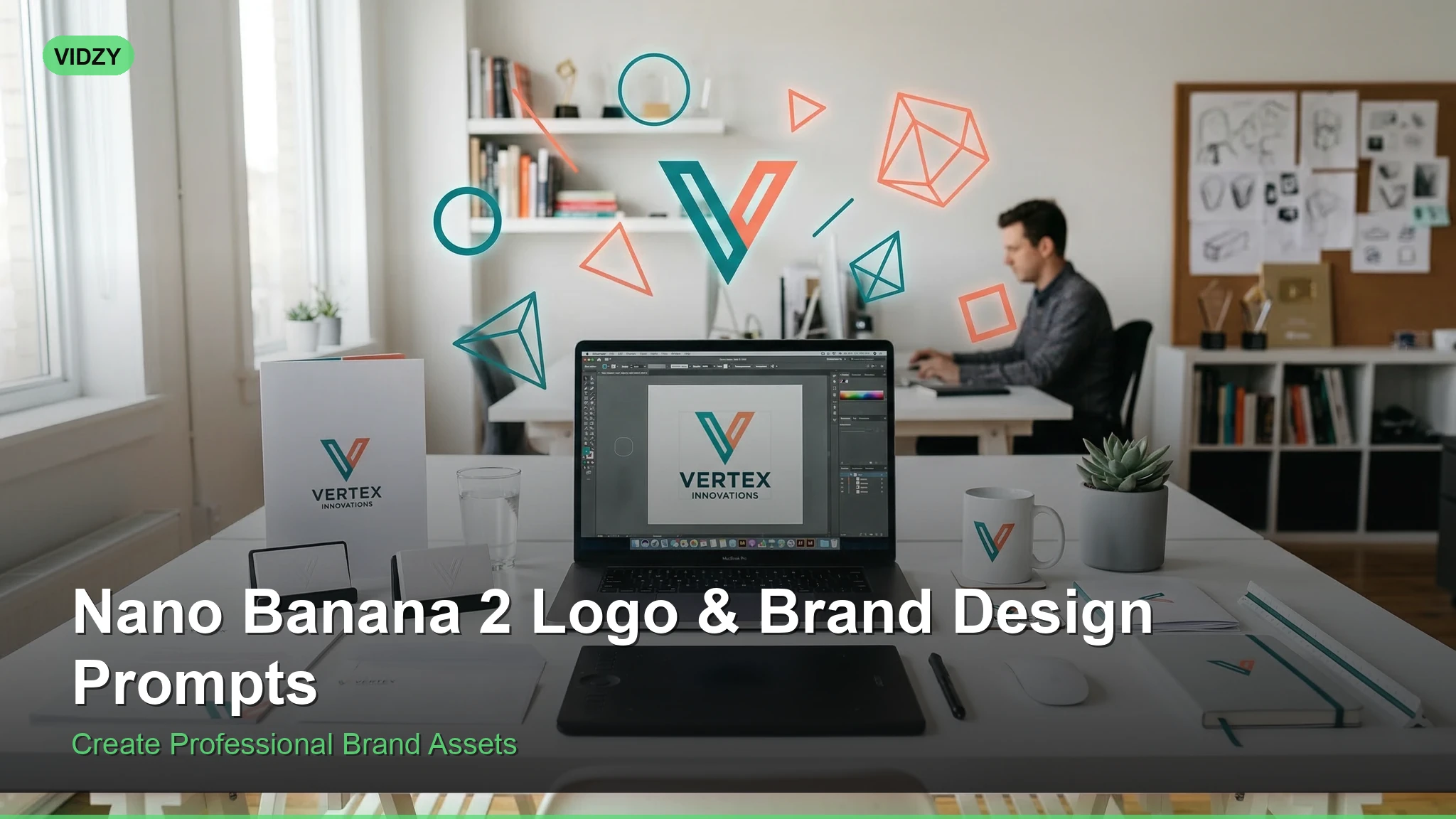
Create Professional Logo and Brand Designs with Nano Banana 2 Prompts
Logo design has always been one of the hardest challenges in AI image generation. Most models produce logos with garbled text, inconsistent geometry, and a distinctly “AI” look that no business would use. Nano Banana 2 changes the game — this specialized model from fal.ai excels at clean vector-style graphics, brand-appropriate imagery, and minimalist design compositions. With the right nano banana logo prompts, you can generate professional-quality logo concepts, brand identity elements, and design assets in seconds.
Whether you’re a startup founder prototyping brand identity, a designer looking for rapid concept exploration, or a freelancer creating client mood boards, this guide gives you the prompts and techniques to get real, usable results from Nano Banana 2.
Why Nano Banana 2 Excels at Logo Design
Nano Banana 2 was designed with a focus on clean lines, geometric precision, and design-aware composition. Unlike general-purpose image models that try to be good at everything, Nano Banana’s architecture handles the specific challenges of brand and logo design:
- Clean geometry — Circles are actually round. Lines are straight. Symmetry is maintained. This sounds basic, but most AI models struggle with geometric precision.
- Flat design understanding — The model understands the difference between a 3D-rendered logo and a flat vector logo, and can produce both accurately.
- Negative space awareness — Great logos use negative space cleverly, and Nano Banana handles this better than general-purpose models.
- Minimalist restraint — When you ask for “minimal,” you actually get minimal. Not “less detailed but still cluttered.”
That said, AI-generated logos are best used as starting concepts. You’ll want to refine your chosen design in Adobe Illustrator, Figma, or another vector tool before using it professionally. The AI gives you the creative direction; you (or your designer) refines the execution.
Essential Prompt Structure for Logo Prompts
Nano banana logo prompts work best when you follow a specific structure. Logo prompts differ from photograph prompts — you need to think like a graphic designer, not a photographer.
[Logo Type] + [Subject/Symbol] + [Style] + [Color Specification] + [Background] + [Design Principles]
Example:
Minimalist logo design for a mountain coffee brand, geometric mountain peak combined with a coffee cup silhouette, flat vector style, earth tone palette with deep brown and forest green, white background, clean lines, professional brand identity, scalable design
Key differences from photo prompts:
- No camera or lens references — these trigger photographic styles
- Always specify “white background” or “transparent background” for clean extraction
- Include “vector,” “flat design,” or “logo design” to keep the model in the right visual mode
- Name specific colors rather than relying on mood descriptions
Logo Prompts by Industry
Tech Startup Logo
Modern minimalist logo for a tech startup called “Nexus,” abstract interconnected nodes forming an N shape, gradient from electric blue to purple, flat design, clean geometry, silicon valley aesthetic, white background, professional brand mark, suitable for app icon
Restaurant and Food Brand
Elegant logo for an Italian restaurant, stylized fork and wheat stalk forming a circular emblem, warm gold and deep burgundy color palette, classic serif typography feel, slightly vintage but refined, white background, fine dining brand identity, clean vector illustration
Fitness and Wellness
Dynamic logo for a fitness brand, abstract human figure in motion forming a forward-leaning arrow shape, bold orange and charcoal black, modern sans-serif energy, flat design with subtle gradient, athletic and powerful, white background, sports brand identity
Eco-Friendly / Sustainability
Organic natural logo for a sustainability brand, leaf integrated into a circular recycling-inspired shape, sage green and earth brown palette, hand-drawn organic feel with clean execution, eco-friendly design, minimalist, white background, environmental brand identity
Finance and Consulting
Professional logo for a financial advisory firm, abstract shield or pillar shape conveying trust and stability, navy blue and silver color scheme, geometric and precise, corporate brand identity, timeless design, no gradients, flat solid colors, white background
Creative Agency
Playful yet professional logo for a creative design agency, overlapping geometric shapes in vibrant primary colors (red, yellow, blue) creating secondary colors where they overlap, Bauhaus inspired, modern and bold, flat design, white background, artistic brand mark
Brand Identity Element Prompts
Logos are just one piece of brand identity. Nano Banana 2 can also generate supporting brand elements.
Brand Pattern
Seamless repeating pattern for a luxury brand, geometric art deco inspired motif in gold lines on navy background, elegant and sophisticated, tileable pattern design, fashion brand textile print, clean vector geometry, consistent line weight throughout
App Icon
iOS app icon design, rounded square format, gradient background from coral pink to warm orange, centered white geometric camera symbol, clean flat design, modern and approachable, suitable for App Store listing, single color iconography on vivid background
Social Media Brand Avatar
Circular brand avatar for social media, bold single letter “V” centered on a gradient background from teal to emerald green, modern geometric sans-serif style, clean and recognizable at small sizes, brand identity design, flat minimal, professional
Business Card Layout Concept
Minimalist business card design layout, horizontal orientation, white background with small geometric logo mark in top left corner in navy blue, clean typography placeholder lines, subtle gold foil accent line along bottom edge, luxury professional stationery design, print-ready aesthetic
Related: prompt engineering guide
Color Strategy for Logo Prompts
Color choices make or break a logo. Here are proven color combinations to specify in your prompts:
- Trust and corporate: Navy blue + white, or dark blue + silver
- Energy and youth: Electric blue + bright orange, or magenta + yellow
- Luxury and premium: Black + gold, or deep purple + gold
- Nature and wellness: Sage green + cream, or forest green + earth brown
- Creativity and innovation: Vibrant purple + teal, or coral + deep blue
- Warmth and community: Warm orange + deep red, or terracotta + cream
Always specify colors explicitly. “Professional colors” is vague; “navy blue #1B2A4A and warm gold #D4A853” gives the model a precise target.
Advanced Logo Prompt Techniques
Use negative space descriptions. The best logos use negative space cleverly — think the FedEx arrow or the Spartan Golf Club logo. Include “clever use of negative space” and describe specifically what shape should appear in the negative space.
Logo design featuring a bear head silhouette where the negative space between the ears forms a mountain peak, single color black on white background, wildlife adventure brand, clever double-meaning logo, minimalist vector design
Specify logo types by name. The design world has specific names for different logo formats:
- Wordmark — Text-only logo (like Google, Coca-Cola)
- Lettermark — Initials only (like IBM, HBO)
- Brand mark / Pictorial — Symbol only (like Apple, Twitter)
- Combination mark — Symbol + text (like Adidas, Burger King)
- Emblem — Text inside a symbol (like Starbucks, Harley-Davidson)
Using these terms helps Nano Banana understand exactly what type of logo to generate.
Reference design movements. “Bauhaus inspired,” “Swiss design,” “Art Deco,” “Memphis Group style,” and “Japanese minimalism” are all powerful style anchors that the model understands well.
From AI Concept to Final Logo
Here’s the recommended workflow for using AI-generated logos professionally:
- Generate 20-30 variations using different prompts and slight modifications.
- Select 3-5 favorites that capture the direction you want.
- Recreate in vector using Adobe Illustrator or Figma. Trace the AI output manually — don’t auto-trace, as you’ll lose the clean geometry.
- Refine and test at different sizes, on different backgrounds, and in monochrome.
- Build the brand system — Define your colors in exact hex values, choose complementary typefaces, and create usage guidelines.
For rapid concept generation, you can use Vidzy’s AI image generator to produce multiple logo concepts quickly, then bring your favorites into a vector editor for professional refinement.
Frequently Asked Questions
Can I use AI-generated logos for my business?
You can use AI-generated logos as concepts and starting points. However, for a professional brand, you should always recreate the design in vector format (SVG/AI) for scalability and trademark registration. Most intellectual property attorneys recommend having a human designer refine the AI concept to ensure it’s sufficiently original for trademark purposes.
How do I get text in my logo that actually looks good?
Current AI models, including Nano Banana 2, still struggle with text rendering. The best approach is to generate the logo symbol or mark using AI, then add your brand name separately in a vector editor using a properly licensed typeface. Never rely on AI to generate readable typography.
What makes Nano Banana 2 better for logos than Midjourney or Flux?
Nano Banana 2’s architecture is optimized for design-oriented outputs. It handles geometric precision, flat color fills, and minimalist composition more consistently than general-purpose models. While Midjourney produces beautiful artistic imagery, it tends to add artistic embellishments and textures that are unwanted in logo design.
How many variations should I generate before picking a direction?
Generate at least 20-30 variations with different prompts, symbols, and color schemes. Logo design is inherently iterative — even professional designers produce dozens of concepts before narrowing down. The speed of AI generation means you can explore more directions in minutes than a designer might in days.
Start Designing Your Brand Identity
Nano banana logo prompts open up brand design to anyone with a clear vision and the patience to iterate. The key is specificity — tell the model exactly what type of logo, what colors, what style movement, and what industry you’re designing for. Vague prompts produce vague results.
Take the industry-specific prompts from this guide, swap in your own brand concept, and start generating. Remember: the AI is your concept artist, not your final designer. Use it to explore directions rapidly, then invest in proper vector refinement for anything you plan to use professionally.
Need help structuring your design prompts? Vidzy’s AI Prompt Generator helps you build detailed, structured prompts optimized for design-focused models like Nano Banana 2. Learn more about logo design principles to further sharpen your creative direction.