


Master Flux Food Photography Prompts for Mouthwatering AI Images
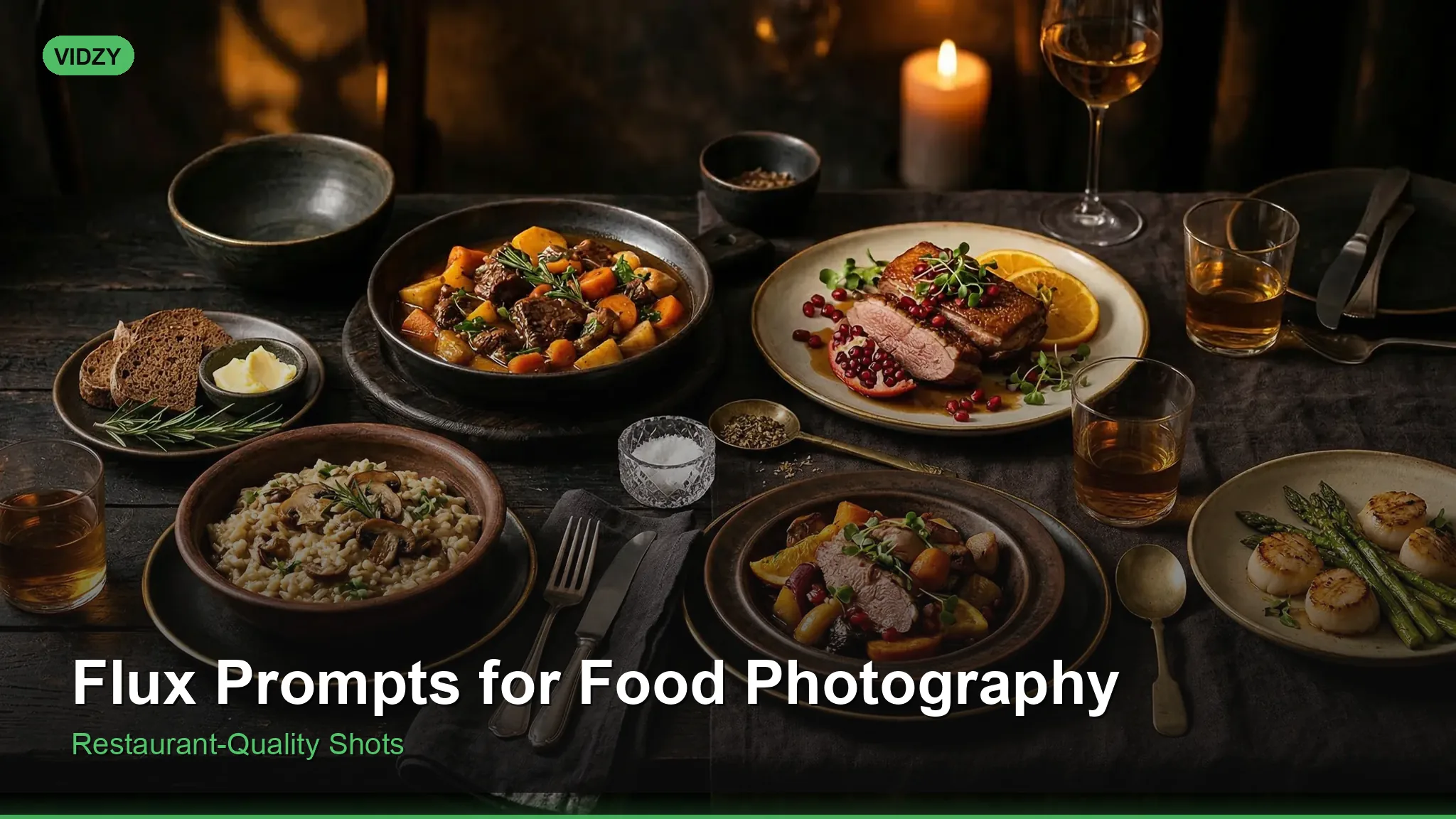
Great food photography makes you hungry just looking at it. The colors pop, the textures feel tangible, and the composition draws your eye straight to the hero dish. Achieving this with a camera requires expensive equipment, careful lighting setups, and often a professional food stylist. With flux food photography prompts, you can generate stunning food images that rival professional shoots — no studio required.
Flux has become the go-to AI image generator for food photography because of its exceptional handling of textures, lighting, and color accuracy. Where other AI models might make food look plastic or uncanny, Flux renders the glistening surface of a glazed donut, the steam rising from a bowl of ramen, or the crumbly layers of a croissant with remarkable realism.
This guide covers everything from basic food photography prompts to advanced techniques for specific cuisines, styles, and commercial applications.
Fundamentals of Flux Food Photography Prompts
Food photography follows specific conventions that your prompts need to respect. Understanding these fundamentals will dramatically improve your results.
Lighting is king: In food photography, lighting determines whether food looks appetizing or unappetizing. Natural side lighting — light coming from a window to one side — is the classic food photography look. Specify “natural side lighting from left” or “soft directional window light” in every prompt.
Angle matters: Different foods look best from different angles. Flat foods like pizza and cookies look best from directly overhead (flat lay). Tall foods like burgers and layered cakes look best from a 45-degree or straight-on angle. Drinks and bowls often work at a 30-degree angle.
Color temperature: Warm tones make food look more appetizing. Cool, blue-tinted light makes food look clinical and unappetizing. Unless you are going for a specific artistic effect, keep your prompts warm.
Props and surfaces: The background and surrounding elements set the mood. Rustic wooden boards, marble counters, linen napkins, and ceramic plates all communicate different price points and dining experiences.
Essential Flux Prompts for Classic Food Photography
These foundational prompts work across cuisines and food types. They deliver the kind of images you see in food magazines and restaurant websites.
Prompt: “Professional food photography of [dish], shot on a weathered oak table surface, natural side lighting from a large window on the left, shallow depth of field with background softly blurred, warm color temperature, fresh herbs scattered beside the plate, ceramic plate with subtle texture, editorial food magazine style, Canon EOS R5 with 50mm f/1.4 lens”
Prompt: “Overhead flat lay food photography of [dish] on a dark slate surface, arranged with complementary ingredients and vintage utensils, soft diffused natural light from above, rich and moody color palette, food styling with deliberate negative space, Bon Appetit magazine aesthetic”
Prompt: “Close-up detail shot of [dish], extreme shallow depth of field, focus on texture and surface detail, warm backlight creating a glow around the edges, steam or heat haze visible, macro food photography, appetizing warm tones, shot at f/2.8”
Replace “[dish]” with detailed descriptions. Not just “pasta” but “handmade pappardelle with slow-braised beef ragu, shaved Parmigiano-Reggiano, and fresh basil leaves.”
Flux Prompts by Cuisine Type
Different cuisines have distinct visual identities. These cuisine-specific prompts capture the aesthetic conventions that make each type of food photography feel authentic.
Japanese and Asian Cuisine
Prompt: “Food photography of a perfectly arranged sushi platter on a dark lacquered wooden board, wasabi and pickled ginger as accents, Japanese ceramic dishes in the background, soft natural lighting, clean minimalist composition, negative space on right, authentic Japanese restaurant atmosphere, warm undertones”
Prompt: “Steaming bowl of tonkotsu ramen, rich milky broth with chashu pork, soft-boiled egg cut in half showing jammy yolk, green onions and nori, shot at 30-degree angle on a dark counter, steam rising naturally, moody restaurant lighting with warm highlights, Fujifilm film simulation aesthetic”
Italian and Mediterranean
Prompt: “Rustic Italian food photography, freshly made margherita pizza on a wooden peel, charred crust with bubbles visible, fresh mozzarella and basil, dusting of flour on surface, warm tuscan kitchen background slightly blurred, golden hour window light, Mediterranean warmth and abundance”
Prompt: “Mediterranean mezze spread photographed from above, hummus with olive oil drizzle and paprika, tabbouleh, stuffed grape leaves, warm pita bread, colorful vegetables, terracotta and ceramic plates, linen tablecloth, outdoor dining terrace ambiance, bright natural light”
Bakery and Pastry
Prompt: “Artisan bakery photography of freshly baked sourdough bread, cross-section showing open crumb structure, flour-dusted crust, rustic wooden cutting board, linen cloth, morning window light, warm golden tones, professional bakery photography for cookbook, shallow depth of field”
Prompt: “French pastry photography, row of colorful macarons in pastel shades arranged on a marble surface, soft even lighting, clean and elegant composition, patisserie aesthetic, each macaron with perfect smooth shells and ruffled feet, slight overhead angle”
Beverages and Cocktails
Prompt: “Cocktail photography of a craft gin and tonic in a crystal copa glass, botanical garnishes of rosemary and grapefruit, ice cubes with visible clarity, condensation on glass surface, dark moody bar background with bokeh lights, dramatic side lighting, elegant and sophisticated mood”
Prompt: “Specialty coffee photography, latte art in a ceramic cup on a wooden counter, steam curling upward, coffee beans scattered nearby, warm morning light from side window, cozy cafe atmosphere, shallow depth of field, warm tones with slight desaturation”
Advanced Flux Food Photography Techniques
Take your food images from good to exceptional with these advanced prompting strategies.
The hero and supporting cast approach: Identify one element as the hero (sharpest focus, brightest lighting, center-ish placement) and describe supporting elements as secondary. This creates natural visual hierarchy.
Prompt: “Food photography composition with a single slice of layered chocolate cake as the hero subject in sharp focus at center-right, whole cake blurred in background left, chocolate sauce drizzle caught mid-pour, scattered cocoa powder, dark moody lighting with a single warm spotlight on the hero slice”
Motion and action: Adding movement makes food images feel alive — a drizzle of honey, a pour of cream, a sprinkle of spices.
Prompt: “Action food photography, golden honey being drizzled from a wooden dipper onto a stack of fluffy pancakes, honey mid-stream caught in motion, fresh berries and butter on top, warm morning kitchen light, slightly backlit to make honey glow, high shutter speed freeze frame”
Seasonal and thematic styling: Context sells. Match your food styling to seasons, holidays, or specific dining occasions.
Prompt: “Autumn harvest food photography, pumpkin soup in a rustic ceramic bowl, swirl of cream on top, surrounded by small pumpkins, cinnamon sticks, autumn leaves on a reclaimed wood table, warm amber window light, cozy fall atmosphere, Thanksgiving dinner aesthetic”
Commercial Food Photography Prompts
If you are creating images for menus, food delivery apps, or advertising, these prompts focus on commercial viability.
Prompt: “Commercial food photography for restaurant menu, gourmet burger with brioche bun, smashed patty, melted aged cheddar, caramelized onions, special sauce, fresh lettuce, on branded parchment paper, clean background suitable for menu design, even professional lighting, appetizing and craveable”
Prompt: “Food delivery app product photography, [dish] in eco-friendly takeout container, clean white background, overhead angle, even soft lighting, no harsh shadows, clearly shows portion size and ingredients, optimized for small thumbnail display, bright and appetizing colors”
For commercial food images destined for social media, pair them with the right captions. Our AI Prompt Generator helps you craft compelling descriptions to accompany your food photography across platforms.
Styling Tips That Improve Every Food Prompt
These prompt additions consistently improve food photography results in Flux:
Add “slightly imperfect, natural food styling” to avoid the overly perfect, fake look that screams “AI-generated.”
Include “visible texture” when describing bread crusts, meat surfaces, or vegetable skin — texture is what makes food photos feel real.
Specify your plate and surface materials. “Handmade stoneware plate” reads very differently from “white porcelain plate” or “black slate serving board.”
Mention “complementary garnish” or specific fresh herbs — a sprig of thyme, a few microgreens, a scatter of flaky sea salt — to add that finishing touch that professional food stylists always include.
Always describe the food with appetite-triggering words: “golden-brown crust,” “caramelized edges,” “jammy yolk,” “crispy,” “tender,” “flaky,” “glistening.”
Frequently Asked Questions
Why does Flux work better for food photography than other AI tools?
Flux excels at rendering organic textures, translucent materials, and subtle color variations — all critical for believable food images. It handles the interplay between light and food surfaces (glossy glazes, matte bread crusts, translucent liquids) with particular skill.
How do I make AI food photos look less artificial?
Add imperfections: “a few crumbs on the surface,” “slightly uneven drizzle,” “one berry slightly crushed.” Real food is never perfectly symmetrical. Also avoid overly saturated colors and specify “natural, true-to-life color rendering.”
What angle works best for food photography prompts?
It depends on the dish. Use 0 degrees (overhead/flat lay) for flat dishes, spreads, and arrangements. Use 25-45 degrees for bowls, drinks, and most plated dishes. Use 0-15 degrees (eye level) for tall items like burgers, layer cakes, and stacked pancakes.
Can I use these prompts for a restaurant menu?
Yes. For menu photography, prioritize clarity and appetizing presentation over artistic styling. Use clean backgrounds, even lighting, and make sure the food fills most of the frame. Specify “commercial food photography for print menu” in your prompt.
How do I show steam in food photography prompts?
Specify “visible steam rising naturally from the surface” and pair it with backlighting or side lighting: “backlit steam catching the light.” Adding “freshly served, piping hot” also helps the model understand that steam should be present.
Create Scroll-Stopping Food Images
The difference between a food photo that gets scrolled past and one that makes someone stop and crave what they see comes down to lighting, texture, and composition. These flux food photography prompts give you the language to control all three.
Start with the fundamental prompts, adjust for your specific cuisine and context, and experiment with the advanced techniques as you get comfortable. The best food photography — whether shot with a camera or generated with AI — tells a story about the experience of eating, not just the appearance of food.
Ready to create video content to match your food photography? Use our AI Prompt Generator to craft video prompts, and check the Platform Video Size Guide to ensure your content looks perfect everywhere you post it.
![Best DALL-E Prompts for Creative Images [2026]](https://getvidzy.com/wp-content/uploads/2026/03/post39-featured-768x432.webp "Best DALL-E Prompts for Creative Images [2026] 3")