


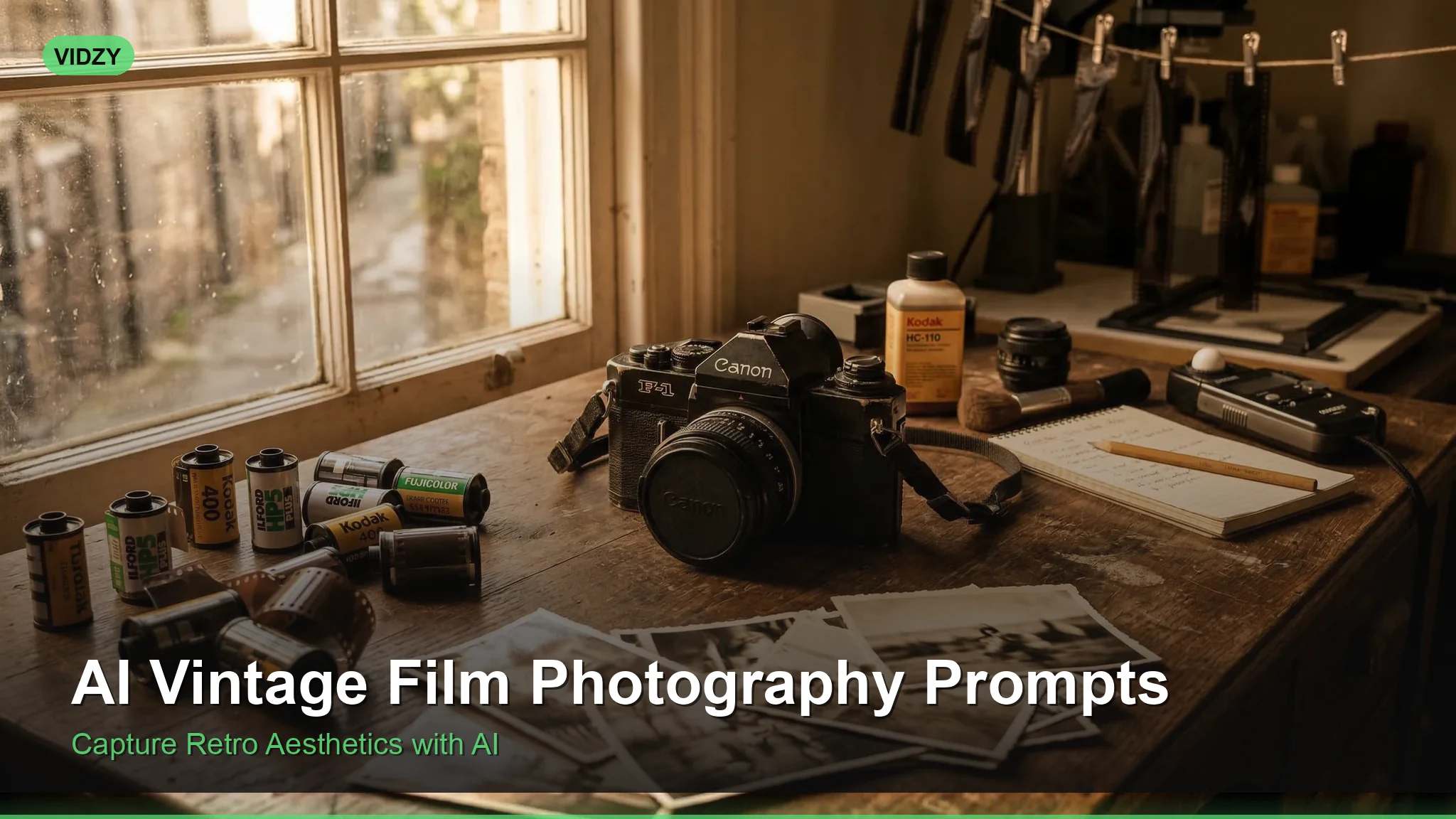
Recreate the Magic of Analog Film with AI Vintage Film Prompts
There’s something about vintage film photography that digital perfection can never quite replicate — the soft grain, the imperfect color shifts, the warm halation around highlights, and that indefinable feeling of a moment captured on chemical emulsion. Now, with AI image generators, you can recreate these beloved analog aesthetics with remarkable accuracy using the right AI vintage film prompts.
This guide gives you everything you need: specific film stock references that AI models understand, prompt formulas that nail the vintage look, and ready-to-use prompts across different eras and styles of film photography.
Why Film Stock References Work So Well in AI Prompts
AI image models were trained on millions of photographs, many of which were shot on film and tagged with the film stock used. When you mention “Kodak Portra 400” in your prompt, the model doesn’t just add grain — it shifts the entire color science toward the warm, creamy skin tones and muted greens that Portra is famous for.
This is why AI vintage film prompts produce some of the most convincing and aesthetically pleasing AI images. The models have strong, specific associations with named film stocks, camera bodies, and darkroom techniques.
Here are the film stocks that AI models respond to most effectively:
- Kodak Portra 400 — Warm skin tones, soft contrast, slightly muted colors. The gold standard for portrait film.
- Kodak Ektar 100 — Vivid saturated colors with fine grain. Ideal for landscapes and travel photography.
- Fujifilm Superia 400 — Cool greens and blues with punchy contrast. Classic consumer film look from the 90s and 2000s.
- Fujifilm Pro 400H — Pastel-like colors with cool undertones and gorgeous highlight roll-off. A wedding photographer’s favorite before it was discontinued.
- Kodak Gold 200 — Warm golden cast, visible grain, nostalgic everyday snapshot feel.
- Ilford HP5 Plus 400 — Rich black-and-white with beautiful tonal range and moderate grain.
- Kodak Tri-X 400 — Contrasty black-and-white with pronounced grain. The photojournalist’s film for decades.
- Kodachrome 64 — Highly saturated, warm reds and yellows, deep blacks. The iconic slide film of the 20th century.
- CineStill 800T — Cinematic tungsten-balanced film with red halation around highlights. The film photographer’s current cult favorite.
- Lomography Color Negative 800 — High grain, saturated colors, unpredictable color shifts. Deliberately imperfect and charming.
The Anatomy of a Perfect Vintage Film Prompt
Every effective vintage film prompt follows this structure:
[Subject] + [Setting/Mood] + [Film Stock] + [Camera/Lens] + [Film Characteristics] + [Era Reference]
The film characteristics section is where the magic happens. Here are the key terms to include:
Grain descriptors: “visible film grain,” “heavy grain,” “fine grain,” “35mm grain texture”
Color characteristics: “faded colors,” “color shift,” “cross-processed,” “expired film look,” “light leaks”
Print/scan qualities: “scanned film negative,” “vintage print,” “slightly overexposed,” “soft halation”
Imperfection cues: “dust and scratches,” “soft focus,” “vignetting,” “lens flare”
Ready-to-Use AI Vintage Film Prompts
1. 1970s Kodachrome Summer
A family having a picnic in a sun-drenched park, checkered blanket with sandwiches and lemonade, children playing in the background, shot on Kodachrome 64 slide film, warm saturated reds and yellows, deep rich shadows, slightly faded with age, 1970s Americana aesthetic, 35mm SLR camera perspective, nostalgic summer afternoon
2. Portra 400 Golden Hour Portrait
Young woman sitting on the hood of a vintage car at sunset, wearing a linen dress, hair blowing in the breeze, shot on Kodak Portra 400, warm creamy skin tones, soft pastel sky, shallow depth of field, gentle film grain, scanned 35mm negative, natural and effortless beauty, analog photography
3. CineStill 800T Night Street
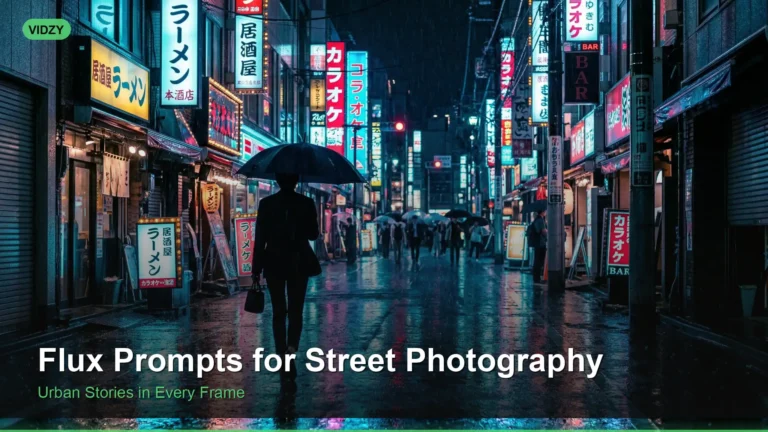
Rain-soaked city street at night, neon signs reflecting in puddles, lone figure with an umbrella walking away, shot on CineStill 800T, red halation around bright lights, tungsten color balance with warm streetlights going orange, cinematic grain, moody atmosphere, urban film photography
4. Black-and-White Photojournalism
Street market vendor arranging fresh produce at dawn, dramatic directional light cutting through market stalls, shot on Kodak Tri-X 400 pushed to 1600, high contrast black and white, pronounced grain, photojournalistic documentary style, Leica M camera aesthetic, Henri Cartier-Bresson inspired decisive moment
5. Expired Disposable Camera
Group of friends laughing at a house party, flash photography harsh and direct, slightly blown-out highlights, shot on expired Fujifilm Disposable camera, heavy grain, muted shifted colors leaning green and magenta, red-eye effect, 2000s party snapshot aesthetic, authentic and unposed, point-and-shoot flash
6. Medium Format Fuji Pro 400H Wedding
Bride standing by a window holding a bouquet of white peonies, soft natural window light wrapping around her, shot on Fujifilm Pro 400H with Contax 645, ethereal pastel tones, creamy out-of-focus background, minimal grain, romantic and dreamy wedding photography, medium format film bokeh
7. 1960s Kodak Ektachrome Travel
Classic European café terrace with wicker chairs and small round tables, cobblestone street, warm afternoon light, shot on Kodak Ektachrome E100 slide film, vivid blues and warm highlights, slightly faded like a found vacation slide from the 1960s, travel photography, vintage European summer
8. Lomography Cross-Processed
Close-up of wildflowers in a meadow with a blurred fence in the background, shot on cross-processed Lomography film, extreme color shifts with vivid cyan shadows and yellow highlights, heavy vignetting, dream-like and surreal, experimental film photography, oversaturated and unpredictable
9. Ilford HP5 Fine Art Landscape
Solitary tree on a misty hillside, long exposure creating silky smooth clouds, shot on Ilford HP5 Plus 400, rich black and white with full tonal range from deep blacks to bright whites, fine grain, Ansel Adams zone system aesthetic, large format camera look, contemplative fine art landscape
10. 1980s Kodak Gold Snapshot
Children riding bicycles down a suburban street lined with autumn trees, warm golden afternoon light, shot on Kodak Gold 200, warm color cast with golden highlights and slightly green shadows, visible grain, nostalgic 1980s suburban America, vernacular photography, found family photo aesthetic
Advanced Techniques for Vintage Film AI Images
Combine film stock with a specific camera body. Saying “shot on Nikon FM2 with Kodak Tri-X” is more effective than just the film stock alone. The camera reference adds ergonomic and optical characteristics.
Reference specific decades for color grading. “1970s color photography” produces different color science than “1990s snapshot photography” even with the same film stock, because printing and scanning conventions changed over time.
Use “expired film” for extra character. Adding “expired film” or “film expired by 10 years” introduces color shifts and fogging that make images feel more authentically vintage.
Specify the scanning method. “Flatbed scanned negative” gives different aesthetics than “drum scanned slide” or “vintage print photographed.” Each adds its own layer of analog texture.
For generating vintage film-style images without the complexity of long prompts, Vidzy’s AI Prompt Generator can build these structured prompts for you automatically.
Matching Film Stocks to Subjects
Not every film stock works for every subject. Here’s a quick reference guide:
- Portraits: Portra 400, Pro 400H, Kodak Gold 200
- Landscapes: Ektar 100, Velvia 50, Ektachrome E100
- Street photography: Tri-X 400, HP5 Plus, CineStill 800T
- Weddings: Pro 400H, Portra 160, Portra 800
- Night scenes: CineStill 800T, Portra 800, Lomo 800
- Nostalgic snapshots: Kodak Gold, Fuji Superia, disposable camera film
- Fine art: Ilford Delta 3200, Tri-X pushed, large format Portra
Frequently Asked Questions
Do AI vintage film prompts work in all image generators?
Film stock references work best in Stable Diffusion, Flux, and Midjourney. DALL-E recognizes some film names but is less consistent with specific color science reproduction. For the most accurate film simulation, Flux and fine-tuned Stable Diffusion models deliver the best results.
How do I add realistic film grain without overdoing it?
Specify the grain amount relative to the film stock. “Fine grain” for low-ISO films (Ektar 100, Portra 160), “moderate grain” for 400-speed films, and “heavy pronounced grain” for pushed or high-speed films. Avoid just saying “grainy” which often produces excessive noise.
Can I combine multiple film stock references in one prompt?
It’s best to stick with one film stock per prompt. Combining “Portra 400 and Tri-X” confuses the model because they have contradictory color characteristics (one is color, one is B&W). If you want a hybrid look, describe the characteristics you want without naming conflicting stocks.
What’s the difference between “vintage” and “retro” in AI prompts?
“Vintage” tends to produce images that look like they were actually taken decades ago — with authentic aging, fading, and period-appropriate styling. “Retro” produces modern images styled with vintage-inspired aesthetics — cleaner, more deliberate, and less authentically aged. Use “vintage” for realism and “retro” for stylized nostalgia.
Bring Analog Warmth to Your AI Images
The beauty of AI vintage film prompts lies in their ability to add soul and character to digital images. Film grain isn’t just noise — it’s texture. Color shifts aren’t flaws — they’re personality. Light leaks aren’t mistakes — they’re happy accidents that make an image feel alive.
Use the prompts and film stock references in this guide as your starting point, then experiment by mixing different eras, cameras, and subjects. The analog world had endless variety, and now you can explore all of it through AI.
Want to generate vintage film-style images instantly? Try Vidzy’s AI image generator — it produces beautiful film-inspired images with perfectly structured prompts, no darkroom required.